
Wrapped vs solid bronze bushings
Two bronze constructions that look alike in the bore and behave differently everywhere else. Wrapped bronze is rolled from thin, cold-worked strip and has a longitudinal joint; solid bronze is cast and machined from dense stock. Both normally use grease or oil, but their walls, fits, load ratings and lubricant features are not interchangeable.
The main difference between wrapped and solid bronze bushings is how the bearing body is made. Wrapped bronze (JBM-090 / 092) is calibrated from CuSn8 strip, leaving a split and a 1–2.5 mm wall; solid bronze (JBM-600 series) is cast or machined from dense stock, allowing heavier walls, any alloy and custom features.
- Wrapped CuSn8: 110–150 HB, 120 N/mm² static / 40 moving, 2 m/s, walls 1–2.5 mm, Ø10–300 mm
- Solid C93200: 65–75 HB, 45 N/mm² static / 25 moving greased, 0.5 m/s (more with oil), any wall, Ø3–1000 mm
- Wrapped: rolled diamond pockets or through holes; solid: machined grooves, holes and oilways
- Solid bronze can be re-machined after fitting; wrapped bronze only lightly sized where the drawing allows
What is a wrapped bronze bushing?
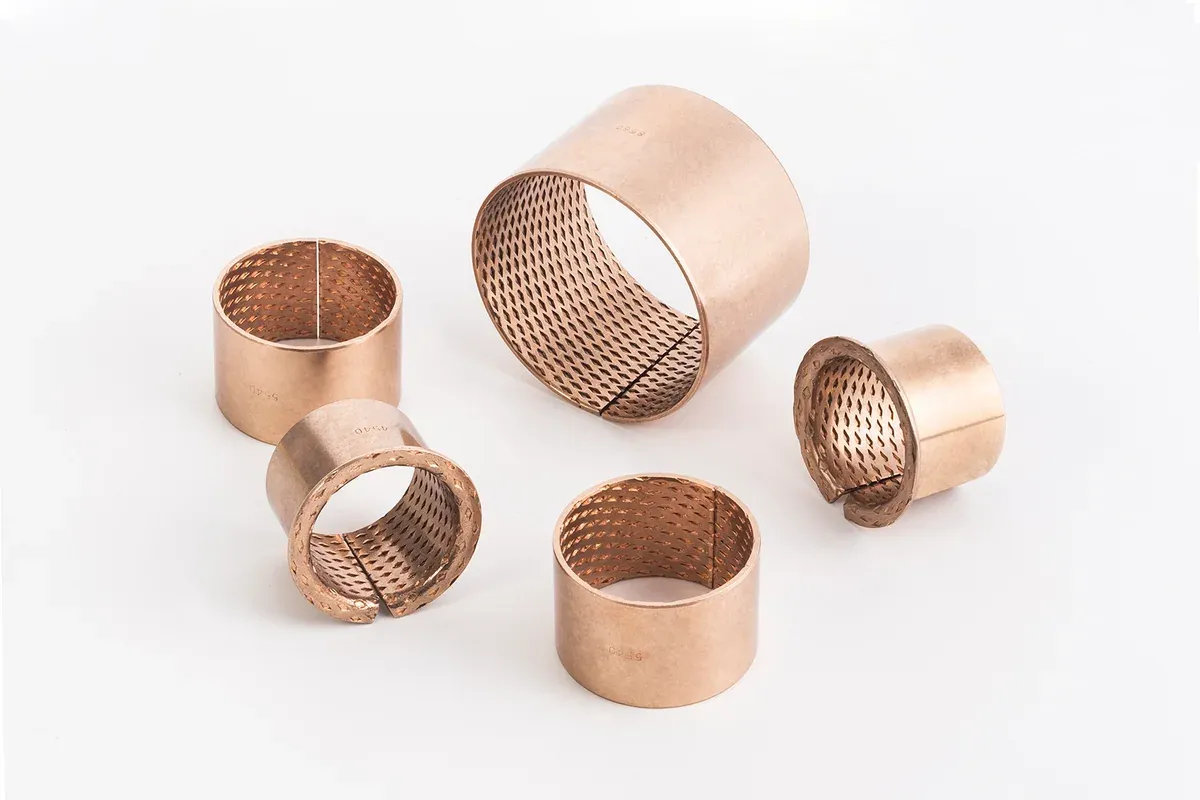
A wrapped bronze bushing is formed from calibrated bronze strip into a thin-wall sleeve or flanged form. Forming leaves a longitudinal joint in the wall. JBM-090 adds diamond-shaped lubricant pockets rolled into the bore; JBM-092 uses through holes for a different lubricant-feed route. The cold work hardens the CuSn8 strip to 110–150 HB, roughly twice the hardness of cast C93200, which is what lets a 1–2.5 mm wall carry 120 N/mm² static and 40 N/mm² moving. Wrapped bronze is a bronze-strip construction; it is not a steel-backed bimetal bushing.
What is a solid bronze bushing?
A solid bronze bushing is machined from dense cast bronze stock into the finished bearing geometry. The wall is normally continuous around the bore; shoulders, flanges, steps, grooves, oilways and locating features can be machined into the part, and the wall can be as thick as the housing allows. “Solid bronze” describes the construction, not one alloy: the standard is C93200 / SAE 660 (JBM-600), with CuSn10, aluminium bronze and manganese bronze (JBM-610 to 640) for higher load, and the grade still has to be specified on the drawing.
How do wrapped and solid bronze bushings compare?
The manufacturing route changes the wall, the joint, the hardness, the load rating, the lubricant features and the available geometry.
| Selection factor | Wrapped bronze (JBM-090 / 092) | Solid bronze (JBM-600 series) |
|---|---|---|
| Starting material | CuSn8 strip, cold formed to 110–150 HB | Dense cast stock, C93200 at 65–75 HB or a harder alloy |
| Joint | A longitudinal split | Continuous wall unless the drawing adds a split |
| Wall | 1.0–2.5 mm | Any; ISO 4379 lists three walls per bore, drawings any other |
| Load, static / moving | 120 / 40 N/mm² | 45 / 25 N/mm² greased (C93200); more in harder alloys or with a full oil film |
| Speed | 2 m/s lubricated | 0.5 m/s greased; higher with oil |
| Lubricant features | Rolled pockets (090) or through holes (092) | Machined grooves, holes and oilways to pattern |
| Lubrication | Grease at assembly (pockets) or fed through the wall (holes) | External grease or oil |
| Fits | Housing H7, shaft f7–f8, bore H9 after fitting | Housing H7, OD s6 / r6, bore E6 → H8, shaft e7 |
| Sizes | Ø10–300 mm standard; flanged Ø25–300 | Ø3–1000 mm; ISO 4379 series Ø6–200 |
| Geometry | Sleeves and flanged forms | Any machined shape: flanges, steps, thrust faces, plates |
| Substitution risk | Wall, seam and installed bore differ from a solid part | Alloy, clearance and lubricant route differ from a wrapped part |
What do pockets, through holes and grooves do?
They store, distribute or feed grease and oil across the running surface. JBM-090 pockets retain lubricant across the bronze surface and release it as the shaft moves; JBM-092 through holes connect the bore to a lubricant source through the housing; the patterns are functional, not decorative. Solid bronze uses machined grooves, radial holes and oilways whose position should follow the real motion, lubricant feed and load zone: grooves belong in the unloaded part of the bore, because a groove in the load zone vents the pressure that supports the shaft.
Do wrapped and solid bronze bushings need lubrication?
Yes. Both routes need grease or oil at the sliding interface. Wrapped bronze depends on lubricant reaching its pockets or through holes; solid bronze depends on the oilways, grooves or external feed designed into the part and housing. Neither construction should be treated as a dry-running type: for dry running within the bronze range use graphite-plugged bronze (JBM-650) or oil-impregnated sintered bronze (JBM-700).
When should you choose a wrapped bronze bushing?
Choose wrapped bronze when the joint needs a thin wall, a higher load than cast bronze carries, and a defined pocket or through-hole pattern: greased pivots on agricultural, construction and material-handling equipment, hinges, linkages and any position where radial space is 1–2.5 mm and the shaft is hardened. Match the split construction: a matching bore is not enough; compare OD, wall thickness, length, flange and installed clearance with the existing part, and inspect the joint, edges, housing, shaft and installed bore after press fitting.
When should you choose a solid bronze bushing?
Choose solid bronze when the part needs a dense wall, a named alloy and drawing-specific machined features: thick walls, large diameters, flanges and steps, thrust faces, a bore to be finished after fitting, or an alloy chosen for a hardened or unhardened shaft, corrosion or temperature. Name the alloy on the drawing (“cast bronze” does not identify a chemistry); machine the required features; design the lubricant route around the actual motion and load zone; and control the full fit, because housing, shaft, surface finish, alignment and running clearance belong to the same design decision.
Can wrapped bronze bushings be machined after installation?
Only when the released product and the finishing method allow it. Post-machining changes the wall thickness, the installed clearance and the lubricant features: cutting across pockets or through holes reduces lubricant capacity and leaves damaged edges. A light sizing operation is not equivalent to freely boring a solid bronze sleeve. When a finished bore or special geometry must be machined into the part after fitting, solid bronze is the clearer construction route.
Can wrapped bronze replace solid bronze?
Not automatically. Wall, joint, alloy, fit, lubricant pattern and operating duty all change the decision. Replacing a wrapped bushing: match ID, OD, length, wall, flange, joint and pocket or hole pattern, then check the housing, shaft and lubricant. Replacing a solid bushing: match the alloy, finished geometry, grooves, oil-feed position and running clearance; colour is not an alloy test. Compare the finished parts, not unmatched catalogue maxima: load and speed figures for wrapped and solid products come from different hardnesses, lubricants and test conditions.
The common successful substitution is solid to wrapped in a volume product where a 1–2.5 mm wall fits, the shaft is hardened and grease is applied at assembly: the wrapped part is cheaper at volume and carries more load. The reverse, wrapped to solid, is chosen when the bore must be finished after fitting, the wall is thick, the shaft cannot be hardened or the alloy must change.
Frequently asked questions
Are wrapped bronze bushings split?
Yes. They are formed from strip, so the wall has a longitudinal joint. The joint closes in the H7 housing; position it away from the load zone.
Do wrapped bronze bushings need grease?
Yes. JBM-090 is greased at assembly through its pockets and JBM-092 through its holes; both need an external grease or oil route in service.
What is the difference between cast and wrapped bronze?
Wrapped bronze is thin, hard CuSn8 strip formed into a split bearing with rolled pockets or holes; cast or solid bronze is a dense wall machined to the finished geometry in the alloy the drawing names.
Which carries more load, wrapped or solid bronze?
Wrapped CuSn8 at 120 N/mm² static / 40 moving carries more than greased cast C93200 at 45 / 25, because the cold-worked strip is about twice as hard. Harder cast alloys (aluminium or manganese bronze) close the gap at the cost of machinability.
Can wrapped bronze replace solid bronze?
Not automatically. Wall, joint, fit, clearance, lubricant pattern, alloy and operating duty all change the decision; compare the complete part.
Which bronze grade should I specify?
Use the controlled grade for the exact product: CuSn8 for wrapped, C93200 / SAE 660 (JBM-600) as the standard solid grade, CuSn10, aluminium bronze or C86300 for higher load. Construction words and surface colour do not identify an alloy.
Send the existing part drawing when the construction or alloy is uncertain.
We compare wall, joint, alloy, fit and lubricant features and quote the construction that fits. Samples are free; sizes not in the tables are made to drawing.