
Bushing vs bearing: what is the difference?
Every bushing is a bearing, but not every bearing is a bushing. A bushing is a plain bearing: a sleeve in which the shaft slides. What people usually mean by “bearing” is a rolling-element bearing, in which balls or rollers roll between two rings. The choice between sliding and rolling shapes the whole joint.
A bushing (plain bearing, sleeve bearing) supports a shaft by sliding contact, with a lubricant film or a self-lubricating material between the shaft and the bore. A rolling-element bearing supports the shaft on balls or rollers that roll between an inner and an outer ring. Bushings win on radial space, shock and dirt tolerance, cost and simplicity at slow speed or oscillation; rolling bearings win on friction, speed and predictable life at continuous rotation.
- Bushing: one part, wall from 1 mm (composite) to 10 mm+ (cast bronze), friction 0.02–0.20, no fatigue life limit, needs lubricant or a self-lubricating material.
- Rolling bearing: rings, elements, cage and often seals; friction about 0.001–0.005; finite fatigue life (L10); sensitive to shock and contamination.
- Bushings are rated by specific load (N/mm²) and PV; rolling bearings by dynamic load rating and speed.
- A ball bearing cannot be swapped for a bushing by bore size: the housing, clearance, lubrication and load path all change.
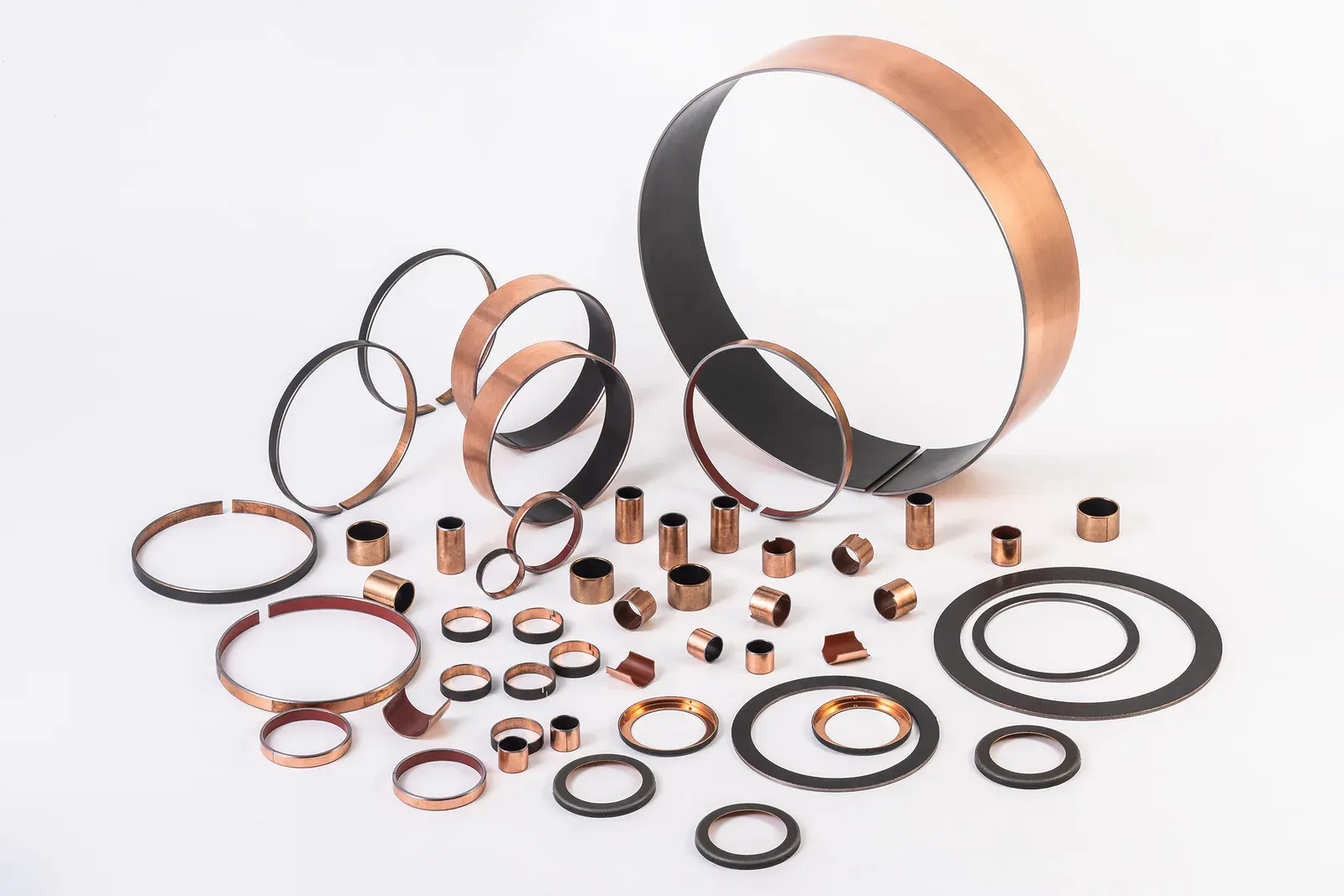
What is a bushing?
A bushing is a cylindrical sleeve fitted into a housing so that a shaft or pin can turn or slide inside it. The shaft bears directly on the bore; there are no moving parts inside the bushing itself. The bore material is what makes it a bearing: cast or wrapped bronze that runs on grease or oil, sintered bronze soaked in oil, a steel shell lined with PTFE or POM composite that runs dry, graphite-plugged bronze, or hardened steel for slow, heavily loaded pins. Bushing, sleeve bearing, plain bearing and journal bearing describe the same thing from different angles.
Because it is one solid part, a bushing can be thin (a steel-backed composite bushing has a wall of 1–2.5 mm), can be made in any size from 3 mm to over a metre in bore, takes shock and misalignment with a shrug, and costs a fraction of a rolling bearing of the same bore. Its price is friction: even a good hydrodynamic bronze bearing has ten to fifty times the friction of a ball bearing, and a dry-running composite bushing more still.
What is a rolling-element bearing?
A ball or roller bearing places hardened steel balls or rollers between an inner ring on the shaft and an outer ring in the housing, held apart by a cage. The shaft turns by rolling the elements along the raceways rather than sliding, which cuts friction to a few thousandths and allows speeds of tens of thousands of revolutions per minute. Deep-groove ball bearings, angular-contact bearings, cylindrical, tapered and needle roller bearings each trade radial capacity, axial capacity and speed differently.
The rolling contact is small and highly stressed, so the steel fatigues: every rolling bearing has a statistical life (L10) at a given load, and it is shortened sharply by shock, misalignment, water or dirt reaching the raceways. Rolling bearings need more radial space than a bushing, a machined housing bore and shaft seat to close tolerances, and seals or shields.
Bushing vs bearing: the key differences
The comparison is really sliding contact against rolling contact. The table lists what changes.
| Bushing (plain bearing) | Ball or roller bearing | |
|---|---|---|
| Contact | Shaft slides on the bore | Elements roll between raceways |
| Parts | One sleeve (or sleeve + thrust washer) | Inner ring, outer ring, elements, cage, seals |
| Friction coefficient | 0.02–0.20 (material and lubrication dependent) | 0.001–0.005 |
| Speed | Slow to moderate; 0.5 m/s greased bronze, 2 m/s dry (PTFE composite), higher only on an oil film | High; limited by lubricant and heat |
| Load per unit space | High; up to 250 N/mm² static on projected area | Moderate; radial space taken by rings |
| Shock, vibration, misalignment | Tolerant | Sensitive; raceway indentation |
| Dirt and water | Tolerant, especially bronze which embeds particles | Needs sealing; contamination is the main killer |
| Life | Wear-limited; no fatigue limit | Fatigue-limited (L10); predictable by calculation |
| Lubrication | Grease, oil, or self-lubricating material | Grease or oil, sealed for life or relubricated |
| Noise | Quiet | Audible at speed and when worn |
| Size range | 3 mm to over 1,000 mm bore | Standard catalogue sizes |
| Cost | Low | Higher, especially in large sizes |
When a bushing is the better choice
A bushing fits when the motion is slow, oscillating or intermittent and the environment is rough.
- Pivot pins in construction, agricultural and materials-handling machinery: high load, oscillation through a small angle, dirt and shock.
- Hydraulic cylinder eyes, linkages, hinges and gates.
- Radial space is limited: a thin-wall composite or wrapped bronze bushing fits where no ball bearing would.
- Very large or non-standard bores where a rolling bearing is prohibitively expensive or unavailable.
- Wet, dusty or corrosive service where seals cannot be maintained.
- Applications that must run dry or maintenance-free at slow speed: PTFE composite, graphite-plugged or sintered bronze.
- Low-cost, high-volume assemblies (appliances, furniture, automotive interiors) where a moulded or sintered bushing costs cents.
When a rolling-element bearing is the better choice
Rolling contact earns its complexity when speed, efficiency or precision dominate.
- Continuous rotation at high speed: motors, spindles, fans, pumps above a few hundred rpm where a plain bearing would overheat.
- Low starting torque and minimal friction losses matter: hand-driven, battery-powered or efficiency-rated equipment.
- Precise shaft location with controllable preload: machine-tool spindles, gearboxes with helical gears.
- A calculated, guaranteed service life is required and the environment can be sealed.
Can a bushing replace a ball bearing?
Often, at slow speed, and it is a common cost and reliability improvement in oscillating joints. But it is a redesign, not a swap. The bore of the housing changes (a bushing needs an interference fit and a smaller radial section), the shaft needs a bearing-quality surface and often hardening, the running clearance has to be set for the bushing material and temperature, and the lubrication has to be provided or a self-lubricating material chosen. The load check changes from a dynamic rating and life to specific load and PV. Going the other way, from bushing to rolling bearing, needs more room and cleaner conditions than the joint may have.
Send the existing bearing designation, the shaft and housing dimensions, the load and the motion. We will say whether a bushing fits and in which material.
Frequently asked questions
Is a bushing a type of bearing?
Yes. A bushing is a plain bearing: a sleeve in which the shaft slides. Ball and roller bearings are rolling-element bearings. Both are bearings.
What is the difference between a sleeve bearing and a bushing?
None in practice. Sleeve bearing, plain bearing, journal bearing and bushing name the same cylindrical sliding bearing. Some trades reserve “bushing” for a sleeve that is also a spacer or a guide.
Why do bushings have more friction than ball bearings?
Because the shaft slides on the bore instead of rolling. Even with a full oil film a bronze bushing runs at a friction coefficient of about 0.01–0.05 against 0.001–0.005 for a ball bearing; a dry PTFE composite bushing runs at 0.02–0.20.
Do bushings last longer than bearings?
In slow, dirty, shock-loaded joints a bushing usually outlasts a rolling bearing because it has no raceways to indent and tolerates contamination. In clean, fast, continuous rotation the rolling bearing lasts longer and runs cooler.
Can I replace a ball bearing with a bushing of the same bore?
Not directly. The housing bore, shaft surface, clearance, lubrication and load rating all differ. It is often a good change in slow oscillating joints, but it must be engineered.
Which bushing material replaces a ball bearing in a dry application?
A steel-backed PTFE composite bushing for slow rotation or oscillation up to about 2 m/s dry, or a graphite-plugged bronze bushing for heavier load at very slow speed. Neither reaches ball-bearing speeds.
Send the drawing. We answer within 12 hours.
Dimensions, material or just the application: our engineers reply with a material proposal and a quotation. Free samples of standard and custom parts, no minimum order.