
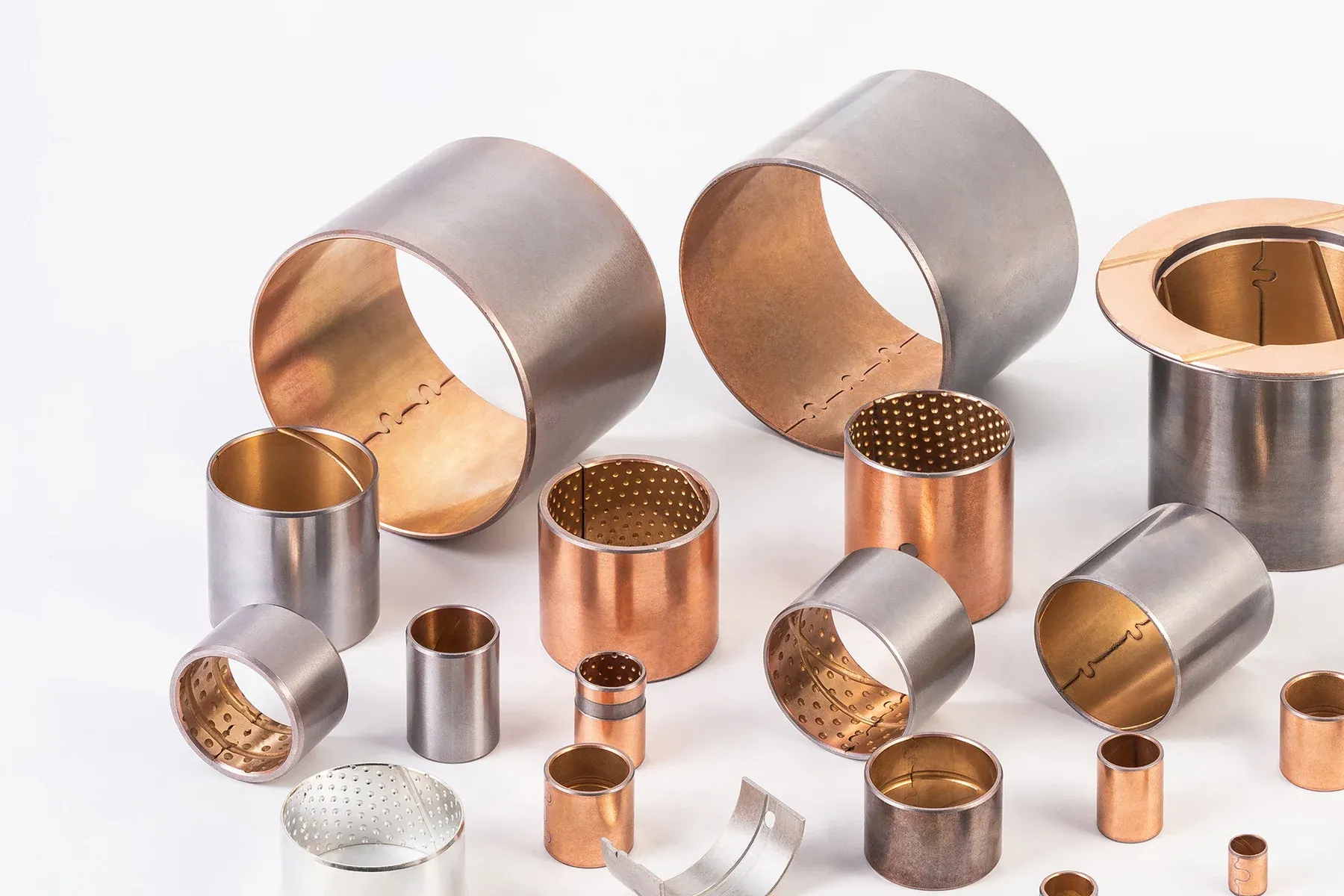
Transmission bushings
Automatic and manual transmissions, transfer cases and torque converters use plain bushings wherever a shaft turns inside another part at high speed in oil: the converter hub, the stator support, the pump body, planetary carriers and idler shafts, and the pilot bushing that centres the input shaft in the crankshaft. They are small, fast and precise.
- 8–10 m/sBimetal in transmission oil
- 150 N/mm²Bimetal JBM-800, dynamic
- CuPb10Sn10Standard lining alloy
- AlSn20CuJBM-850 for highest speed
Transmission bushings run at high shaft speed under light to moderate load in transmission fluid, which makes them a bimetal problem: steel-backed bushings with a thin sintered bronze lining (JBM-800 series, 8–10 m/s with oil, 150 N/mm² dynamic). The clutch pilot bushing is the exception: it runs without oil and is sintered oil-impregnated bronze or a PTFE composite bushing.
- Torque converter hub, stator support and pump bushings: bimetal CuPb10Sn10 or CuPb24Sn4, oil lubricated, 8–10 m/s
- Planetary carrier, idler and reverse-gear bushings: bimetal or wrapped bronze with oil grooves and holes
- Shift-fork and selector bushings: POM or PTFE composite, low speed, splash lubricated
- Pilot bushing (crankshaft to input shaft): sintered bronze or PTFE composite, no lubrication
- Aluminium-tin bimetal (AlSn20Cu, JBM-850) for the highest speed and best embeddability at lower load
Bushings for transmissions and drivelines
Oil-lubricated bimetal for everything that spins fast; sintered bronze or PTFE composite for the dry pilot bushing and the slow shift linkage.
Bimetal bushings
Converter hub, stator, pump, planetary and idler bushings with oil grooves and holes.
JBM-800 / 850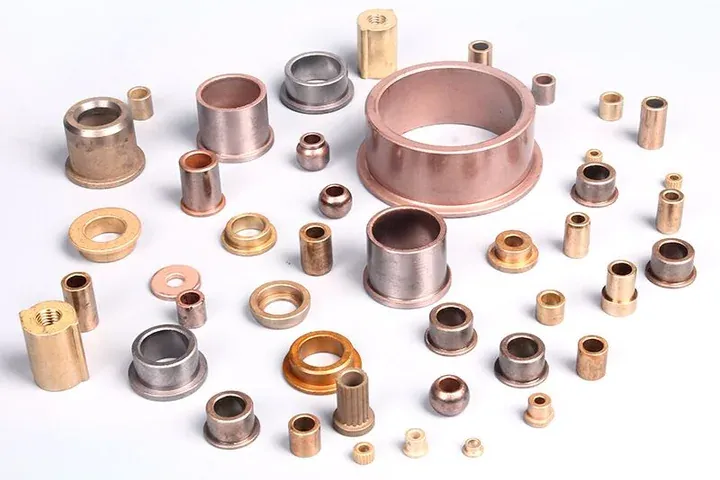
Sintered bronze bushings
Oil-impregnated pilot bushings and small motor bearings that never see fresh oil.
JBM-700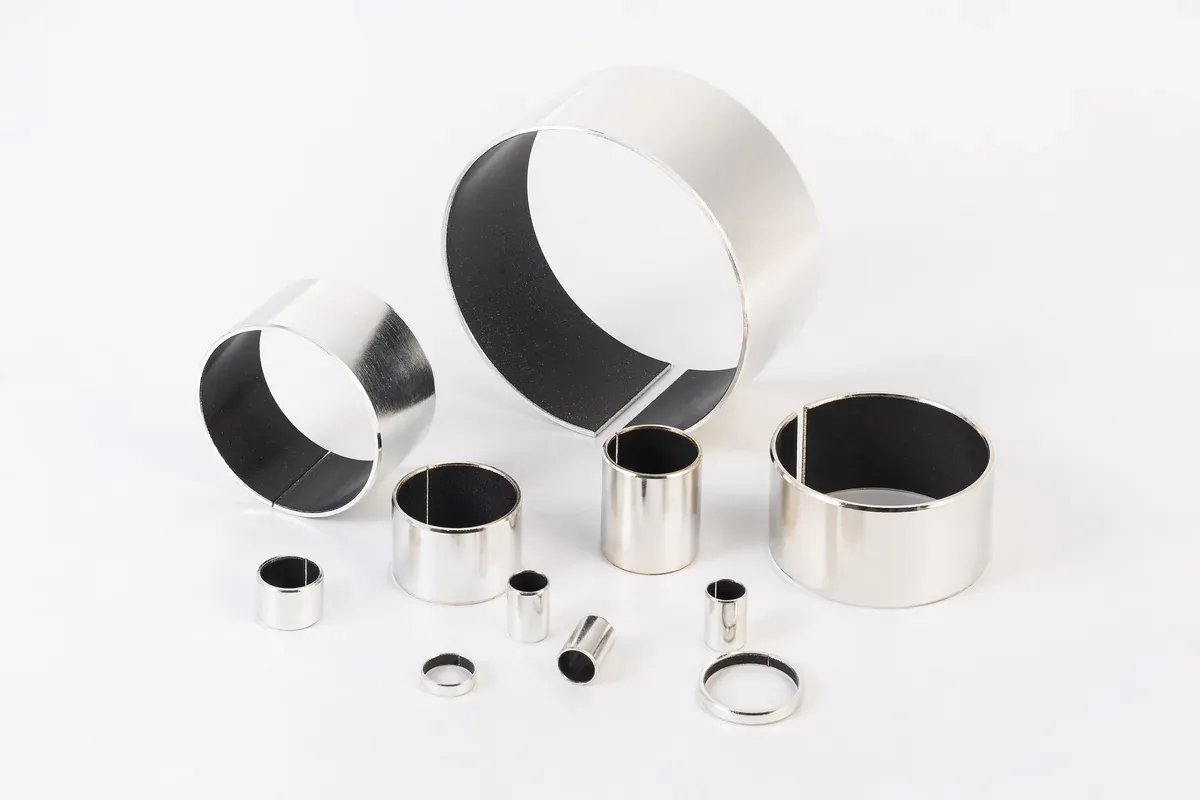
PTFE composite bushings
Shift-fork, selector and pilot positions: low speed, dry or splash lubricated.
JBM-10
Where the bushings are
The torque converter hub runs in a bushing in the transmission pump body at engine speed; the stator support and the converter cover hub each carry a bushing. Inside the gearbox, planetary carriers turn on bushings on their supports, idler and reverse gears run on bushings on fixed shafts, and the output shaft is often bushed in the extension housing. The manual gearbox adds the pilot bushing in the crankshaft flange, in which the input shaft tip turns whenever the clutch is disengaged, and the shift-fork and selector-rail bushings that move slowly and rarely.
| Position | Speed | Load | Lubrication | Usual bushing |
|---|---|---|---|---|
| Torque converter hub / pump body | Engine speed, continuous | Light–moderate | ATF, pressure fed | Bimetal CuPb10Sn10 (JBM-800) or CuPb24Sn4 (JBM-810) |
| Stator support | Relative speed converter–stator | Light | ATF | Bimetal |
| Planetary carrier / idler shafts | High, continuous | Moderate | Splash or fed | Bimetal with grooves and holes |
| Extension housing / output shaft | Shaft speed | Light, side load from yoke | Splash | Bimetal or wrapped bronze |
| Shift fork / selector rail | Slow, intermittent | Light | Splash | POM or PTFE composite |
| Pilot bushing (crankshaft) | Slip speed, intermittent | Light | None | Sintered oil-impregnated bronze or PTFE composite |
Why bimetal
A transmission bushing must run at several thousand rpm for years without measurable wear, in oil that carries clutch debris and reaches 120–150 °C, in a housing that is aluminium and expands more than the shaft. A steel-backed bushing with a thin sintered copper-alloy lining does this: the steel back keeps the press fit in the aluminium housing and the lining is thin enough to conduct heat and thick enough to embed particles. JBM-800 (CuPb10Sn10, 80–120 HB) is the general-purpose lining: 150 N/mm² dynamic, 8 m/s and PV 10 N/mm²·m/s with oil. JBM-810 (CuPb24Sn4) is softer and more forgiving of shaft finish and debris at 10 m/s; JBM-850 (AlSn20Cu) is the aluminium-tin lining for the highest speed, 15 m/s, at 100 N/mm².
Oil holes and grooves are formed in the lining to feed the running surface from the pressure circuit; the bushing joint (straight or interlocking butt) is positioned away from the loaded arc. Standard wrapped sizes cover 10–150 mm shaft; transmission parts are normally to the OE drawing.
| Lining | Alloy | Hardness | Dynamic load | Oil: speed / PV | Character |
|---|---|---|---|---|---|
| JBM-800 | CuPb10Sn10 | 80–120 HB | 150 N/mm² | 8 m/s / 10 N/mm²·m/s | General purpose, hard, fatigue resistant |
| JBM-810 | CuPb24Sn4 | 45–70 HB | 130 N/mm² | 10 m/s / 10 | Soft, embeds debris, best anti-seizure |
| JBM-830 | CuSn10 | 70–100 HB | 130 N/mm² | 5 m/s / 10 | Lead-free lining option |
| JBM-850 | AlSn20Cu | 30–40 HB | 100 N/mm² | 15 m/s / 8 | Highest speed, aluminium-tin |
JBM catalogue values with oil lubrication; maximum temperature 250 °C in oil. Separate limits, not one operating point. Lead-free status of any lining requires a material declaration.
The pilot bushing
The pilot bushing sits in the end of the crankshaft and supports the tip of the gearbox input shaft. It only sees relative motion when the clutch is disengaged and the input shaft slows while the crank keeps turning, so it runs intermittently at slip speed with no oil supply. Sintered oil-impregnated bronze is the classic material: the pores hold enough oil for the life of the clutch. Steel-backed PTFE composite bushings are the modern alternative, dry running, with a firmer press fit and no oil to bleed out on a hot engine. Needle roller pilot bearings are used where the shaft alignment is precise; a plain bushing tolerates more misalignment.
Specifying and replacing
Transmission bushings are to the OE drawing: shaft diameter and tolerance, housing bore, length, oil holes and grooves, lining alloy and, for the converter hub, the surface treatment of the hub. For aftermarket and rebuild programmes we quote against the OE part number after comparing dimensions and material; the lining is matched to the shaft finish (Ra 0.32–0.63 µm, ≥ 53 HRC for JBM-800) and to the fluid.
Send the OE number or the drawing, the shaft speed and the fluid. Samples are free; there is no minimum order.
Frequently asked questions
What is a torque converter bushing?
The plain bushing in the transmission pump body (and sometimes the stator support) in which the torque converter hub turns at engine speed in ATF. It is a steel-backed bimetal bushing with a sintered copper-lead-tin or aluminium-tin lining.
What is a pilot bushing?
A small bushing in the end of the crankshaft that centres the manual-gearbox input shaft. It runs intermittently at clutch slip speed without oil and is made of sintered oil-impregnated bronze or steel-backed PTFE composite.
Why does a worn converter bushing matter?
The hub runs eccentric, the pump seal leaks and the pump gears wear; on many transmissions it is the first sign of a rebuild. Replacing it needs the hub surface checked and, if scored, resurfaced.
Bronze or bimetal for a gearbox bushing?
Bimetal for anything turning at shaft speed in oil: the thin lining runs cooler and holds its fit in an aluminium housing. Solid or wrapped bronze for slow, greased or splash-lubricated pivots such as shift linkages.
Can you supply transmission bushings to an OE part number?
Yes, after comparing the dimensions and lining with the OE part. Interchangeability is confirmed part by part; send the number, the drawing if you have it, and the shaft speed and fluid.
Send the joint, not just the part.
Pin diameter, load, motion, lubrication and environment: our engineers reply within 12 hours with a material, a size and a quotation. Free samples, no minimum order.