
Bushing selection guide
This guide works by elimination rather than recommendation. Each of the five filters removes candidate materials against a stated limit, and what survives all five is your shortlist. Most applications reduce to two or three viable products within a few minutes.
Start with whichever constraint you already know is hardest. If the joint runs at 260 °C, temperature eliminates more candidates than anything else and belongs first; if the housing gives you 1 mm of radial space, start with installation space. The filters are independent and can be applied in any order.
- Load: direction sets the form (sleeve, washer, flanged); pressure p = F ÷ (d × L) eliminates materials
- Motion: oscillating and start-stop duty use lower ratings than continuous rotation
- Lubrication access: what will really happen in service, not what the schedule says
- Temperature: continuous, not peak; the most decisive filter for polymers
- Space: radial wall under 2.5 mm eliminates machined bronze; under 0.9 mm eliminates everything standard
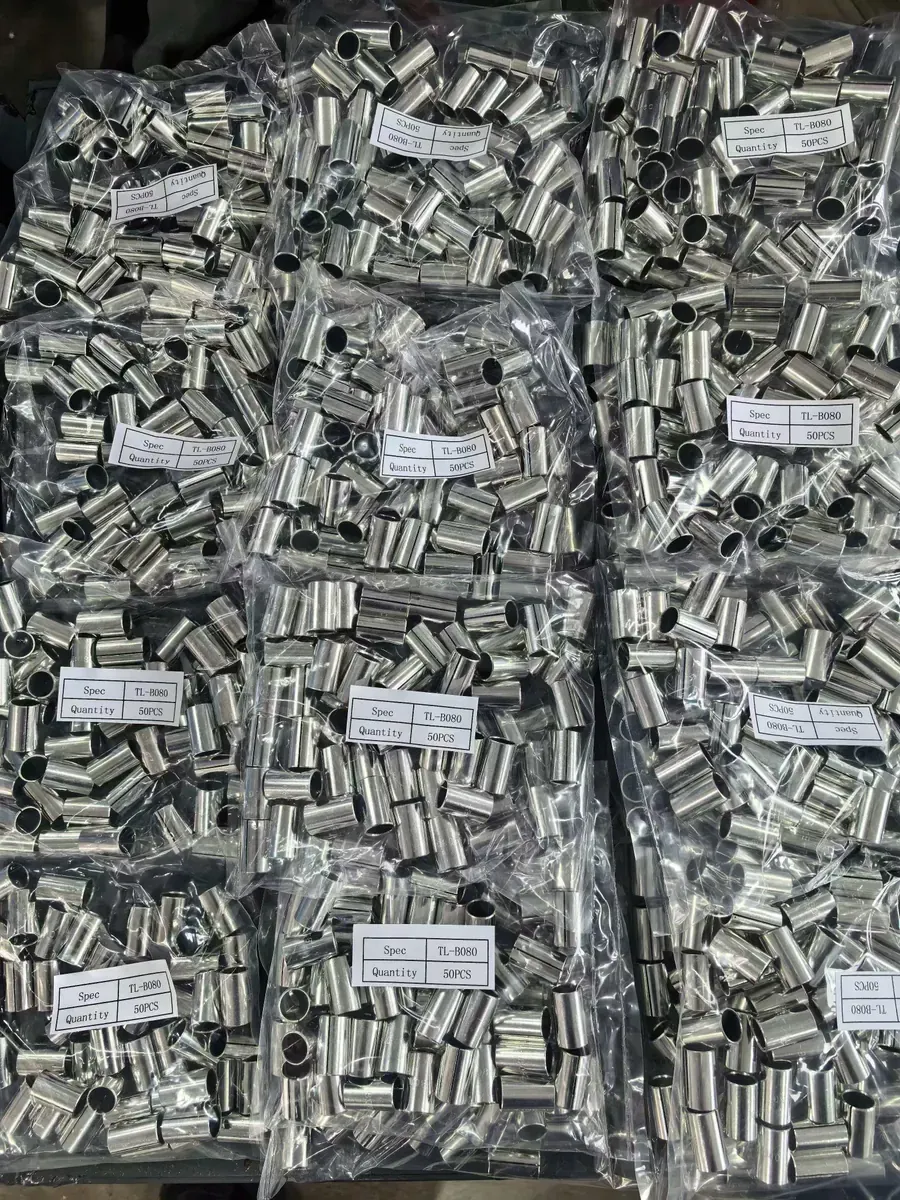
Filter 1: load direction and magnitude
Direction determines the form. Radial load only: a sleeve bushing. Axial load only: a thrust washer. Radial and axial: a flanged bushing, or a sleeve plus a washer. Radial load with angular misalignment: a spherical bearing, outside our range. Where the axial load is significant rather than incidental, use a dedicated washer rather than a flange: a flange carries axial load through the flange root, and that root is the limiting section.
Magnitude eliminates materials. Calculate the specific load first: p = load (N) ÷ (bore diameter × bearing length, in mm). Then compare it with the moving (dynamic) rating of each material if the shaft moves under load, and with the static rating only for a joint that is loaded while stationary. Static and dynamic ratings differ by a factor of three to five and are not interchangeable.
| Specific load p, shaft moving | Materials that remain |
|---|---|
| Up to 14 N/mm² | All materials, including sintered bronze (JBM-700) and solid plastics |
| 14–25 N/mm² | All except sintered bronze and plastics |
| 25–40 N/mm² | Wrapped bronze (JBM-090), graphite bronze (JBM-650), PTFE (JBM-10), POM (JBM-20), bimetal (JBM-800), steel; cast bronze only with a full oil film |
| 40–60 N/mm² | Graphite bronze, PTFE composite, POM composite, bimetal, hardened steel |
| 60–150 N/mm² | Bimetal on oil or grease (150), POM composite oiled (140), graphite bronze 650W3 (100 at 0.1 m/s), hardened steel |
| 150–250 N/mm² | Hardened steel JBM-ST (250 at 0.1 m/s); composites only as a static load |
| Above 250 N/mm² | Increase bearing length or diameter; no standard product qualifies |
Moving ratings from the product pages: cast bronze 25 (45 static), wrapped 40 (120 static), PTFE 60 (250 static), POM 60 oscillating / 140 oiled (250 static), bimetal 150, graphite 50–100, sintered 14, steel 250.
Filter 2: motion type
Motion changes the applicable rating and, in some cases, the lubrication feature. Oscillating duty is harder on a bearing than continuous rotation at the same load, because the reversal point never develops a hydrodynamic film and sits under load throughout; this is why the oscillating rating of a composite is about a quarter of its static rating. Frequent start-stop favours a different lubrication feature from continuous duty: through holes form an oil film quickly on start-up, while pockets hold grease longer between service intervals.
| Motion | Governing rating | Preferred materials |
|---|---|---|
| Continuous rotation | Dynamic load and PV | Bimetal on oil (PV 10), sintered bronze at light load, PTFE composite at low PV |
| Oscillating | Oscillating load rating | PTFE composite (60 N/mm²), POM composite (60 N/mm² dry, more with oil), wrapped bronze (40 N/mm²) |
| Reciprocating, heavy side load | PV and edge loading | PTFE composite (JBM-1D cylinder form, fluid-lubricated), bronze-mesh PTFE (JBM-FR) |
| Frequent start-stop | Breakaway friction | Wrapped bronze with through holes (JBM-092), PTFE composite |
| Slow indexing or near-static | Static load, seizure resistance | Graphite bronze (JBM-650), hardened steel (JBM-ST), POM composite |
Filter 3: lubrication access
This filter is decided by what will realistically happen in service, not by what the maintenance schedule says. Products with rolled oil pockets are frequently described as self-lubricating, but they require grease at assembly and re-greasing in service. If the joint genuinely cannot be lubricated, confirm the product is rated for dry running rather than relying on the category name.
There is one case where lubrication is a liability rather than an asset. In abrasive environments grease collects dust and grit and holds it in the contact area as an abrasive paste, while a dry surface lets contamination pass through. Agricultural, quarrying and construction equipment frequently give longer life on dry-running composite or graphite bronze than on greased bronze despite the lower headline load rating.
| Access in service | Materials that remain |
|---|---|
| None: sealed or unreachable | PTFE composite (JBM-10), graphite bronze (JBM-650), sintered bronze (JBM-700), bronze-mesh PTFE (JBM-FR), solid plastics |
| Grease at assembly only | Above, plus POM composite (JBM-20), wrapped bronze with pockets (JBM-090) |
| Periodic re-greasing possible | Above, plus bimetal on grease (JBM-800 series), cast bronze (JBM-600), wrapped bronze with holes (JBM-092), hardened steel |
| Circulating oil supply | All materials; bimetal on oil reaches PV 10 N/mm²·m/s and POM composite PV 22 |
Filter 4: temperature
Temperature is often the most decisive filter and can reduce the shortlist to a single material. Standard POM composite stops at +130 °C, which is the single most common cause of a material being eliminated at this stage; solid plastics stop earlier still. Continuous and peak temperature are different specifications: rate the bushing for the continuous condition and confirm that peaks stay inside the limit rather than averaging the two.
| Operating temperature | Materials that remain |
|---|---|
| Below −40 °C | PTFE composite (to −195 °C), wrapped bronze (to −100 °C) |
| −40 to +90 °C | All materials |
| +90 to +130 °C | All except sintered bronze on standard oil and most solid plastics |
| +130 to +200 °C | Cast bronze, wrapped bronze, graphite bronze, PTFE composite, bimetal (limited by the lubricant), hardened steel |
| +200 to +250 °C | Cast bronze, graphite bronze grade 650, PTFE composite, bronze-mesh PTFE |
| +250 to +280 °C | PTFE composite (JBM-10), graphite bronze in aluminium or tin bronze grades |
| +280 to +400 °C | Graphite bronze in aluminium bronze (650S2) or tin bronze (650S3) with a high-temperature plug |
Filter 5: installation space
Radial clearance between shaft and housing determines wall thickness, and wall thickness eliminates whole manufacturing routes. Standard bore ranges also constrain the choice, but non-standard dimensions and tolerances are produced to drawing across every material, so a size falling outside the range is a quotation question rather than an elimination.
A worn housing is worth mentioning here. Because wrapped and composite bushings hold a precise wall from about 1 mm, a worn bore can often be machined oversize and fitted with a thin-wall part rather than the housing being replaced or sleeved.
| Available radial wall | Materials that remain | Standard bore range |
|---|---|---|
| Under 0.9 mm | None as standard; custom thin-wall specification | — |
| 1.0 mm | Wrapped bronze, bimetal, PTFE and POM composite | Ø6–30 mm in the strip series |
| 1.0–2.5 mm | All wrapped and composite types | PTFE Ø6–300, POM Ø10–280, wrapped bronze Ø10–300, bimetal Ø10–150 mm |
| Above 2.5 mm | Machined bronze (JBM-600), graphite bronze, sintered bronze, hardened steel, plastics | Bronze Ø3–1000 mm; ISO 4379 series Ø6–200 mm |
Final check: the shaft
The shaft is not a selection axis, but it will invalidate a selection that passed all five filters. Confirm the mating surface before releasing the drawing. If the mating component cannot be hardened, PTFE composite and cast bronze are the materials that do not require it, and eliminating a heat-treatment operation from the shaft frequently outweighs the difference in bushing price. Parallelism between shaft and bushing should be held within 0.02 mm across the full bearing width in every case.
| Selected material | Shaft hardness | Shaft finish Ra |
|---|---|---|
| PTFE composite (JBM-10) | No hardening required; hardened where the load allows | 0.2–0.4 µm |
| POM composite (JBM-20) | Hardened recommended for the oiled 140 N/mm² rating | 0.4–0.8 µm |
| Bimetal, tin and leaded bronzes (JBM-800/820/830/840) | ≥ 53 HRC | 0.32–0.63 µm |
| Bimetal CuPb24Sn4 (JBM-810) | ≥ 45 HRC | 0.32–0.63 µm |
| Wrapped bronze CuSn8 (JBM-090/092) | Hardened; the strip is 110–150 HB | 0.4–0.8 µm |
| Cast bronze C93200 (JBM-600) | Unhardened steel acceptable | 0.4–0.8 µm |
| Graphite bronze, hardened steel | Hardened, harder than the base alloy (HB ≥ 210 for grade 650) | ≤ 1.6 µm graphite bronze; hardened ground pin for steel |
Worked example
A construction-equipment boom pivot: 60 mm pin, 50 mm bearing length, 180 kN peak load, oscillating through roughly 40° at low speed, greased at assembly but not reliably afterwards, ambient to +80 °C, 5 mm radial space available.
Filter 1: p = 180 000 ÷ (60 × 50) = 60 N/mm². Cast bronze (25 moving), wrapped bronze (40) and sintered bronze are eliminated on magnitude; the load is radial with axial location needed, so a flanged sleeve is indicated. Filter 2: oscillating duty, so the oscillating rating applies. 60 N/mm² sits exactly at the limit for PTFE composite and dry POM composite, so both are marginal; bimetal (150) and graphite bronze 650W3 (100) are comfortable. Filter 3: grease at assembly but unreliable afterwards favours a material that stores its lubricant or needs none, which points to POM composite (pockets), graphite bronze or bimetal with a generous grease charge; PTFE is set aside on load. Filter 4: +80 °C eliminates nothing. Filter 5: 5 mm radial space is generous and eliminates nothing.
Shortlist: a graphite-plugged bronze flanged bushing (650W3), or a bimetal flanged bushing (JBM-800F) greased at assembly. Graphite bronze needs no grease at all and tolerates a dusty site; bimetal carries more load and costs less at volume but depends on the grease charge. The deciding question is whether the site is dusty and the greasing schedule is really unreliable, which points to graphite bronze, or whether cost at volume dominates, which points to bimetal.
Common selection mistakes
Copying an oil groove onto a dry-running replacement. A groove pattern carried over from a legacy bronze part removes bearing area from a composite bushing for no benefit; self-lubricating materials need a plain bore. Specifying by static rating for a moving joint: static and dynamic ratings differ by a factor of three or more, and if the shaft moves under load the static figure is not the one that applies. Treating the free-state bore as the installed bore: wrapped and composite bushings are supplied oversize and reach working dimension only after press fitting into an H7 housing. Positioning an oil groove in the loaded zone: the groove vents the pressure that supports the shaft, so grooves and supply holes belong in the unloaded portion of the bore. Selecting on bushing price alone: the cost of hardening a shaft, of a lubrication schedule and of the downtime when that schedule is missed all sit outside the bushing quotation and frequently exceed it.
What to send for a quotation
The five filters narrow the field, and six values close it: shaft diameter, housing bore and bearing length, or a drawing; load in newtons and whether it is static, rotating or oscillating; sliding speed or oscillation frequency and angle; continuous and peak operating temperature; lubrication available at assembly and in service; and the environment: contamination, chemicals, washdown, food or medical contact. Send those with a drawing or an existing part number and we return a specification with the alternatives and the reasoning. Non-standard dimensions and tolerances are made to order across every material.
Use the plain bearing PV calculator to check p, v and PV against the limits of each material before you send the enquiry.
Frequently asked questions
Which bushing material is best?
There is no universal answer. Apply the five filters (load, motion, lubrication access, temperature, space) and the shaft check; what survives is the shortlist, and the drawing and the site conditions decide between the survivors.
What is the difference between static and dynamic load ratings?
The static rating applies to a joint loaded while stationary; the dynamic (moving) rating applies when the shaft rotates, oscillates or slides under load and is three to five times lower. Use the dynamic figure whenever the shaft moves.
Which bushings run without lubrication?
PTFE composite (JBM-10), graphite-plugged bronze (JBM-650), oil-impregnated sintered bronze (JBM-700), bronze-mesh PTFE and solid plastics. Wrapped bronze with pockets and POM composite need grease at assembly; cast bronze and bimetal need grease or oil in service.
How do I calculate the load on a bushing?
Divide the radial force in newtons by the projected area, bore diameter × bearing length in mm, to get the specific load p in N/mm². Compare it with the moving rating of the material if the shaft moves.
Does the shaft need to be hardened?
For bimetal (≥ 53 HRC, ≥ 45 HRC for CuPb24Sn4), wrapped bronze, graphite bronze and hardened steel bushings, yes. PTFE composite and cast C93200 bronze run on unhardened steel.
Send the six values and we return a specification.
Dimensions or drawing, load and load type, speed, temperature, lubrication and environment. Non-standard sizes are made to order in every material; samples are free.