
Self-lubricating bushings: how oilless bearings work
A self-lubricating bushing carries its lubricant inside the bearing material and releases it to the shaft as it runs. Three mechanisms do this, each with its own load, speed and temperature envelope, and choosing among them is most of the design.
Self-lubricating or oilless bushings need no grease or oil in service. Sintered bronze holds oil in its pores and releases it with heat. Graphite-plugged bronze carries solid lubricant in plugs through the wall that the shaft smears into a film. PTFE composite bushings have a PTFE running layer that transfers a low-friction film to the shaft. They trade some load or speed against zero maintenance.
- Sintered oil-impregnated bronze: ≈ 14 N/mm² continuous, to 6 m/s light load, −10 to +90 °C; small motors and appliances
- Graphite-plugged bronze: 50–100 N/mm², ≤ 0.5 m/s dry, −40 to +400 °C; slow, heavy, hot, wet, inaccessible joints
- PTFE composite: 250 N/mm² static, 60 rotating, 2 m/s dry, −195 to +280 °C; the general maintenance-free bushing
- Self-lubricating does not mean unlimited: wear life is proportional to PV, and dirt and rough shafts shorten it
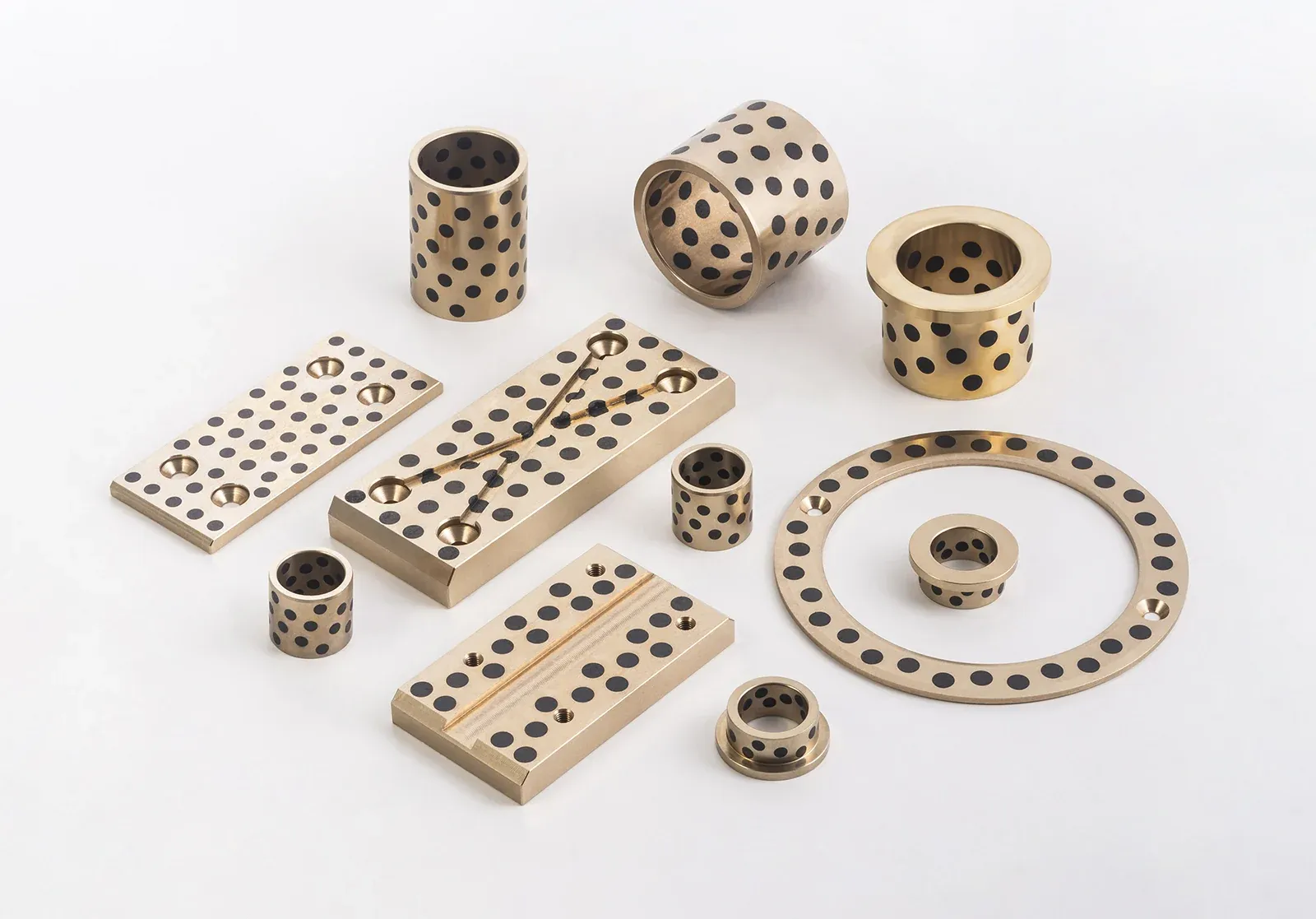
Three ways a bushing lubricates itself
Oil in the pores. Sintered bronze is pressed from powder and left 18–25 % porous; the pores are filled with oil under vacuum. Friction warms the bushing, the oil expands out onto the shaft, and when the bearing cools it is drawn back in. Nothing is consumed while the temperature stays moderate, so the charge lasts the life of a fan motor. Overheat it and the oil is expelled for good.
Solid lubricant in plugs. A cast bronze bushing is drilled through the wall in a staggered pattern and the holes are filled with graphite or PTFE + MoS₂ plugs. The shaft smears plug material across the bronze on the first movements; where the film wears, the next pass over a plug renews it. The bronze carries the load, so this type takes heavy loads and heat that would destroy a polymer, but it must move slowly, below about 0.5 m/s, because there is no oil to carry heat away.
PTFE transfer film. In a PTFE composite bushing the running layer is PTFE with solid lubricants bonded to a steel back through porous bronze. PTFE has the lowest friction of any solid and transfers a molecular film to the shaft during running-in; afterwards PTFE slides on PTFE. The layer is thin, so the load path is stiff and the bushing takes 250 N/mm² static, but the same thinness means the wear life is finite and set by the PV.
Compared
The three mechanisms overlap little; the duty usually points to one of them.
| Property | Sintered bronze | Graphite-plugged bronze | PTFE composite |
|---|---|---|---|
| Lubricant | Oil in pores | Graphite or PTFE + MoS₂ plugs | PTFE running layer |
| Load | ≈ 14 N/mm² continuous | 50–100 N/mm² | 250 N/mm² static, 60 rotating |
| Speed | To 6 m/s, light load | 0.5 m/s dry, 1–2.5 lubricated | 2 m/s dry, > 3 in fluid |
| Temperature | −10 to +90 °C | −40 to +250 / +400 °C | −195 to +280 °C |
| Shaft | Unhardened steel OK, Ra ≤ 0.8 | Hardened, Ra ≤ 1.6 | Steel, ground Ra 0.2–0.4 recommended |
| Dirt | Poor | Good (hard base, no grease) | Poor (embedded grit cuts shaft) |
| Water | Poor | Good with PTFE + MoS₂ plug | Good |
| Size range | Small, pressed | Ø8–160 mm standard, any to drawing | Ø10–280 mm, wrapped |
| Cost driver | Tooling; cheap in volume | Machining and plugs | Strip; cheap in volume |
What self-lubricating does not mean
It does not mean unlimited life. Every self-lubricating bushing wears; the rate is roughly proportional to the PV product, and the design life follows from the layer or plug volume available. It does not mean tolerance of abuse: a rough shaft scrapes the film off, grit embedded in a soft layer cuts the shaft, and heat beyond the limit destroys the mechanism (oil expelled, plugs oxidised, PTFE softened). And it does not mean grease is forbidden: a thin coat at assembly shortens running-in on graphite and PTFE types, though grease in service can trap dirt against a PTFE layer.
Where a joint can be greased on schedule, a greased bronze or bimetal bushing usually carries more load for its size and costs less. Self-lubricating types earn their place where the joint cannot or will not be maintained, where lubricant would contaminate the product, or where the temperature or the medium defeats grease.
Choosing
Start from the load and the temperature.
- Light load, high cycles, moderate temperature. Sintered bronze: fan and appliance motors, office machines, small implements.
- Heavy load, slow, hot, wet or dirty. Graphite-plugged bronze: gates, casting machines, moulds, cranes, dam and turbine equipment.
- Moderate load, any temperature, dry, volume. PTFE composite: pedals, hinges, linkages, cylinders, pumps, agricultural and automotive pivots.
- Heavy load with grease once at assembly. POM composite: the greased cousin of PTFE composite for edge loads and dirt below 130 °C.
Frequently asked questions
What is an oilless bushing?
A self-lubricating bushing: it carries lubricant inside the bearing material (oil in pores, solid-lubricant plugs or a PTFE layer) and needs no grease or oil in service.
How long does a self-lubricating bushing last?
Its wear life is set by load × speed (PV), temperature, shaft finish and dirt. Within the rated PV it is designed to outlast the machine; beyond it, wear is fast. Ask for a life estimate with the duty stated.
Can a self-lubricating bushing run under water?
Graphite-plugged bronze with a PTFE + MoS₂ plug and a stainless shaft, and PTFE composite bushings, run submerged. Sintered bronze loses its oil in water.
Should I grease a self-lubricating bushing?
Not in service, unless the design calls for it. A thin coat at assembly shortens running-in on graphite and PTFE types; POM composite must be greased at assembly.
Which self-lubricating bushing carries the most load?
PTFE composite at 250 N/mm² static (60 N/mm² rotating); graphite-plugged bronze at 50–100 N/mm² continuous and slow. Sintered bronze is for light duty.
Not sure which bushing? Send the joint.
Dimensions, load, speed, lubrication and environment: our engineers reply within 12 hours with a material proposal and a quotation. Free samples, no minimum order.