
Low-friction materials for bearings
Friction in a plain bearing is set by the pair of surfaces and what lies between them. A handful of materials have low friction against steel in their own right, PTFE, graphite and MoS₂ above all, and bearing design is largely the art of putting one of them at the interface while something stronger carries the load.
The lowest-friction solids against steel are PTFE (μ ≈ 0.04–0.10 dry), graphite and MoS₂ (≈ 0.05–0.15), followed by POM and UHMWPE (≈ 0.15–0.30) and nylon (≈ 0.20–0.40). Bronze on steel is ≈ 0.10–0.20 lubricated. None of the low-friction solids is strong enough to carry high loads alone, so bushings combine them with a bronze or steel structure: PTFE and POM layers on steel, graphite plugs in bronze, oil in sintered bronze.
- Coefficient of friction is a property of the pair and the conditions (load, speed, temperature, lubricant), not of one material
- PTFE composite bushings: μ 0.02–0.20 dry; POM composite 0.05–0.25 greased; bimetal bronze 0.04–0.15 lubricated; cast bronze 0.08–0.15 greased
- Low friction and low wear are different properties: PTFE has the lowest friction but wears fast unfilled, which is why it is used as a thin filled layer
- Lubricant film beats any solid: a full oil film gives μ ≈ 0.001–0.01, which is why fast bearings are oil fed
Materials compared
Representative ranges against steel from the tribology literature and the bushing datasheets on this site; actual values depend on load, speed, temperature, surface finish and contamination.
| Material | μ dry vs steel | μ lubricated | Wear resistance | Load capacity | Temperature | Used in bushings as |
|---|---|---|---|---|---|---|
| PTFE (filled) | 0.04–0.10 | 0.02–0.05 | Low unfilled, good filled | Low alone | −200 to +260 °C | Running layer of PTFE composite bushings |
| Graphite | 0.05–0.15 | — | Good | Low alone | To 400 °C in air | Plugs in graphite bronze bushings |
| MoS₂ | 0.05–0.10 | — | Good | Low alone | To 350 °C in air | Additive in PTFE layers and plugs |
| POM (acetal) | 0.15–0.30 | 0.05–0.10 | Good | Moderate | To 100–130 °C | Running layer of POM composite bushings; solid bushings |
| UHMWPE | 0.10–0.20 | 0.05–0.10 | Very good (abrasion) | Low | To 80 °C | Solid plastic bushings and liners |
| Nylon (PA) | 0.20–0.40 | 0.05–0.15 | Good | Moderate | To 100 °C | Solid plastic bushings |
| Bronze (C93200) | 0.25–0.35 | 0.08–0.15 | Good | High | To 250 °C | Cast, wrapped and sintered bronze bushings |
| Sintered bronze + oil | — | 0.05–0.15 | Good | Low–moderate | To 90 °C | Oil-impregnated bushings |
| Bimetal CuPb10Sn10 | — | 0.04–0.15 | Very good | Very high | To 250 °C in oil | Bimetal bushings |
| Hardened steel | 0.5–0.8 (galls) | 0.10–0.15 | Excellent | Very high | To 350 °C | Hardened steel bushings, greased |
Why the low-friction material is always a layer
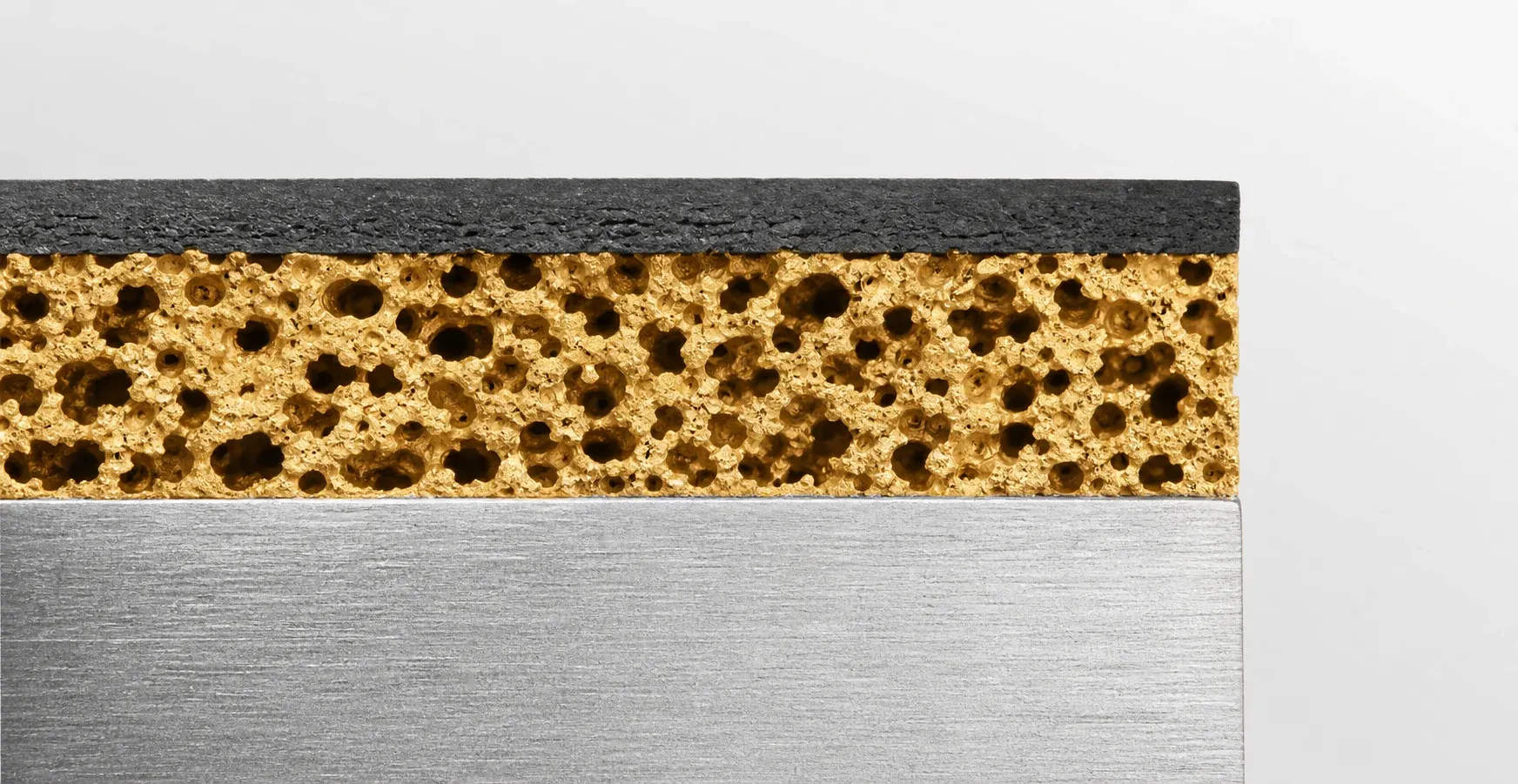
PTFE creeps under a few N/mm², graphite is brittle, and POM expands and softens with heat. Used alone they make poor bushings. Bonded as a thin layer to a steel back through porous bronze, PTFE carries 250 N/mm² static because the load path through the layer is only a few hundredths of a millimetre long; plugged into cast bronze, graphite lubricates a bushing that carries 50–100 N/mm² because the bronze, not the graphite, carries the load. The bearing designer separates the load-carrying function from the friction-reducing one and gives each to the material that does it best.
When a lubricant film beats every solid
At speed, with a supply of oil, a plain bearing builds a hydrodynamic film that separates the surfaces completely; friction falls to 0.001–0.01 and wear to nothing. That is why fast bearings, engine, gearbox and pump bushings, are oil fed and made of bimetal or bronze rather than PTFE. Below about 0.5 m/s no film forms and the bearing runs in boundary lubrication on whatever is at the interface: grease and the bronze itself, or a self-lubricating solid. The low-friction solids matter in the slow, dry, hot and unmaintained regime, which is where most bushings live.
Choosing a low-friction bushing
Match the regime, then the material.
- Dry, any temperature, moderate load. PTFE composite: the lowest friction available in a bushing, 250 N/mm² static, −195 to +280 °C.
- Dry, heavy, slow, hot. Graphite-plugged bronze: 50–100 N/mm², to 400 °C, at ≤ 0.5 m/s.
- Greased once, high PV, edge load. POM composite: 22 N/mm²·m/s under oil, tough layer, to 130 °C.
- Oil fed, fast. Bimetal: μ 0.04–0.12 on a film, 8–15 m/s.
- Light, quiet, cheap, corrosion-free. Solid POM, nylon or UHMWPE bushings, or sintered bronze.
Frequently asked questions
What material has the lowest coefficient of friction?
Among engineering solids, PTFE: about 0.04–0.10 dry against steel, lower when filled and run in. Graphite and MoS₂ are close. A hydrodynamic oil film beats all of them at 0.001–0.01.
Why not make the whole bushing out of PTFE?
PTFE creeps under load and conducts heat poorly. As a thin layer on a steel back it carries 250 N/mm²; as a solid bushing it carries a small fraction of that and cold-flows.
Is low friction the same as low wear?
No. PTFE has the lowest friction and, unfilled, one of the highest wear rates. Bushing materials are filled, layered or plugged to get both.
What is the friction of a bronze bushing?
About 0.08–0.15 greased in boundary lubrication; lower on an oil film at speed; 0.25–0.35 dry, which is a failure mode, not a design point.
Which bushing has the lowest friction?
A PTFE composite bushing (0.02–0.20 depending on load and speed) among dry-running types; an oil-fed bimetal bushing on a full film among lubricated ones.
Not sure which bushing? Send the joint.
Dimensions, load, speed, lubrication and environment: our engineers reply within 12 hours with a material proposal and a quotation. Free samples, no minimum order.