
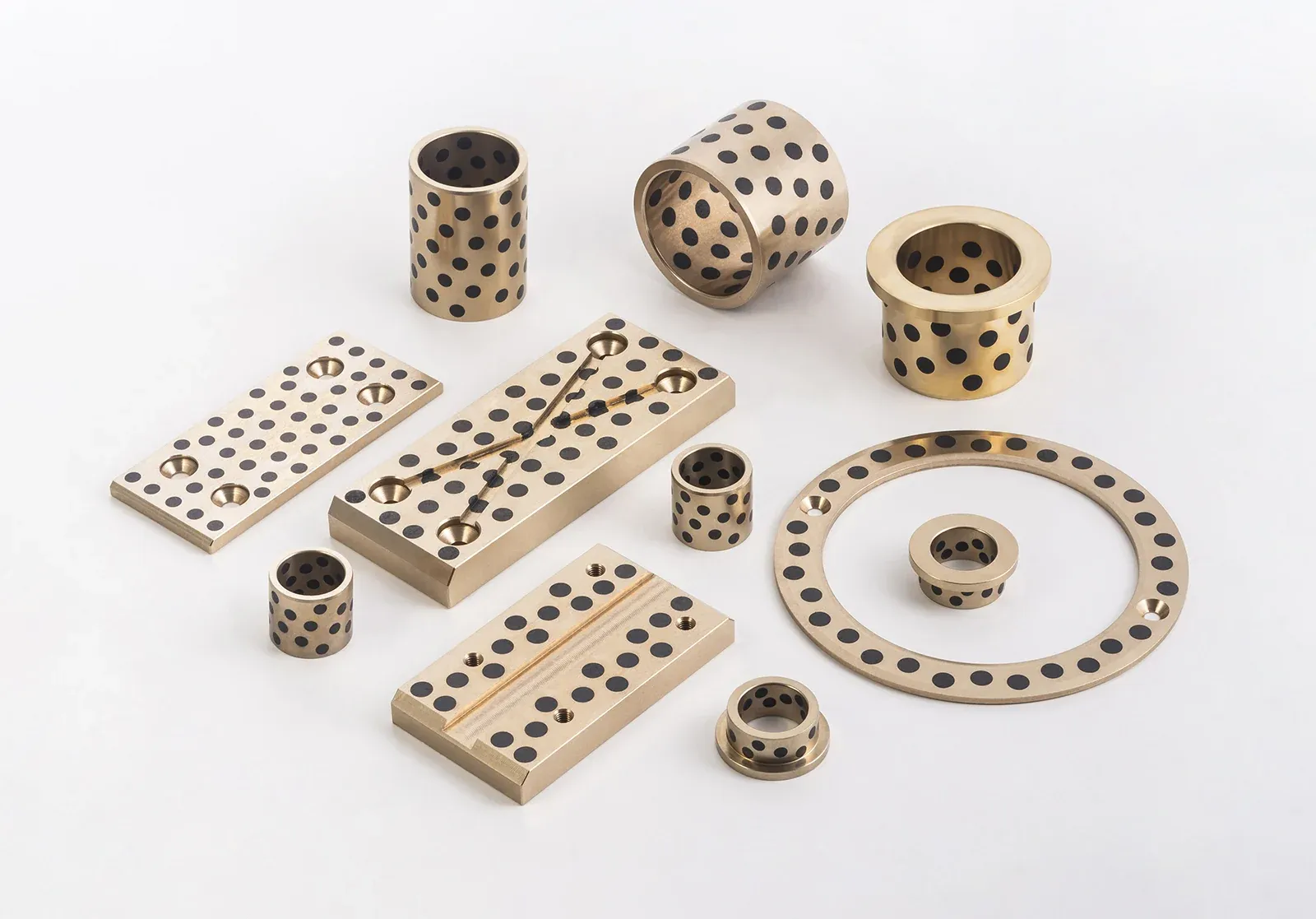
Graphite bronze bushings
A cast bronze body carries the load; plugs of graphite or PTFE + MoS₂ pressed through the wall lubricate the shaft. For joints that cannot be greased, run hot, sit under water or move slowly under heavy load. Cylindrical bushings Ø8–160 mm standard, flanged bushings, thrust washers and wear plates, and parts to your drawing.
- Ø8–160 mmStandard cylindrical sizes
- 50–100 N/mm²Maximum load by grade
- 0.5 m/sDry, grade 650
- +400 °CAluminium / tin bronze grades
A graphite bronze bushing (also called a graphite-plugged, oilless or solid-lubricant bushing) is a machined cast bronze bushing with a staggered pattern of holes drilled through the wall and filled with solid lubricant. In service the shaft smears the plug material into a film across the bronze; where the film wears, the next pass over a plug renews it. The bushing needs no oil, grease or maintenance.
- Series JBM-650. Base metals: high-strength brass CuZn25Al5Mn4 (grades 650, 650S5, 650W1, 650W3), aluminium bronze CuAl10Ni5Fe5 (650S2), tin bronze CuSn12 (650S3), leaded bronze CuSn5Pb5Zn5 (650S1)
- Plugs: graphite-based (general machinery, to 400 °C) or PTFE + MoS₂ (water and seawater lubrication, to 300 °C)
- Grade 650: 50 N/mm², 0.5 m/s dry / 1.0 m/s lubricated, −40 to +250 °C; 650W3 up to 100 N/mm² at 0.1 m/s
- Aluminium and tin bronze grades: 50 N/mm², 2.5 m/s lubricated, −40 to +400 °C
- Standard cylindrical series Ø8–160 mm (F7 bore, m6 outside diameter for an H7 housing); flanged Ø10–120 mm
Forms
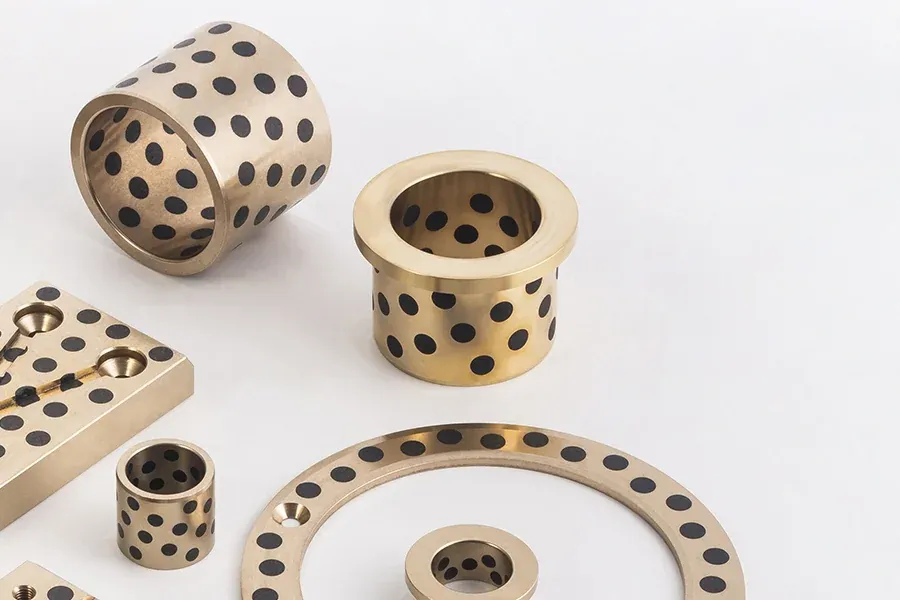
All four forms use the same base metals and plugs. Plugs are placed in every sliding face, including flange faces and thrust surfaces.
Cylindrical bushings
Ø8–160 mm bore standard series; gate trunnions, casting-machine rolls, pivot pins, tie-bar and column guides.
Ø8–160 mmFlanged bushings
Ø10–120 mm bore with a locating flange that takes axial load or fixing screws; mould column and ejector-plate guides, crane pivots.
Ø10–120 mm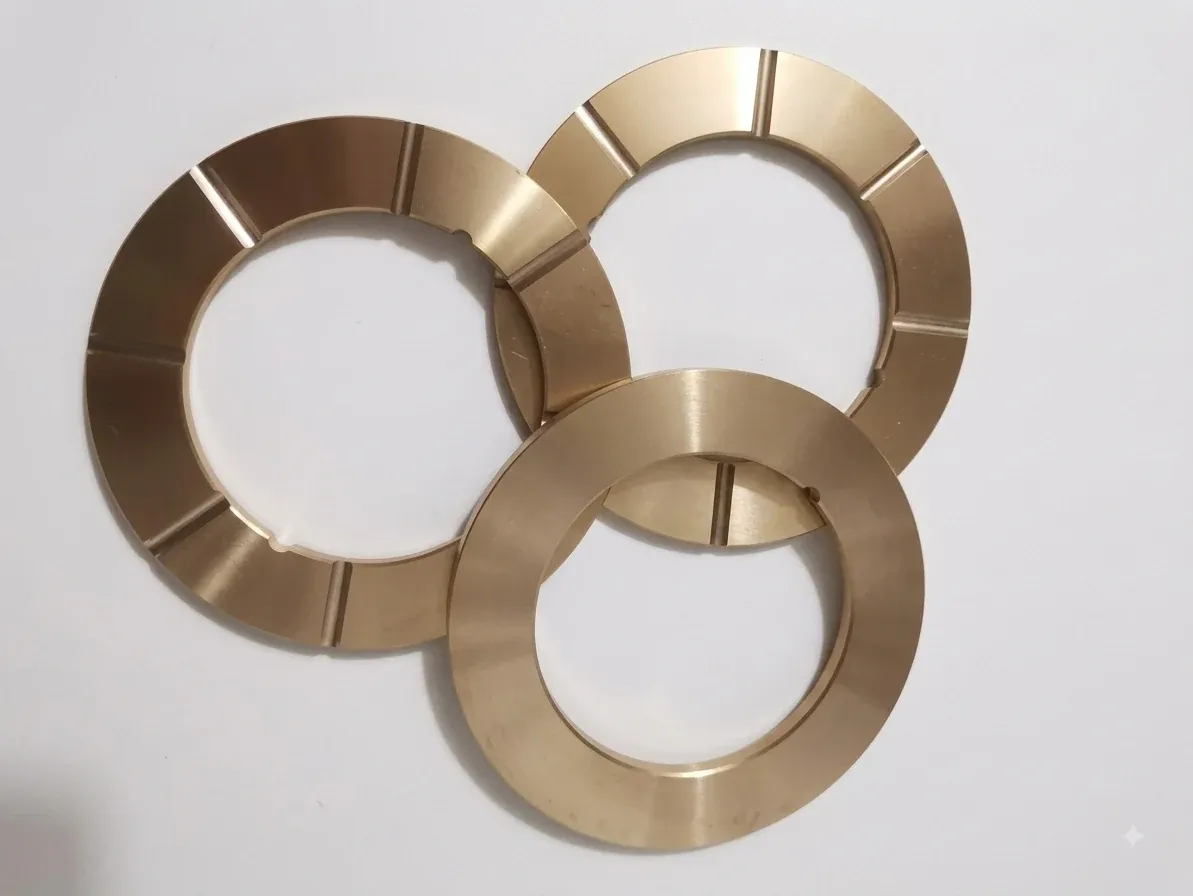
Thrust washers
Shaft 10–120 mm, plugs in the sliding face, plain or counterbored bolt holes; gate hinges, slewing tables, turntables.
Axial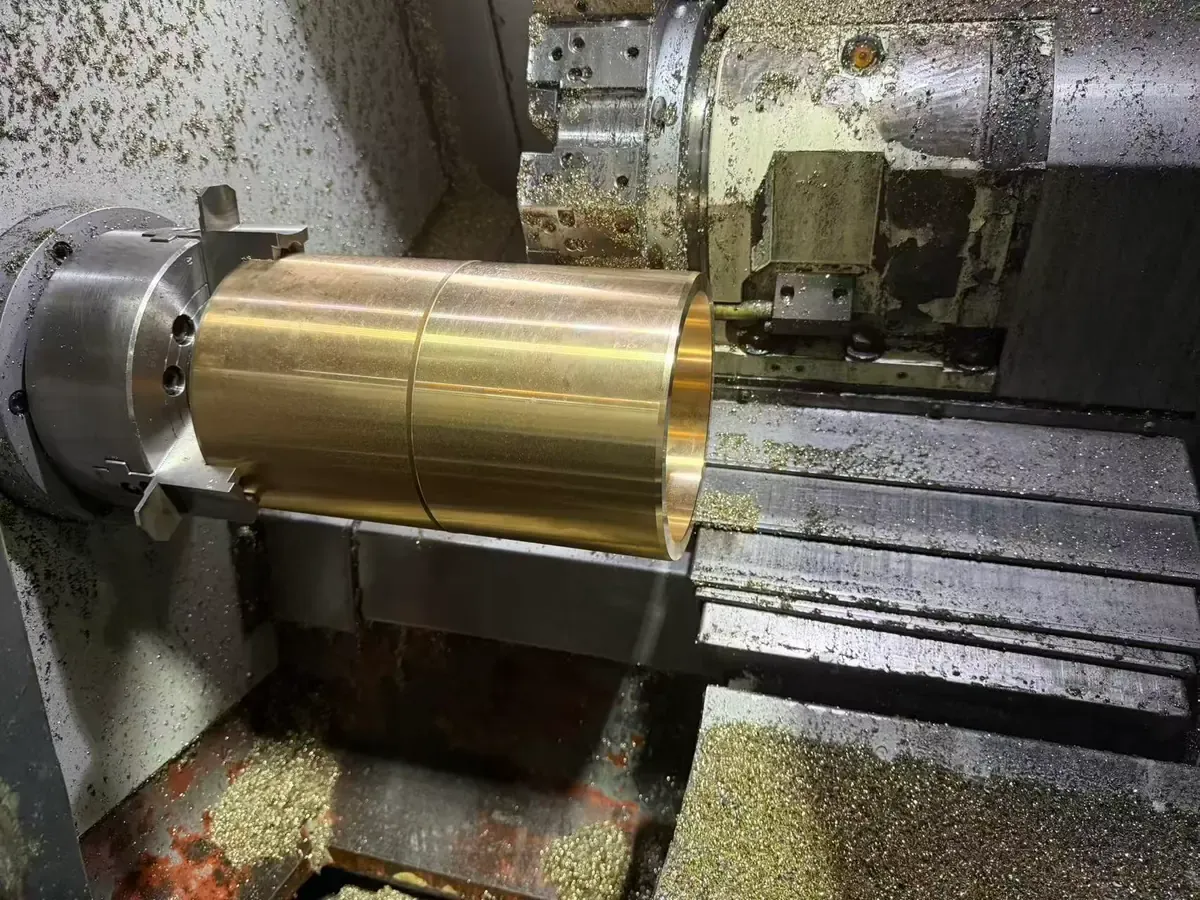
Wear plates
Flat and curved plates with plugs, counterbored for fixing; slides, guides and liners to drawing.
To drawing
When a graphite bronze bushing is the right choice
Five conditions defeat greased bronze, oil-impregnated sintered bronze and polymer-lined bushings; in each of them the solid-lubricant plug keeps working because it needs no oil film and no maintenance visit.
No access for relubrication
Gate hinges, casting-machine segments, moulds running three shifts: nobody reaches the grease nipple. The plugs hold the lubricant supply inside the wall for the life of the bushing.
Heat
Above about 150 °C grease oxidises and drains. Graphite plugs in a CuZn25Al5Mn4 body work to 250 °C; in the aluminium bronze and tin bronze grades to 400 °C.
Water
Water flushes grease out of a plain bronze bushing. A graphite or PTFE + MoS₂ film stays on the shaft; with a stainless or hard-chromed shaft the pair runs submerged for years.
Heavy load at very low speed
Below 0.5 m/s no hydrodynamic film can form, so a lubricated bushing runs in boundary friction anyway. The cast base carries 50 N/mm² (grade 650) to 100 N/mm² (650W3) with the plug film doing the lubrication.
Abrasive dirt
Grease traps particles and grinds them into the shaft. A dry plug-lubricated surface holds nothing, and a base alloy of HB ≥ 210 resists embedding.
Not the right choice: continuous rotation faster than 0.5 m/s dry or 1 m/s greased (grade 650) generates more heat than the plugs can carry away. For fast, lightly loaded shafts a PTFE composite or bimetal bushing runs cooler and costs less.
Base metal grades
The base metal carries the load and sets the temperature limit; the plug does the lubrication. Grade 650 (high-strength brass CuZn25Al5Mn4, HB ≥ 210) is the standard: strong, hard and economical. Its heat-treated variants 650S5 and 650W3 carry 75–100 N/mm² at lower speed. The aluminium bronze CuAl10Ni5Fe5 (650S2) and tin bronze CuSn12 (650S3) run to 400 °C and to 2.5 m/s with lubrication; the leaded bronze CuSn5Pb5Zn5 (650S1) is the softest and most forgiving of shaft finish.
| Grade | Base metal | Hardness HB | Max. load | Speed dry / lubricated | PV dry / lubricated | Temperature |
|---|---|---|---|---|---|---|
| 650 | CuZn25Al5Mn4 | ≥ 210 | 50 N/mm² | 0.5 / 1.0 m/s | 1.65 / 3.25 N/mm²·m/s | −40 to +250 °C |
| 650S5 | CuZn25Al5Mn4 (hardened) | ≥ 240 | 75 N/mm² | 0.1 / 0.25 m/s | 1.65 / 3.25 | −40 to +250 °C |
| 650W1 | CuZn25Al5Mn4 | ≥ 210 | 75 N/mm² | 0.5 / 1.0 m/s | 1.65 / 3.25 | −40 to +250 °C |
| 650W3 | CuZn25Al5Mn4 | ≥ 235 | 100 N/mm² | 0.1 / 0.25 m/s | 1.65 / 3.25 | −40 to +250 °C |
| 650S1 | CuSn5Pb5Zn5 | ≥ 60 | 50 N/mm² | 0.5 / 2.5 m/s | 1.0 / 1.65 | −40 to +400 °C |
| 650S2 | CuAl10Ni5Fe5 | ≥ 200 | 50 N/mm² | 0.5 / 2.5 m/s | 1.0 / 1.65 | −40 to +400 °C |
| 650S3 | CuSn12 | ≥ 85 | 50 N/mm² | 0.5 / 2.5 m/s | 1.0 / 1.65 | −40 to +400 °C |
Reference limits of the 650 series recommended by the plug-material supplier; each value is a separate limit, not a simultaneous operating point. Confirm the selection against the actual load, motion, counterface and environment.
Solid lubricants
Two plug formulations cover almost every case. The graphite-based plug (SL1) has low friction, resists chemical attack and works to 400 °C; it is the default for general machinery in air. The PTFE + MoS₂ plug (SL4) has lower friction still and is formulated for water lubrication, to 300 °C: ships, hydraulic turbines, gates and pumps where the bushing runs wet.
Plugs are pressed in with an interference fit and run through the full wall thickness, so the lubricant supply is proportional to the wall, not to a thin coating. The staggered pattern is laid out so that every track of the shaft crosses a plug on each revolution or stroke.
Shaft and housing
The shaft is the counterface for a hard base alloy (HB ≥ 210 for grade 650) and must be harder than it: hardened or surface-hardened steel or a hard-chrome layer, ground or fine-turned to Ra 1.6 µm or better. An unhardened shaft is marked by the brass and loses the graphite film; a rough shaft keeps scraping the film off. In water use a stainless shaft or a hard-chrome layer of at least 30 µm; where the shaft cannot be hardened, use the softer tin bronze grades 650S1 or 650S3.
The standard cylindrical series is finished F7 in the bore and m6 on the outside diameter for an H7 housing. The bearing works dry from the first movement, but a thin coat of grease or oil at assembly shortens the running-in during which the plugs build their film on the shaft; after that it runs dry within the limits above.
Sizes
The standard cylindrical series covers Ø8–160 mm bore in about 220 sizes, flanged bushings Ø10–120 mm and thrust washers for 10–120 mm shafts. Larger diameters, wear plates, curved segments and any special form are machined to drawing; the plug pattern is laid out for each part.
What to put in the enquiry
Six items let us propose the grade and plug and quote within 12 hours.
Dimensions
Bore × outside diameter × length, flange, or the drawing; for washers and plates the sliding face and fixing holes.
Load and motion
Radial and axial force, rotating, oscillating or sliding, speed or cycles per minute.
Environment
Temperature, water or seawater, chemicals, dust.
Shaft
Material, hardness, finish and plating.
Grade preference
650 unless stated; or state the duty and let us choose.
Quantity
Sample, batch and annual quantity. Samples are free; no minimum order.
Where graphite bronze bushings are used
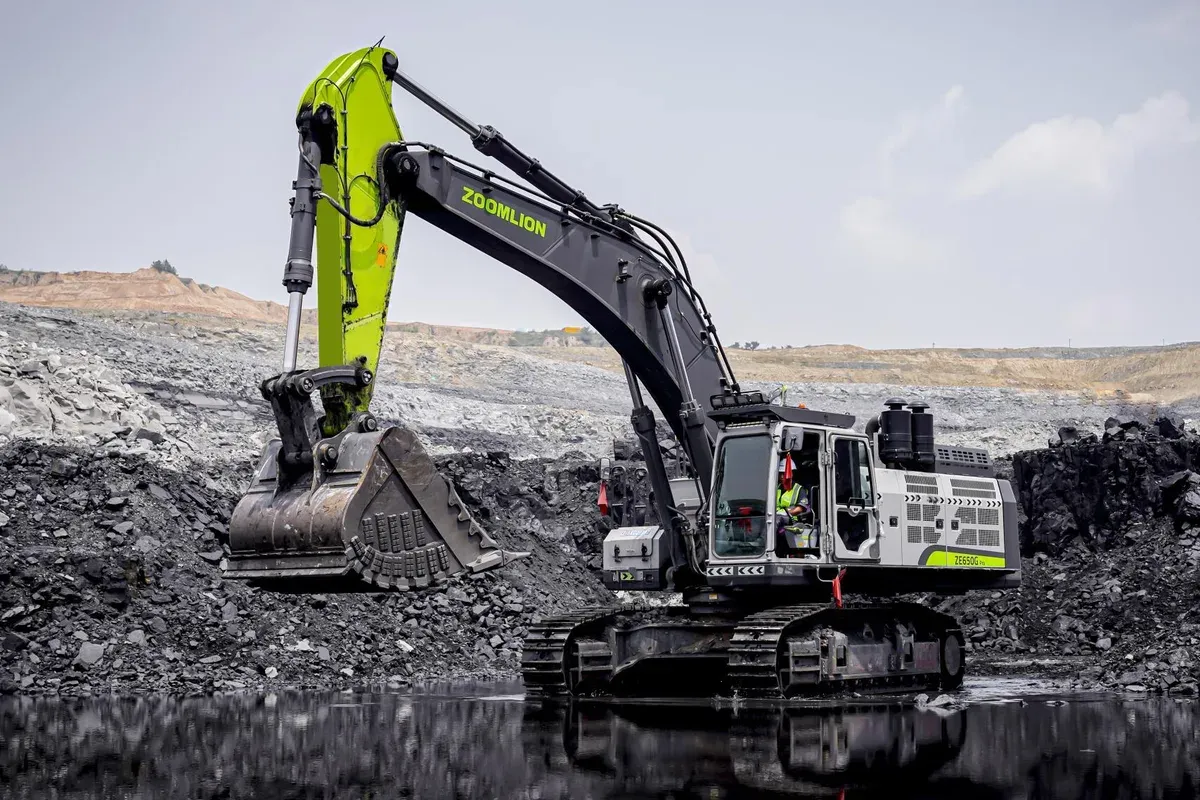
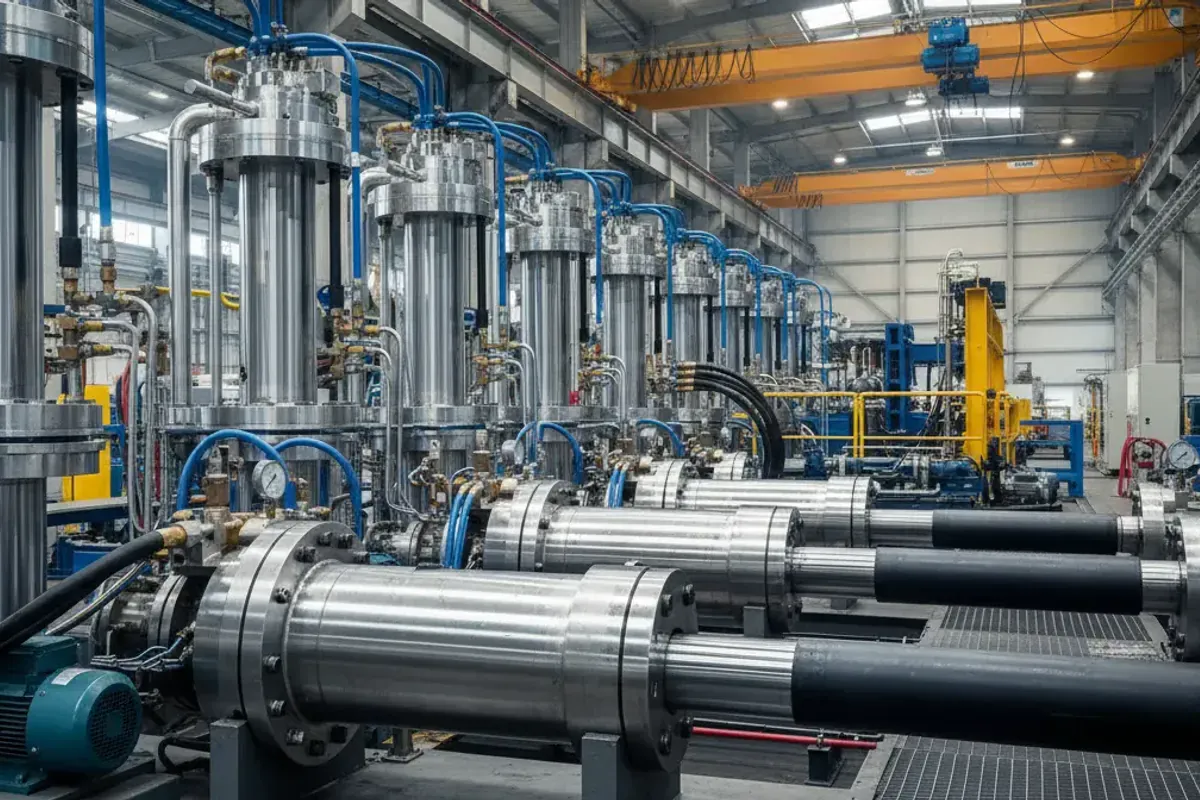
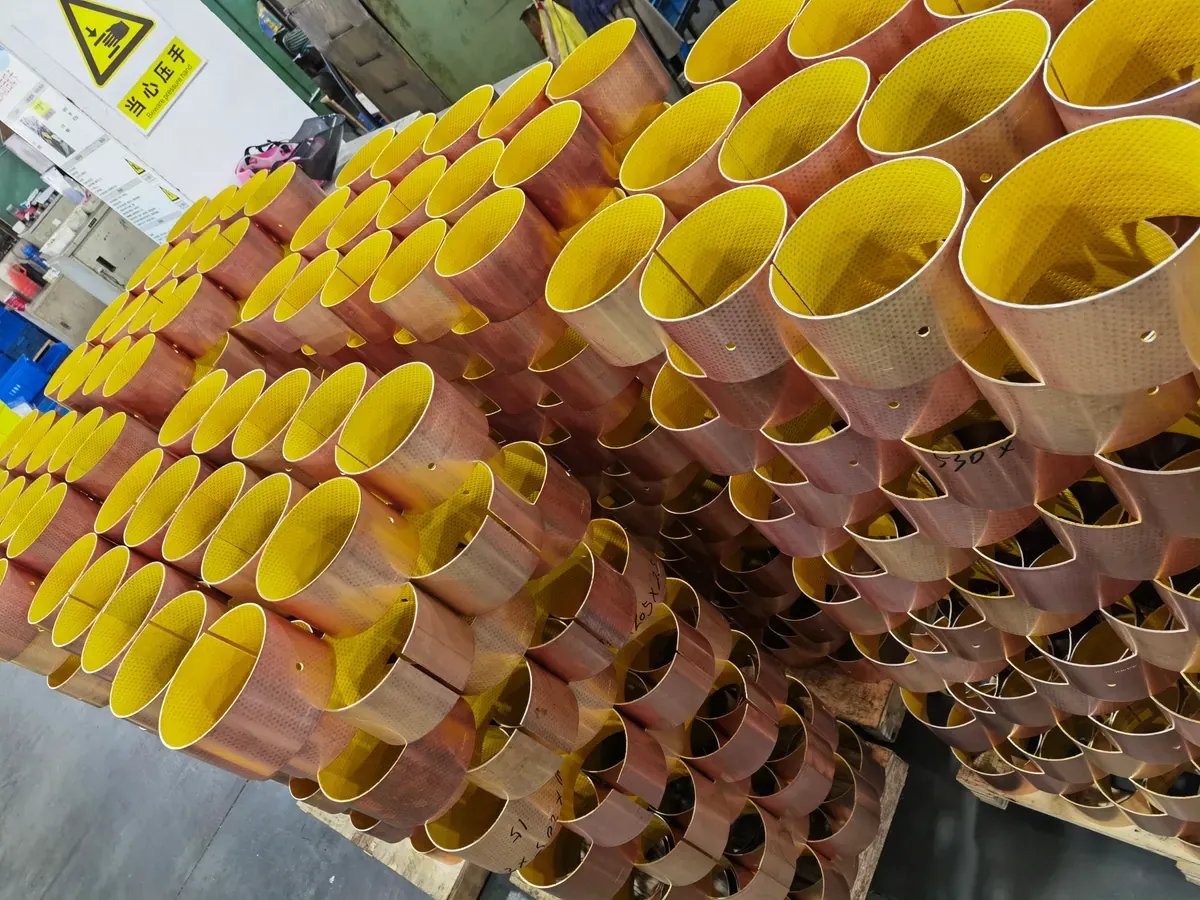
Slow, heavy, hot, wet or inaccessible joints.
Frequently asked questions
What is a graphite bronze bushing?
A cast bronze bushing with holes drilled through the wall in a staggered pattern and filled with solid lubricant, graphite or PTFE + MoS₂. The bronze carries the load; the plugs lubricate the shaft for the life of the part without oil or grease.
How fast can a graphite bushing run?
Grade 650: 0.5 m/s dry, 1.0 m/s with lubrication. The aluminium and tin bronze grades reach 2.5 m/s lubricated. Above these speeds the heat generated exceeds what the plugs can carry away; use a PTFE composite or bimetal bushing instead.
What load can it carry?
50 N/mm² of projected area for grade 650 and the aluminium and tin bronze grades; 75 N/mm² for 650S5 and 650W1; 100 N/mm² for 650W3 at 0.1 m/s. Load, speed and temperature are separate limits.
Can graphite bushings run under water?
Yes, with the PTFE + MoS₂ plug and a stainless or hard-chromed shaft. Water does not wash the plug film off as it does grease, which is why they are used in gates, turbines and ships.
Graphite bushing or oil-impregnated sintered bronze?
Sintered bronze for small, light, fast bearings (motors, appliances) where oil in the pores is enough. Graphite-plugged cast bronze for heavy load, high temperature, water or very slow motion where the sintered part would be crushed or run dry.
Is it interchangeable with OILES 500 or JDB bushings?
The 650 series covers the same duty and the standard dimension series overlap, but interchangeability is confirmed part by part from the drawing, never assumed from the series name. Send the part number or the measured dimensions and we check base metal, plug, fits and size.
Send the load, the speed and the environment.
Our engineers confirm the base metal and plug formulation and quote within 12 hours. Samples are free and there is no minimum order.