
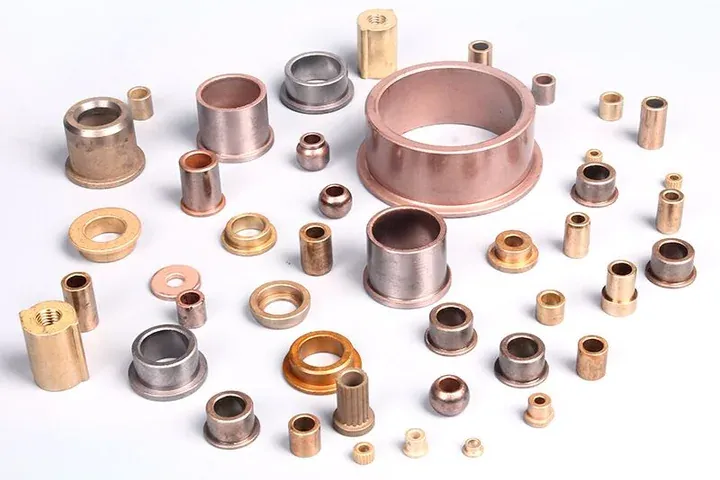
Sintered bronze bushings
Porous bronze bushings pressed from copper–tin powder, sintered and filled with lubricating oil. As the bearing warms the oil expands out of the pores onto the shaft; as it cools the oil is drawn back in. The result is a small, cheap, quiet, self-lubricating bearing for light loads and high cycles: fan motors, appliances, power tools, office machines and small agricultural implements.
- 18–25 %Oil by volume
- ≈ 14 N/mm²Continuous load (typical)
- 6 m/sSpeed, light load
- 0Relubrication
An oil-impregnated sintered bronze bushing (oilite-type bushing) is a powder-metal plain bearing with 18–25 % of its volume as interconnected pores filled with oil. It needs no external lubrication for its service life, runs quietly against unhardened shafts and is made in large quantities to close tolerances without machining.
- JBM-700: sintered Cu 87–90 % / Sn 10 % bronze (ISO 5755 / MPIF CT-1000 type), density 6.4–7.2 g/cm³, oil content 18–25 % by volume; standard mineral oil, or -H high-temperature, -L low-temperature and -FG food-grade oils
- Typical duty: specific load up to about 14 N/mm² continuous, sliding speed up to 6 m/s at light load, PV up to about 1.8 N/mm²·m/s
- Working temperature −10 to +90 °C with standard mineral oil; other oils extend the range
- Forms: cylindrical sleeves, flanged bushings, thrust washers, spherical (self-aligning) bushings; metric and inch
- Sizes pressed to standard tooling or to drawing; small parts in high volume, no minimum order for samples
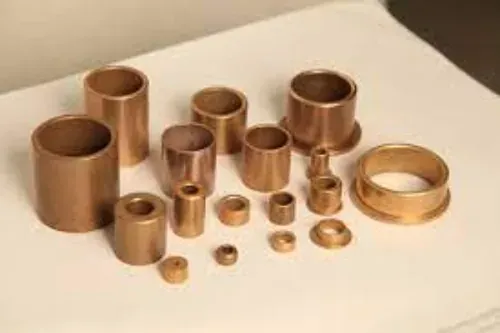
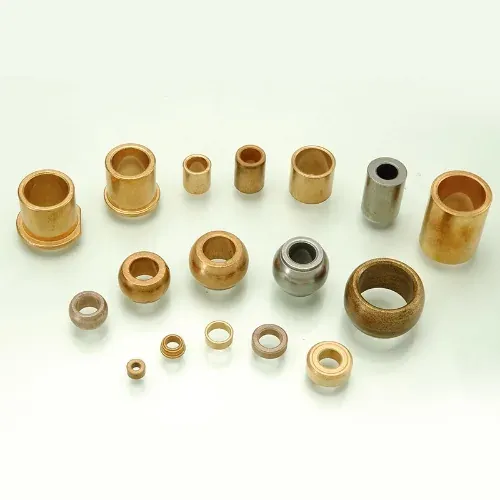
Forms
All forms are pressed and sintered to shape, sized in a die and impregnated; only special features are machined.
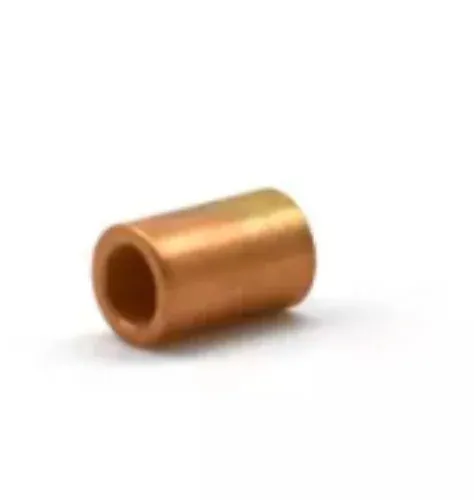
Cylindrical sleeves
JBM-700 plain sleeves in metric and inch series; the standard motor and appliance bearing.
JBM-700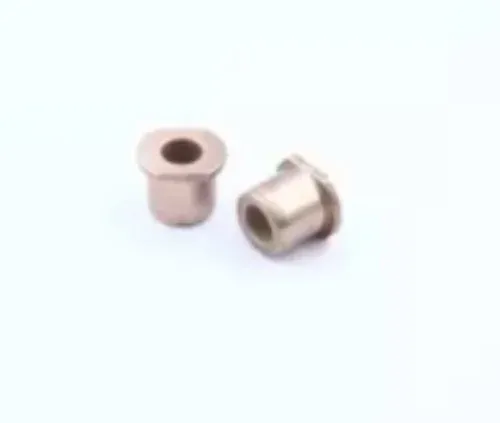
Flanged bushings
JBM-700F, located by the flange in a through-bore or sheet-metal housing.
JBM-700F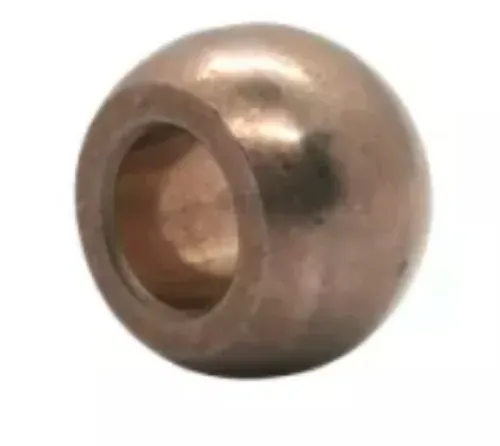
Spherical bushings
Ball-shaped outside for self-alignment in stamped housings of small motors and fans.
Self-aligning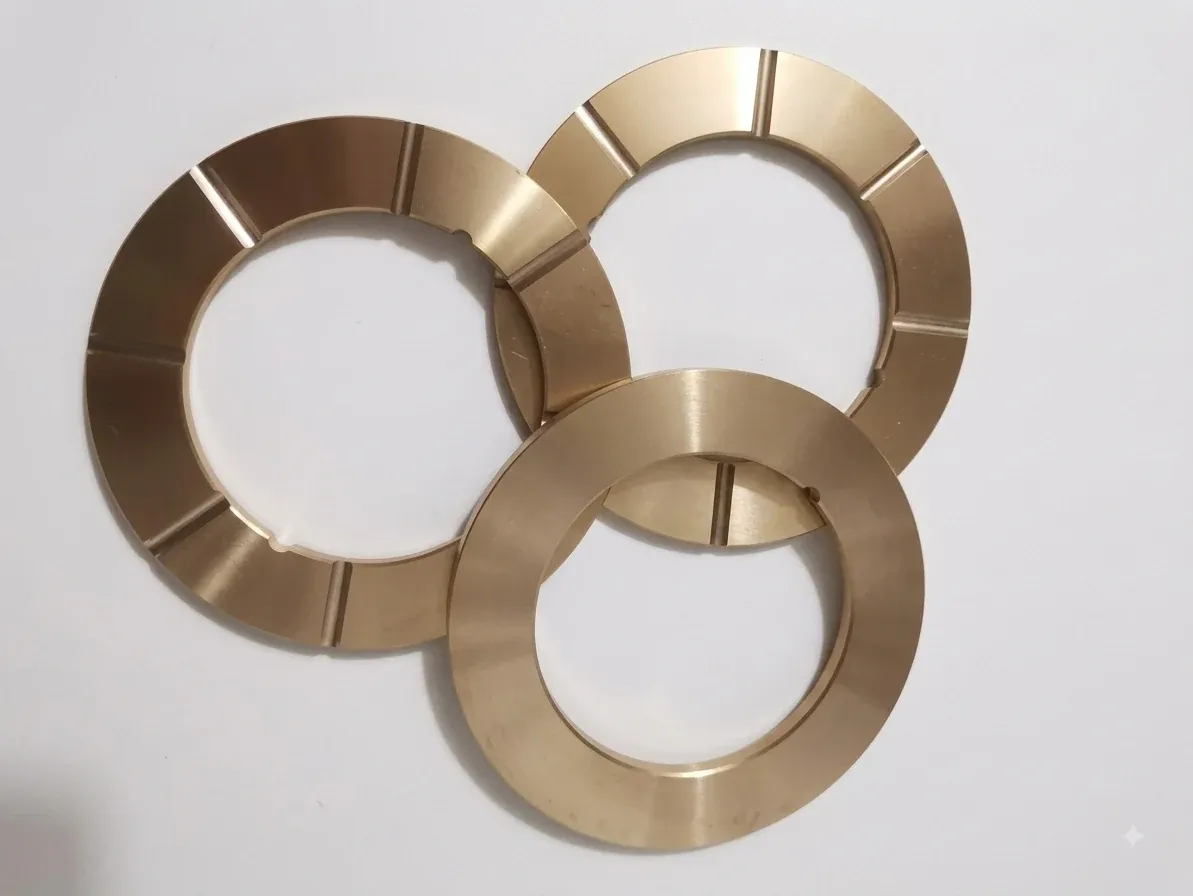
Thrust washers
JBM-700WC flat washers for axial load in the same material.
JBM-700WC
How an oil-impregnated bushing lubricates
The pores of the sintered bronze hold oil by capillary action. When the shaft turns, friction warms the bushing, the oil expands and is drawn to the surface, and the shaft picks up a film that in the best case becomes a full hydrodynamic film. When the shaft stops and the bearing cools, the oil retreats into the pores. The oil is never replaced; the bearing is designed so that the charge lasts the life of the product, which is why the load and temperature limits are lower than for a greased cast bronze bushing: too much heat drives the oil out permanently.
Sintered bronze runs well against unhardened steel shafts, tolerates small misalignment and is very quiet, which is why it is the standard bearing for small electric motors, fans, household appliances and office machinery.
Typical operating limits
The values below are the published typical limits for oil-impregnated tin bronze bearing grades (ISO 5755 / MPIF Standard 35); they depend on oil type, porosity and heat dissipation and are the starting point for selection, not a rating of a specific part.
| Parameter | Unit | Typical value |
|---|---|---|
| Specific load, continuous | N/mm² | up to ≈ 14 |
| Specific load, static | N/mm² | up to ≈ 55 (short duration) |
| Sliding speed, light load | m/s | up to ≈ 6 |
| PV | N/mm²·m/s | up to ≈ 1.8 |
| Working temperature, standard oil | °C | −10 to +90 |
| Density | g/cm³ | 6.4–7.2 |
| Oil content | % by volume | 18–25 |
| Shaft | — | Steel, unhardened acceptable, Ra ≤ 0.8 µm |
Typical values for the material class. A first-party JBM datasheet with the exact grade and oil is issued with the quotation.
Sleeves, flanges, spheres and washers
Cylindrical sleeves and flanged bushings cover most positions. Spherical bushings, with a ball-shaped outside diameter clamped in a stamped housing, let the bearing align itself to the shaft in fan and small-motor end plates. Thrust washers take the axial load of a rotor. All are pressed and sintered to shape and then sized in a die to the finished tolerance, so no machining is needed and the pores stay open; drilling or turning a sintered bushing smears the surface and closes the pores, and is avoided.
Fits and installation
Sintered bronze is pressed into a housing with an interference of roughly 0.5–1 % of the outside diameter; the bore closes by about the same amount, so the bore is ordered oversize to give the running clearance after pressing. Press with a stepped arbor that supports the bore, never by hammering. Do not machine after pressing. Keep the housing and shaft free of solvents, which leach the oil, and specify the oil for high or low temperature, food contact or high speed.
Sizes
Sintered bushings are pressed on standard tooling in metric and inch series (for example 3/16 × 3/8 × 3/4 in, 12 × 18 × 20 mm, 16 × 20 × 12 mm) and to drawing where volume justifies a die. The part number is the series followed by bore-OD-length in millimetres: JBM-700 12-18-20 is a Ø12 × Ø18 × 20 mm sleeve, JBM-700F a flanged bushing, JBM-700WC a thrust washer; inch parts carry the suffix I (JBM-700I). Because the part is pressed, small sizes in large quantities are the economical case; large diameters and one-off sizes are better made in machined cast bronze (JBM-600).
What to put in the enquiry
Five items let us quote within 12 hours.
Dimensions
Bore × outside diameter × length, flange or sphere diameter, or the drawing; metric or inch.
Duty
Radial load, rpm, duty cycle, ambient temperature.
Shaft
Material, hardness and finish.
Oil
Standard mineral oil unless a high-temperature (-H), low-temperature (-L) or food-grade (-FG) oil is required.
Quantity
Annual volume and batch size; pressed parts are priced on volume.
Where sintered bronze bushings are used
Light load, high cycles, no maintenance: small motors, appliances, office machinery and small implements.

Frequently asked questions
What is a sintered bronze bushing?
A porous bronze bearing pressed from copper-tin powder, sintered and impregnated with oil. The oil in the pores lubricates the shaft for the life of the part without any external lubrication. Bushing MFG supplies it as the JBM-700 series.
How long does the oil last?
For the design life of the product if the load, speed and temperature stay within the limits. Heat above about 90 °C with standard oil drives it out permanently; solvents leach it. Re-impregnation is possible but rarely economic.
Can I machine a sintered bushing?
Avoid it. Turning or drilling smears the bronze and closes the pores, cutting off the oil supply. Order the finished size; the part is sized in a die to the tolerance you need.
Sintered bronze or PTFE composite?
Sintered bronze for light load at higher speed, quiet running and unhardened shafts. PTFE composite for higher load, wide temperature range, no oil at all and where oil bleed is unacceptable.
Do you make inch sizes?
Yes. Inch series sleeves and flanged bushings are pressed on standard tooling; state the unit on the enquiry.
Send the size, the speed and the volume.
Our engineers confirm the grade and oil and quote within 12 hours. Samples are free.