
Types of bushings
A bushing is the simplest bearing there is: a sleeve between a shaft and a housing that lets one turn or slide in the other. Behind that simplicity sits a whole range of shapes, materials and lubrication schemes, each the right answer to a different joint. This page lays the range out.
In mechanical engineering a bushing (bush, sleeve bearing, plain bearing) is a cylindrical liner that carries a shaft or pin on a sliding surface, without rolling elements. Bushings are classified three ways: by shape (sleeve, flanged, thrust washer, split, spherical), by material (cast bronze, sintered bronze, graphite-plugged bronze, wrapped bronze, bimetal, PTFE composite, POM composite, hardened steel, solid plastic) and by how they are lubricated (greased or oiled, self-lubricating, dry).
- Shape decides how the bushing is held and what loads it takes: radial only (sleeve), radial + location (flanged), axial (thrust washer)
- Material decides load, speed and temperature: from 14 N/mm² sintered bronze to 250 N/mm² PTFE composite and hardened steel
- Lubrication decides maintenance: greased bronze and steel, oil-fed bimetal, self-lubricating sintered, graphite-plugged and PTFE types
- “Shaft bushing”, “sleeve bearing”, “plain bearing”, “bush” and “journal bearing” all describe the same component from different angles
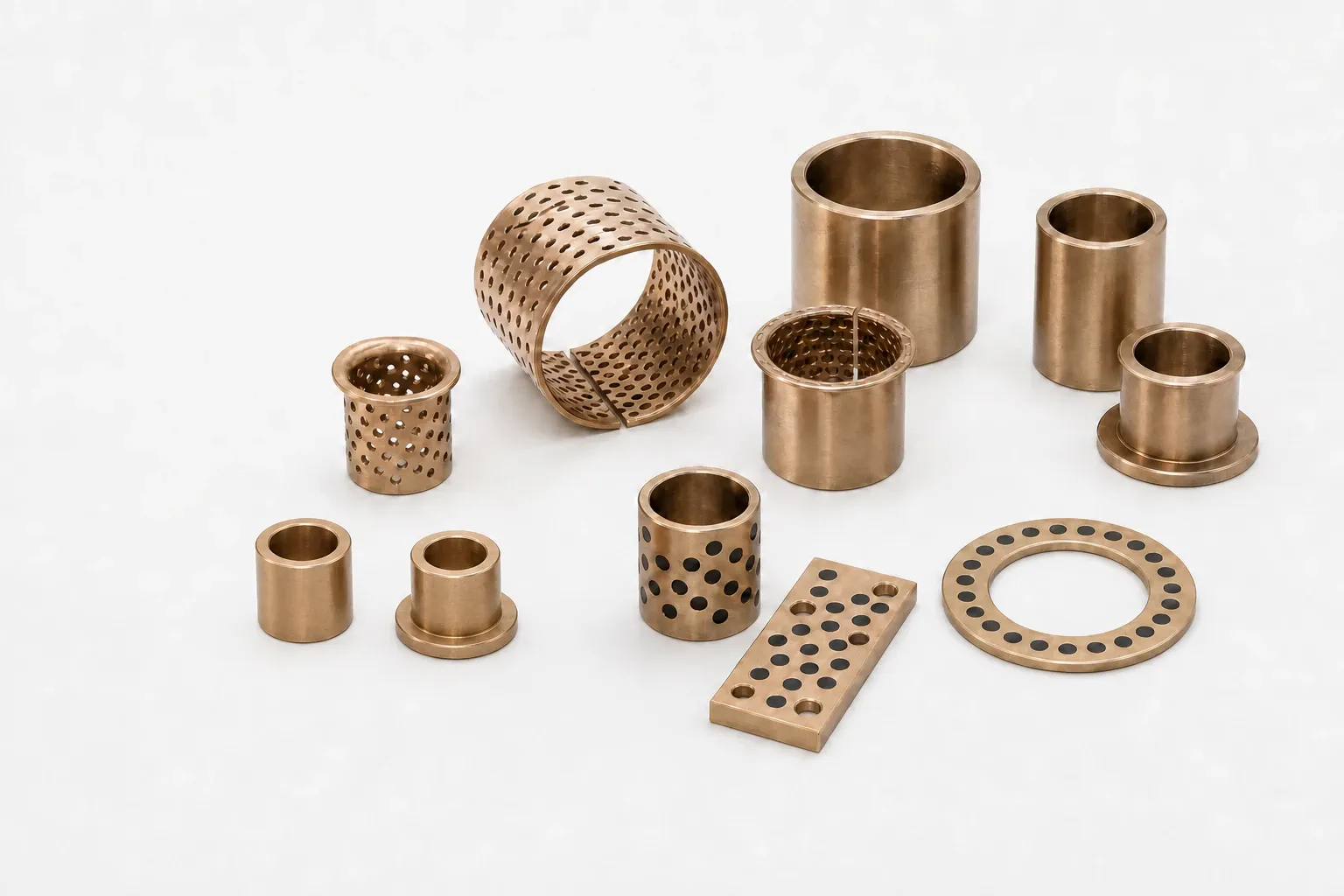
What a bushing is
A bushing is a plain bearing: a sleeve of bearing material pressed into a housing so that a shaft or pin can rotate, oscillate or slide inside it with low friction and controlled wear. It carries the load on a sliding surface with a lubricant film or a self-lubricating material between the parts, in contrast to a rolling-element bearing, which carries the load on balls or rollers. Because there are no moving parts, a bushing is compact, quiet, cheap, tolerant of shock and dirt, and easy to replace, which is why almost every machine has more bushings than ball bearings.
The words overlap. “Bush” is the British and “bushing” the American term; “sleeve bearing” emphasises the shape, “plain bearing” the absence of rolling elements, “journal bearing” the rotating shaft it supports, and “shaft bushing” or “pin bushing” the part it runs on. They are the same component.
Types by shape
Shape is chosen from how the bushing is held in the housing and which loads it must carry.
| Type | Description | Carries | Typical use |
|---|---|---|---|
| Sleeve (cylindrical) bushing | Plain cylinder, press fit in a through-bore | Radial load | The default; pins, shafts, pivots everywhere |
| Flanged bushing | Sleeve with a collar at one end | Radial load + axial location, light thrust | Blind or sheet-metal housings, thrust in one direction |
| Thrust washer | Flat ring | Axial load only | Beside a sleeve where the shaft pushes sideways |
| Split / clinch bushing | Wrapped from strip with a butt joint | Radial load | Volume production: bimetal, wrapped bronze, composite |
| Spherical bushing | Ball-shaped outside in a matching seat | Radial load with misalignment | Small motors, linkages, rod ends |
| Stepped and shouldered | Two outside or inside diameters | Radial + location | To drawing, replacing two parts with one |
| Wear plate / strip | Flat or curved bearing surface | Sliding load | Slides, guides, liners |
Types by material
Material is chosen from the specific load (force ÷ bore × length), the sliding speed, the temperature and the lubrication available. The table gives the materials Bushing MFG manufactures with their headline limits; each is described on its own page.
| Material | Construction | Load | Speed | Temperature | Lubrication |
|---|---|---|---|---|---|
| Cast bronze (JBM-600 series, C93200 etc.) | Machined from continuous-cast bar | 45 N/mm² static, 25 moving | 0.5 m/s greased | −40 to +250 °C | Grease or oil |
| Wrapped bronze (JBM-090 / 092, CuSn8) | Rolled from strip, lubricant pockets | 120 N/mm² static, 40 dynamic | Low | To 250 °C | Grease |
| Sintered bronze (JBM-700) | Pressed powder, oil-impregnated | ≈ 14 N/mm² continuous | To 6 m/s light load | −10 to +90 °C | Self (oil in pores) |
| Graphite-plugged bronze (JBM-650) | Cast bronze with solid-lubricant plugs | 50–100 N/mm² | 0.5 m/s dry | −40 to +400 °C | Self (plugs) |
| Bimetal (JBM-800) | Steel back, sintered CuPb10Sn10 lining | 150 N/mm² dynamic | 3.5 m/s grease, 8 m/s oil | To 250 °C in oil | Grease or oil |
| PTFE composite (JBM-10) | Steel back, bronze, PTFE layer | 250 N/mm² static | 2 m/s dry | −195 to +280 °C | None (dry) |
| POM composite (JBM-20) | Steel back, bronze, POM layer with pockets | 250 N/mm² static, 140 dynamic | 2.5 m/s oiled | −40 to +130 °C | Grease at assembly |
| Hardened steel (JBM-ST) | Heat-treated steel sleeve, HRC 58–62 | 250 N/mm² | 0.1 m/s | −100 to +350 °C | Grease |
| Solid plastic (JBM-30 series: POM, nylon, UHMWPE, PTFE) | Moulded or machined polymer | Low | Low | To ≈ 80–100 °C | None or grease |
Headline limits; each is a separate limit, not one operating point. See the product pages for the full data.
Types by lubrication
Greased and oiled bushings (cast bronze, wrapped bronze, bimetal, hardened steel) carry the most load for their size but need a lubricant supply: a grease nipple and a service interval, or an oil feed. Self-lubricating bushings carry their lubricant inside: oil in the pores of sintered bronze, solid lubricant in the plugs of graphite bronze, PTFE in the running layer of a composite bushing. Dry-running bushings are the self-lubricating types used without any added lubricant.
The choice is a maintenance decision as much as an engineering one. A greased bronze bushing in a joint nobody greases fails faster than a self-lubricating bushing rated for half the load.
How to choose
Four questions narrow the tree to one or two candidates.
- Can it be lubricated in service?. Yes: bronze, bimetal or steel. No: sintered bronze (light), PTFE composite (moderate, wide temperature), graphite bronze (heavy, hot).
- What is the specific load?. Force ÷ (bore × length). Under 15 N/mm²: sintered bronze or plastic. 15–50: cast bronze, PTFE composite. 50–150: bimetal, wrapped bronze, graphite bronze. Over 150 at very low speed: hardened steel, PTFE composite static.
- How fast, how hot?. Fast in oil: bimetal. Fast dry: PTFE composite to 2 m/s. Hot: graphite bronze to 400 °C, PTFE composite to 280 °C, steel to 350 °C. Cold: PTFE composite to −195 °C.
- What shape does the housing want?. Through-bore: sleeve. Blind or thin housing, or thrust: flanged. Axial load: thrust washer. Misalignment: spherical or a shorter sleeve.
Frequently asked questions
What is a bushing in mechanical engineering?
A cylindrical plain bearing pressed into a housing so a shaft or pin can rotate, oscillate or slide in it on a lubricated or self-lubricating surface. It carries load without rolling elements.
What is the difference between a bushing and a sleeve bearing?
None. Sleeve bearing, plain bearing, bush and bushing are the same component named for its shape, its principle or its region.
What are the main types of bushings?
By shape: sleeve, flanged, thrust washer, split, spherical. By material: cast, wrapped, sintered and graphite-plugged bronze, bimetal, PTFE and POM composite, hardened steel, plastic. By lubrication: greased/oiled, self-lubricating, dry.
Which bushing carries the most load?
Hardened steel and PTFE composite bushings at 250 N/mm² static, followed by bimetal at 150 N/mm² dynamic. Cast bronze carries 45 N/mm² static but can be made in any size.
What is a shaft bushing?
A bushing named for the shaft it supports rather than the housing it sits in; the same sleeve bearing. Pin bushing is the equivalent term for a pivot pin.
Not sure which bushing? Send the joint.
Dimensions, load, speed, lubrication and environment: our engineers reply within 12 hours with a material proposal and a quotation. Free samples, no minimum order.