
Journal bearing vs thrust bearing: what is the difference?
The two names describe the direction of the load, not the construction. A journal bearing surrounds the shaft and carries load across it; a thrust bearing faces the end of a shaft or a collar and carries load along it. Most real joints need both, which is why flanged bushings and thrust washers exist.
A journal bearing supports the cylindrical journal of a rotating shaft and carries radial load, the load perpendicular to the axis. A thrust bearing supports a shaft against axial load, the load along the axis, through a flat or conical face. Both exist as plain (sliding) bearings and as rolling-element bearings. In plain form the journal bearing is a sleeve bushing and the thrust bearing is a thrust washer or a bushing flange.
- Journal bearing: cylindrical bore, radial load, rated on the projected area bore × length.
- Thrust bearing: flat annular face, axial load, rated on the annular area π/4 (D² − d²) minus grooves.
- Flanged bushing: one part that carries the radial load in the sleeve and light axial load on the flange.
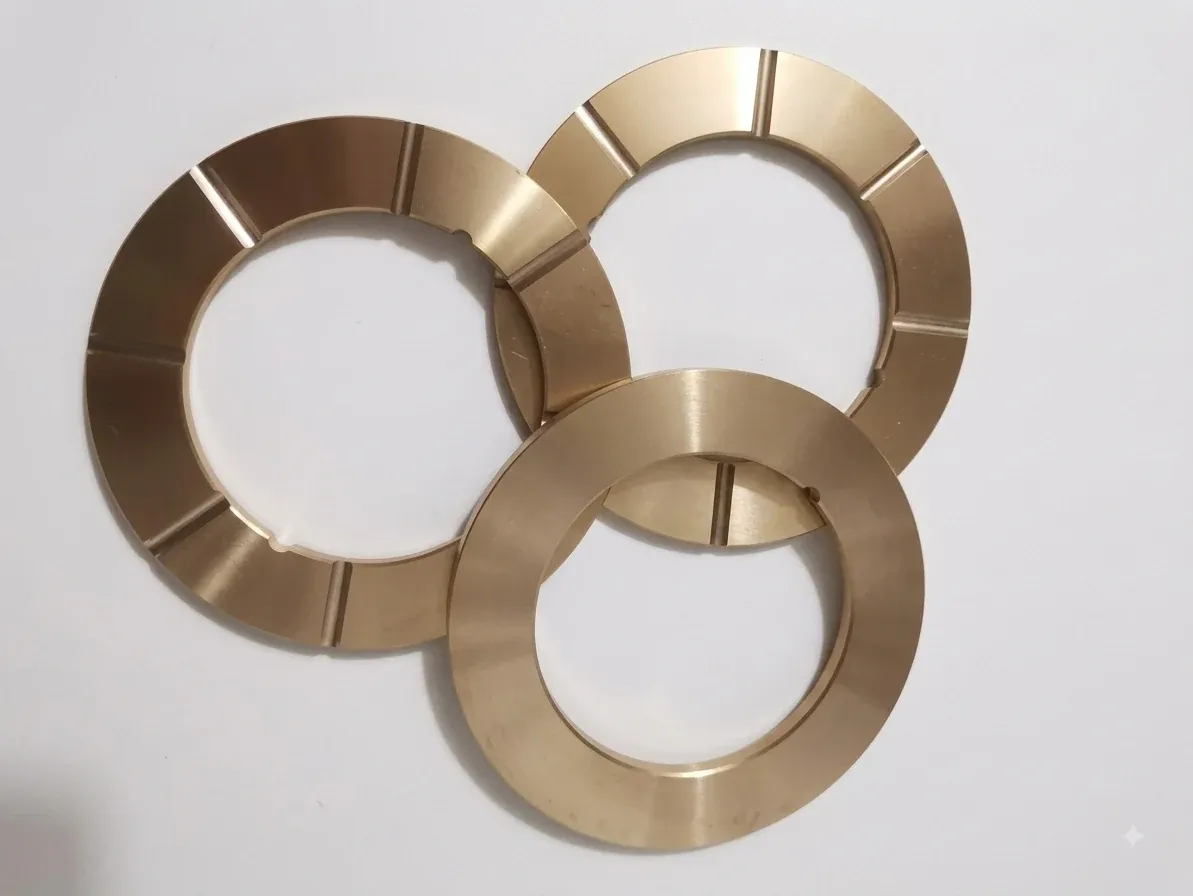
- Thrust washer: a separate ring of bronze, bimetal or PTFE composite placed between the collar and the housing.
What is a journal bearing?
The journal is the part of a shaft that runs inside a bearing. A journal bearing is therefore any bearing that surrounds that section of shaft and carries the load acting across the axis: the weight of a rotor, the belt pull on a pulley, the pin reaction in a linkage. In its simplest plain form it is a sleeve bushing: a cylinder of bronze, bimetal, PTFE composite or hardened steel pressed into the housing, with a running clearance to the shaft and, usually, a lubricant film between them.
Plain journal bearings are rated by specific load, the radial force divided by the projected area of the bore (diameter × length), and by sliding speed. Greased C93200 bronze is rated 45 N/mm² static and 25 N/mm² moving at up to 0.5 m/s; a PTFE composite bushing 250 N/mm² static but only at slow speed dry; a JBM-ST hardened steel bushing 250 N/mm² at 0.1 m/s. A rolling-element journal bearing does the same job with balls or rollers between rings and is rated by dynamic load and life instead.
What is a thrust bearing?
A thrust bearing carries the load that tries to push the shaft along its own axis: the reaction of a helical gear, the pressure on a pump impeller, the weight of a vertical shaft, the side load on a pivot pin from a crooked linkage. It presents a flat face at right angles to the axis, and the shaft bears on it through a collar, a shoulder or the end of the shaft.
The plain form is a thrust washer: a flat ring of bronze, steel-backed bimetal, PTFE composite or graphite-plugged bronze, often with radial grooves so that lubricant can cross the face and the load is carried on separate pads. Its rating is the axial force divided by the annular area of the pads. Because the sliding speed varies from the inside to the outside of the ring and there is no wedge to build a hydrodynamic film on a plain flat face, thrust washers carry lower specific loads than the same material in a sleeve, and they fail first when the load is not evenly distributed. Rolling thrust bearings (ball and cylindrical roller thrust bearings) and tilting-pad hydrodynamic thrust bearings are the alternatives for high speed.
Journal bearing vs thrust bearing: the differences
The table sets the two side by side in their plain-bearing form, which is what most bushing enquiries concern.
| Journal (radial) bearing | Thrust (axial) bearing | |
|---|---|---|
| Load direction | Perpendicular to the shaft axis | Along the shaft axis |
| Geometry | Cylindrical bore around the journal | Flat annular face against a collar or shoulder |
| Plain-bearing form | Sleeve bushing, half bearing | Thrust washer, bushing flange, thrust plate |
| Rolling form | Deep-groove ball, cylindrical roller, needle bearing | Thrust ball, cylindrical or tapered roller thrust bearing |
| Rating basis | Projected area d × L | Annular pad area |
| Lubricant film | Hydrodynamic wedge forms readily in the clearance | Needs grooves or pads; film forms less easily |
| Typical failure | Bore wears oval, scoring, seizure | Face wear, uneven wear from tilt, loss of grooves |
| Bushing MFG products | Bronze, bimetal, PTFE, POM, steel sleeve bushings | Thrust washers in bronze, bimetal, PTFE and POM; flanged bushings |
Most joints need both
A pivot pin in a loader arm is a journal bearing until the arm is pushed sideways; then the end of the bushing becomes a thrust face. A pump shaft carries its own weight radially and the hydraulic thrust of the impeller axially. Gearbox shafts with helical gears see both continuously. Designs deal with this in three ways.
- Flanged bushing. A sleeve with an integral flange at one end. The sleeve carries the radial load; the flange carries light or occasional axial load and locates the bushing in the housing. Available in bronze, bimetal, PTFE and POM composite. The flange is a thrust face of limited area; do not rate it like a thrust washer.
- Sleeve bushing plus thrust washer. Two parts, each sized for its own load. The washer can be a different material from the sleeve, is easy to replace, and can be grooved for lubrication. The standard solution for heavier or continuous axial load.
- Separate thrust bearing. For high axial load at speed, a rolling thrust bearing or a hydrodynamic pad bearing takes the axial load and the journal bearing is left with the radial load only.
On the enquiry, state the radial and the axial load separately. One number labelled “load” cannot be sized.
Selecting a plain thrust bearing
Because a flat face is a less forgiving bearing than a bore, four details decide whether a thrust washer lasts.
- Face load: axial force divided by the pad area, compared with the material limit for a thrust face, which is lower than the sleeve limit of the same material.
- Flatness and perpendicularity of the mating collar and housing face; a tilt of a few hundredths concentrates the whole load on one edge.
- Lubrication path: radial grooves or pockets that let lubricant cross the face; a washer without grooves under continuous rotation runs dry in the middle.
- Retention: a washer must be located by a pin, a tab or a recess so that it does not spin against the housing and wear the wrong face.
Frequently asked questions
Is a journal bearing the same as a bushing?
A sleeve bushing is the plain form of a journal bearing. “Journal bearing” names the function (carrying radial load around a shaft journal); “bushing” names the part. Rolling-element radial bearings are also journal bearings in the functional sense.
Can a journal bearing take axial load?
A plain sleeve cannot; its end face is too small and is not designed as a bearing surface. Add a flange (flanged bushing) for light axial load or a thrust washer for anything more. Some rolling bearings, such as deep-groove ball bearings, take moderate axial load by design.
What is a thrust washer?
A flat ring of bearing material, typically bronze, steel-backed bimetal or PTFE composite, placed between a rotating collar and a stationary face to carry axial load. It is the plain-bearing form of a thrust bearing.
Why are thrust bearings rated lower than journal bearings in the same material?
A flat face has no converging clearance to build a hydrodynamic oil wedge, the sliding speed varies across the face, and any tilt loads one edge. The material is the same; the geometry is less favourable.
Which bearing carries the load in a vertical pump?
The thrust bearing carries the weight of the shaft and impeller plus the hydraulic thrust; the journal bearings only guide the shaft and take unbalance and hydraulic radial forces.
Send the drawing. We answer within 12 hours.
Dimensions, material or just the application: our engineers reply with a material proposal and a quotation. Free samples of standard and custom parts, no minimum order.