
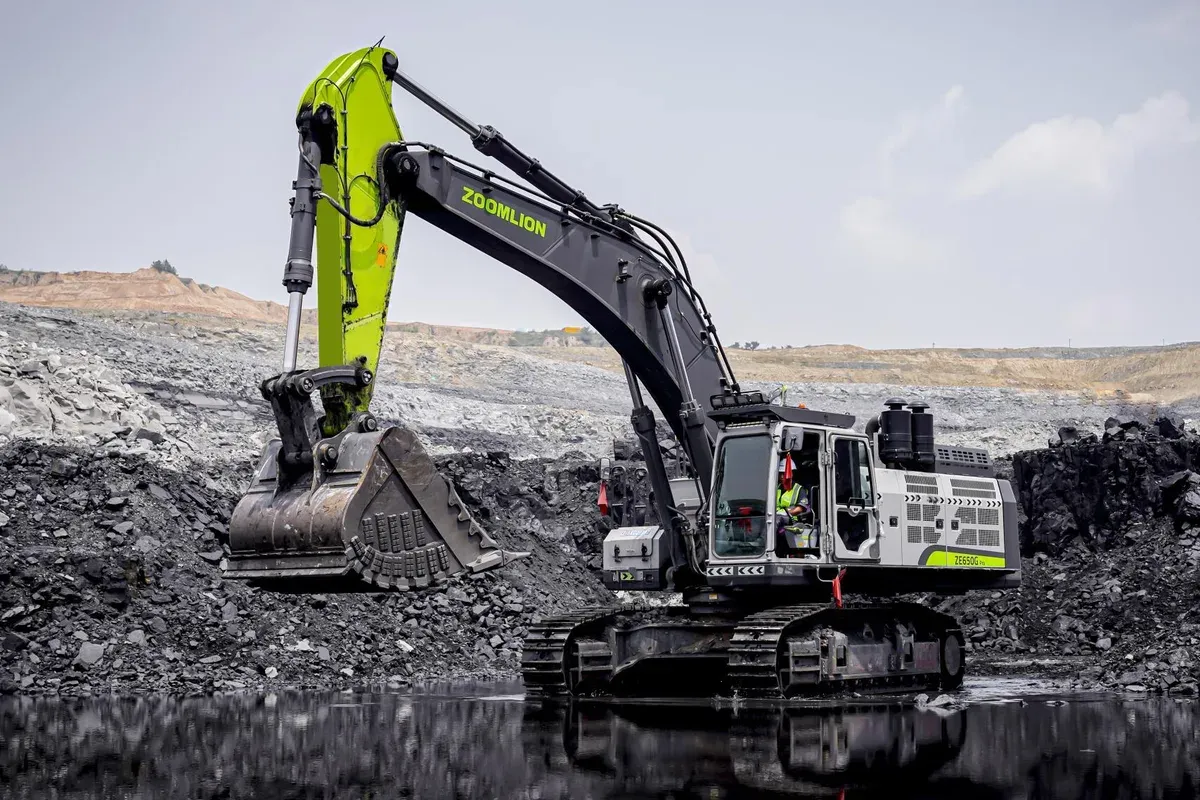
Excavator bushings
An excavator has a dozen greased pin joints between the boom foot and the bucket teeth, all slow, all heavily loaded, all in dirt. The bushings in them are consumables, and the right material at each position decides how often the machine is in the workshop.
- 250 N/mm²Hardened steel at 0.1 m/s
- HRC 58–62JBM-ST bore hardness
- 150 N/mm²Bimetal JBM-800, dynamic
- 0.1–0.3 mmTypical running clearance
Excavator pin joints run at very low speed under high, shock-loaded, abrasive conditions with periodic greasing. Hardened steel bushings (JBM-ST, HRC 58–62, 250 N/mm²) are the standard for boom, arm and bucket pins; bimetal bushings suit the higher-frequency, better-lubricated positions; graphite-plugged bronze suits joints that cannot be greased.
- Boom foot, boom–arm, arm–bucket and link pins: hardened steel sleeves with oil grooves, greased through the pin or the housing
- Cylinder rod-eye and clevis pins: hardened steel or bimetal, depending on load and greasing interval
- Specific loads up to 250 N/mm² at 0.1 m/s on steel; 150 N/mm² dynamic on bimetal JBM-800
- Pin: hardened, chrome-plated or induction-hardened steel ≥ 50 HRC, Ra ≤ 0.8 µm; bushing and pin are a matched pair
- Replacement bushings are matched to the OE part from measured dimensions; wear on the old bushing is not the size
Bushings for excavator pins
Three materials cover the machine: hardened steel on the digging joints, bimetal on cylinder eyes and lighter pivots, graphite-plugged bronze where nobody greases.
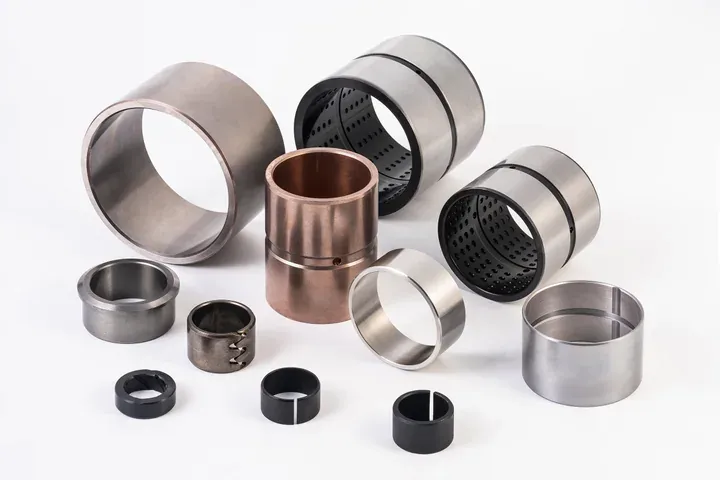
Hardened steel bushings
HRC 58–62, 250 N/mm²: boom, arm, bucket and link pins with oil grooves and grease holes.
JBM-ST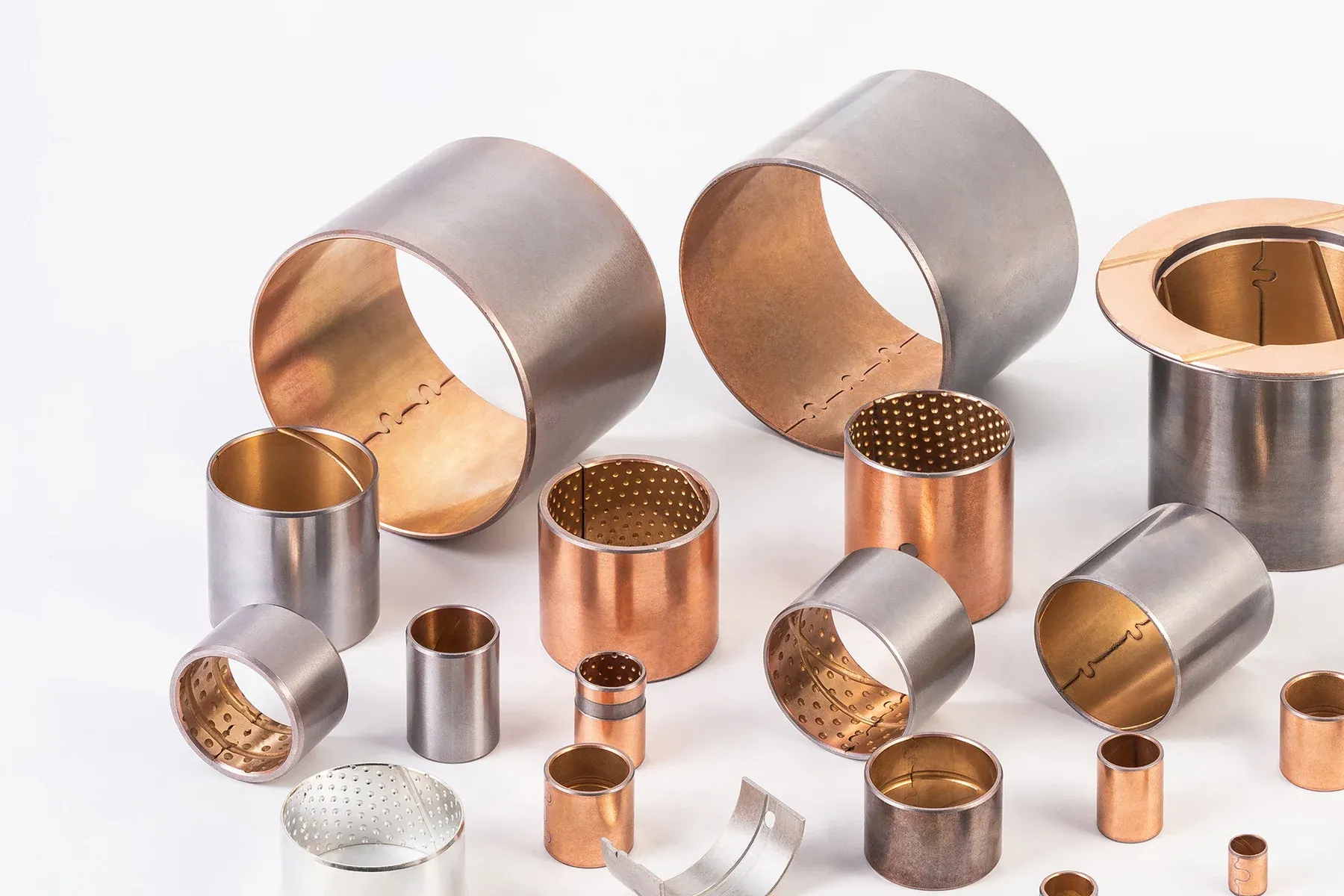
Bimetal bushings
Steel back, CuPb10Sn10 lining: cylinder rod eyes, clevises and well-greased pivots.
JBM-800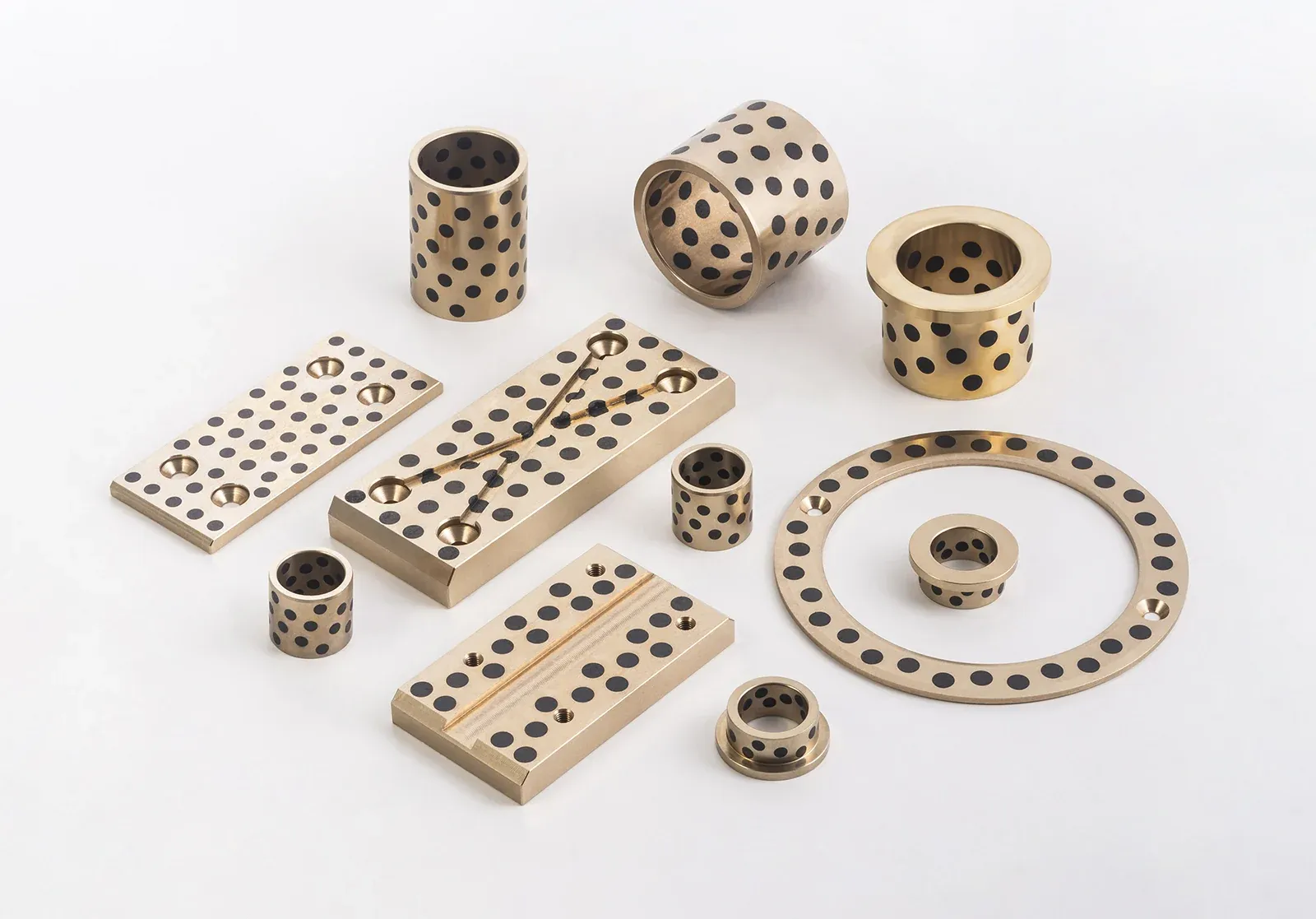
Graphite bronze bushings
Solid-lubricant plugs for blade, coupler and hinge pivots that are never greased.
JBM-650
The joints and what they see
From the machine outward the loads rise and the lubrication gets worse. The boom foot pins carry the whole front end but move through a small arc a few times a minute; they are large, well greased and last. The boom–arm and arm–bucket pins see the digging forces directly, with shock when the bucket hits rock. The bucket link and H-link pins are the smallest, fastest and dirtiest joints on the machine and wear first. Cylinder rod-eye and clevis pins take the full cylinder force and oscillate every cycle.
| Joint | Motion | Load | Lubrication | Usual bushing |
|---|---|---|---|---|
| Boom foot | Small arc, slow | Very high, steady | Greased, good | Hardened steel |
| Boom–arm | Oscillating | High, shock | Greased | Hardened steel |
| Arm–bucket | Oscillating | High, shock | Greased, dirty | Hardened steel |
| Bucket links / H-link | Oscillating, frequent | High, shock | Greased, very dirty | Hardened steel |
| Cylinder rod eye / clevis | Oscillating every cycle | Full cylinder force | Greased | Hardened steel or bimetal |
| Blade, dozer and attachment pivots | Slow, occasional | High | Rarely greased | Graphite-plugged bronze or steel |
Which material where
Hardened steel bushings (JBM-ST) are the default on the digging joints. Heat treated to HRC 58–62 in Grade 45, 40Cr, 20CrMo or GCr15, they carry up to 250 N/mm² at 0.1 m/s and withstand shock and embedded grit better than any bronze; they need grease, fed through radial holes and spread by machined grooves. Working temperature −100 to +350 °C.
Bimetal bushings (JBM-800, steel back with CuPb10Sn10 lining) suit positions with more motion and reliable greasing: 150 N/mm² dynamic load, 3.5 m/s greased, and a lining that conforms to the pin and tolerates brief lubricant starvation. They are lighter and cheaper than solid steel and are common on cylinder eyes and smaller pivots.
Graphite-plugged bronze (650 series, 50–100 N/mm² at ≤ 0.5 m/s) is for pivots that nobody greases: blade tilt, attachment couplers, cab and hood hinges. Cast bronze (C93200) is rarely used on the digging joints because it cannot take the specific load, but it serves on slew-ring and undercarriage positions with good lubrication.
Pin and bushing are a pair
A hardened steel bushing on a soft pin destroys the pin; a hardened pin in a soft bushing destroys the bushing. The pin is normally alloy steel, induction hardened or hard-chrome plated to 50 HRC or more, ground to Ra 0.8 µm or better, with the grease passage drilled through it or through the housing. Specify the pin material and hardness with the bushing enquiry; the bushing bore hardness and clearance are chosen against it.
Running clearance on excavator pins is larger than on machine tools, typically 0.1–0.3 mm depending on diameter, so that grease reaches the loaded arc and dirt has somewhere to go. Too tight a fit seizes when the boom heats in the sun; too loose hammers the housing.
Grease grooves and holes
Grease enters through a nipple on the housing or through the hollow pin, reaches the bushing through one or more radial holes, and is spread across the bore by grooves: straight, spiral or figure-eight. The hole must line up with the housing feed at assembly and sit away from the most heavily loaded arc; the grooves must stop short of the end faces so grease is not pumped out. Seals or dust lips at each end keep grit out and grease in.
Send the pin-and-housing drawing and the position of the grease feed; we lay out the hole and groove pattern for the quoted part.
Specifying a replacement bushing
Measure the housing bore, not the worn bushing: the bushing outside diameter is set from the housing for a press fit. Measure the pin diameter on an unworn section and state the wear allowance you want. Give the bushing length, chamfers, groove pattern and hole position, with the OE number if you have it. We quote from your drawing or your measured dimensions (measuring used parts is not a service we offer) and against OE and aftermarket part numbers after comparing dimensions and material; interchangeability is confirmed part by part.
Housing bore and pin diameter
Measured on unworn surfaces; state the machine model and the joint.
Length and features
Length, chamfers, oil holes, grooves, flange if any.
Material
Hardened steel, bimetal or graphite bronze; or state the joint and let us propose.
Quantity
Sets per machine, fleet size, annual volume. Samples are free.
Frequently asked questions
What are excavator bushings made of?
Mostly hardened steel (HRC 58–62) on the digging joints, bimetal steel-bronze on cylinder eyes and lighter pivots, and graphite-plugged bronze on joints that are never greased. Solid cast bronze is limited to well-lubricated, lower-load positions.
How often should excavator pins be greased?
Follow the machine manual: typically every shift on bucket and link pins, daily or weekly on boom pins. Grease until clean grease shows at the seals; the interval, not the bushing, is what usually fails.
Why do bucket link bushings wear fastest?
They are the smallest joints carrying the digging force, they move most, and they sit in the dirt. Hardened steel bushings, a hardened pin, seals and frequent greasing are the countermeasures.
Can you supply bushings for a specific excavator model?
Yes, from the OE part number or measured dimensions. We compare dimensions and material and confirm interchangeability for each part before quoting.
Do you make the pins as well?
Bushing MFG manufactures the bushings. Pin material and hardness are specified with us so that the pair is matched, and we can advise on the pin specification.
Send the joint, not just the part.
Pin diameter, load, motion, lubrication and environment: our engineers reply within 12 hours with a material, a size and a quotation. Free samples, no minimum order.