
Sleeve bearing vs ball bearing in fans and small motors
The question usually comes from a fan or small-motor datasheet: which bearing to specify, or why the one in service has started to tick. This note compares the two in small rotating machines, where they really compete.
In fans and small motors a sleeve bearing is quieter and cheaper, and a ball bearing lasts longer once the motor runs hot, runs continuously or is mounted with its shaft vertical. The sleeve is oil-impregnated sintered bronze that floats the shaft on an oil film; the ball bearing rolls it on hardened steel balls.
- Friction: about 0.01–0.05 for a sintered sleeve on its oil film, 0.001–0.005 for a ball bearing.
- Heat: standard-oil sintered sleeves are rated −10 to +90 °C; -H and -L oils move the window.
- Life: fan catalogues commonly quote around 30,000–40,000 hours for sleeve bearings and 50,000 hours or more for ball bearings at a moderate temperature.
- Mounting: a sleeve bearing wants its shaft horizontal; a preloaded ball bearing runs in any position.
- Cost: one pressed, oil-filled part against two rings, a ball set, a cage, shields and a preload spring.
What is inside a sleeve-bearing and a ball-bearing motor?
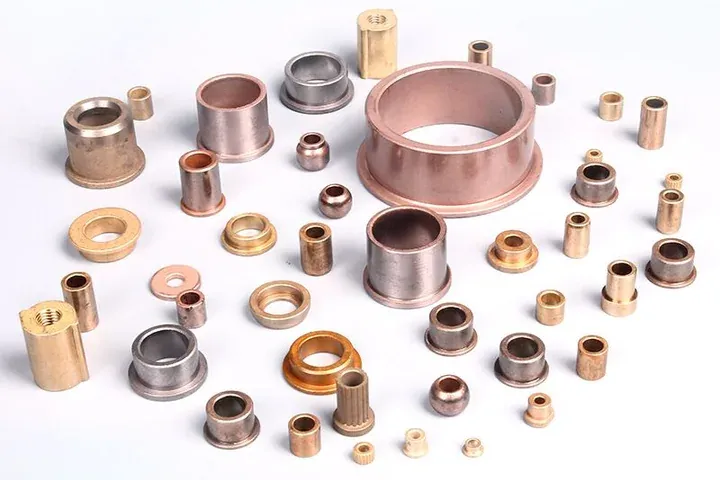
A sleeve-bearing fan or motor runs its shaft in one or two short sleeves of sintered bronze, pressed from powder and left porous so that 18–25 % of the volume is oil. As the shaft turns, the oil warms, seeps out and builds a film that floats the shaft; when the motor cools, most of it is drawn back into the pores. Some designs add an oil-soaked felt ring as a reserve. Small motors often use a spherical sleeve clamped in a stamped end shield, so that it lines up with the shaft when the two shields are slightly out of line.
A ball-bearing motor uses two small deep-groove ball bearings with sealed-in grease, pushed apart by a spring washer that takes up their internal clearance. That preload is why a ball-bearing fan behaves the same in any position; the sealed grease is why nothing can be added later.
Sleeve vs ball bearing compared in fans and small motors
The rows are what a fan or motor user notices. Life figures are typical catalogue values for complete fans, not ratings of our parts.
| Sleeve bearing (sintered bronze) | Ball bearing | |
|---|---|---|
| Friction coefficient | ≈ 0.01–0.05 on a full film; higher at start-up | ≈ 0.001–0.005 |
| Noise when new | The quieter of the two at low speed | A faint rolling hum |
| Noise when worn | Ticking or rattling, then a dragging grind | A growl or rumble from worn raceways |
| Typical rated life, moderate temperature | Around 30,000–40,000 h | 50,000 h and more |
| Heat | Set by the oil: −10 to +90 °C on standard oil (JBM-700) | Set by the grease, which tolerates more heat |
| Speed | To about 6 m/s sliding speed at light load | Higher speed with little lubricant |
| Load | ≈ 14 N/mm² continuous on the projected area | Set by the dynamic load rating of the size |
| Mounting position | Shaft horizontal; less life with the shaft vertical | Any position |
| Shock in transit | No raceway to dent | A drop can dent the raceways |
| Dust | Soaks into the oil at the shaft exit and turns to sludge | Shields keep most of it out |
| Parts and cost | One pressed, oil-filled sleeve or sphere; the cheaper part in volume | Rings, balls, cage, shields and a preload spring; costs more |
Friction ranges as on our bushing vs bearing comparison. The sintered load, speed and temperature limits are the published typical values for JBM-700 with standard mineral oil.
Which lasts longer, a sleeve bearing or a ball bearing?
In a fan or small motor, a sleeve bearing lives as long as its oil. The bronze does not fatigue; it wears only once the film has thinned. Oil leaves by evaporating, by oxidising to varnish and by creeping along the shaft into dust, and all three speed up in a hot motor: for mineral oils the rule of thumb is that the oxidation rate doubles with every 10 °C rise. A ball bearing usually ends its life when its grease is spent, but grease survives heat better than the small oil charge of a sleeve.
One fan maker’s published life tests show the pattern: at low ambient temperature both types lasted about equally long; between 25 and 60 °C the ball-bearing fans lasted about half as long again; above 70 °C only the ball-bearing fans kept running.
In slow, heavily loaded joints the verdict reverses. A loader-arm pin oscillates under shock and grit, which dents raceways and defeats seals, and a bushing outlives any ball bearing that fits the same space; see bushing vs bearing.
Does mounting position matter for a sleeve bearing?
Yes. With the shaft horizontal, the rotor weight presses the shaft onto the lower side of the sleeve, where the oil film builds and holds it steady. With the shaft vertical, as in a fan lying flat, the weight sits on the thrust face, the shaft runs almost unloaded in its clearance and can orbit, and gravity draws oil out of the upper sleeve. Fan makers therefore quote sleeve-bearing life for a horizontal shaft and expect less in other positions; a preloaded ball bearing does not care.
Temperature is the other half. Below the oil window the oil thickens and the motor struggles to start; above it the oil thins, evaporates and is finally driven out of the pores. For JBM-700 sleeves a high-temperature oil (-H) or low-temperature oil (-L) moves the window, and an oil for food machinery (-FG) is available, but no oil makes a sleeve right for a motor that sits near its upper limit for years.
Why sleeve-bearing fans and motors fail
They fail in a fixed order, and most stages can be heard.
- Oil loss: evaporation, oxidation and creep deplete the charge, and dust drawn in at the shaft exit turns the rest into sludge.
- Rising friction: the motor slows, draws more current and runs warmer, which speeds up the oil loss.
- Wear: the clearance opens, the shaft orbits and the fan ticks or rattles; blade tips may start to rub.
- Starting trouble: after a cold night or a long stop, thick, depleted oil holds the shaft and the fan stalls or needs a push.
- Seizure: the dry shaft galls the bronze and the motor stops; without thermal protection the winding can overheat.
A ball-bearing fan fails differently: worn or dented raceways growl, often for months, while it keeps turning. A drop of light oil buys a ticking sleeve some time but does not refill the pores, and solvent sprays wash out what oil is left.
When to specify a sleeve bearing, and when a ball bearing
Check the duty against the sleeve’s limits first. Typical limits for oil-impregnated sintered bronze are about 14 N/mm² continuous load, 6 m/s at light load and a PV of about 1.8 N/mm²·m/s. A Ø8 mm shaft in a 10 mm long sleeve at 3,000 rpm slides at 1.26 m/s; with 30 N of radial load the pressure is 0.375 N/mm² and the PV about 0.47, a quarter of the limit. The same shaft reaches 6 m/s only at about 14,300 rpm, so small motors fail on heat, position and oil, seldom on load. The plain bearing PV calculator runs the check for any size.
We make the sleeve side of this choice, not ball bearings: sintered bronze sleeves, flanged bearings and spheres with standard, -H, -L or -FG oil, pressed and sized to drawing for unhardened shafts finished to Ra ≤ 0.8 µm. Where each belongs:
- Sleeve bearing: a horizontal shaft, a motor well inside the oil window, a product judged on price or noise, a design life inside the oil life. Appliances, office machines, extractor fans, wiper, window and seat motors.
- Ball bearing: a vertical or changing shaft position, a hot enclosure, years of continuous running, a battery drive that needs the lowest starting torque.
- Neither: slow, heavy, oscillating shafts, which want a greased bronze or a dry-running composite bushing.
Frequently asked questions
Which is better, a sleeve bearing or a ball bearing fan?
The sleeve bearing for a cool, horizontally mounted fan that must be cheap and quiet. The ball bearing for a hot enclosure, a vertical shaft or years of continuous running; fan catalogues commonly rate it at 50,000 hours or more against around 30,000–40,000 for a sleeve.
Sleeve or ball bearing for a PC case fan or a graphics card?
A case fan on the front or rear panel runs with its shaft horizontal, which suits a sleeve bearing while the case stays cool. In most tower cases a graphics card lies flat and its fans face down, so their shafts are vertical and they run in warm air: two conditions that favour a ball bearing.
Do sleeve bearings last as long as ball bearings?
In a cool motor with the shaft horizontal they can come close. As the temperature rises the sleeve’s oil evaporates and oxidises faster and the ball bearing pulls ahead; in published fan tests above 70 °C only the ball-bearing fans kept running.
Is a sleeve bearing the same as a bushing?
Yes: a plain bearing, also called a journal bearing, in which the shaft slides rather than rolls. In fans and small motors it is usually oil-impregnated sintered bronze; in machinery it may be cast bronze, bimetal or PTFE composite.
What is the difference between a plain bearing and a ball bearing?
A plain bearing slides the shaft on a film of oil, grease or polymer; a ball bearing rolls it on balls between two rings. The plain bearing carries more load in less space and takes shock; the ball bearing has roughly a tenth of the friction and runs faster.
Why is my sleeve-bearing fan getting louder?
Its oil is running out. The clearance wears open, the shaft begins to orbit and the fan ticks or rattles; a grinding drag and slow starts follow. A drop of oil buys time, but the bearing is near the end of its life.
Building a fan or motor around a sleeve bearing?
Send the shaft diameter, speed, load and motor temperature. We propose the JBM-700 sleeve or sphere and the oil, and quote within 12 hours; samples are free and there is no minimum order.