
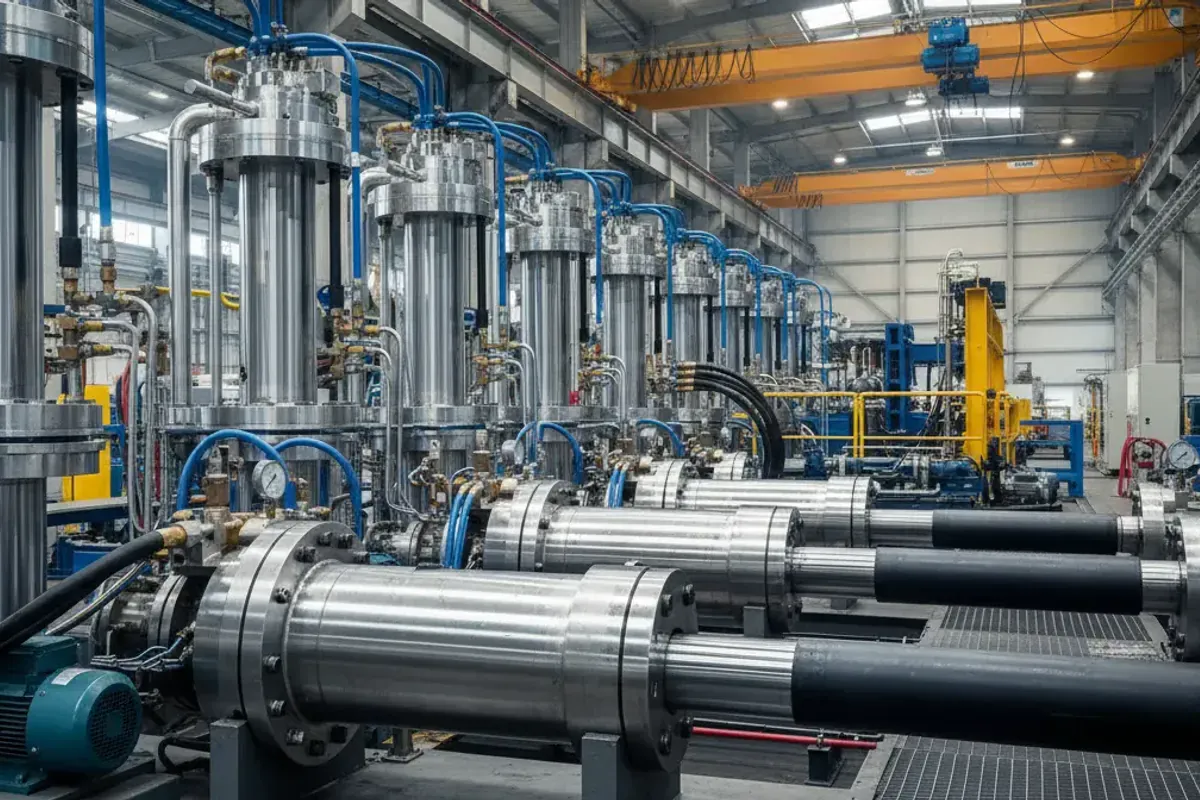
Hydraulic cylinder bushings
A hydraulic cylinder carries plain bearings at both ends and inside: the pin bushings in the rod eye and the clevis or trunnion that connect it to the machine, and the gland bearing and piston wear ring that guide the rod and piston in oil. The two groups have nothing in common except the cylinder.
- 150 N/mm²Bimetal rod-eye bushing, dynamic
- 250 N/mm²PTFE composite gland, static
- > 3 m/sGland bearing in oil
- 120 N/mm²Wrapped bronze, static
The pin bushings on a hydraulic cylinder oscillate under the full cylinder force, greased or dry, in the open; hardened steel, bimetal, wrapped bronze and graphite bronze are used according to load and greasing. The gland bearing and wear ring inside the cylinder run in hydraulic oil at rod speed; PTFE and POM composite bushings and bands are used there.
- Rod eye and clevis: hardened steel (heavy shock), bimetal JBM-800 (150 N/mm² dynamic), wrapped CuSn8 bronze (120 N/mm² static) or graphite bronze (no greasing)
- Trunnion mounts: cast or wrapped bronze, bimetal; flanged where axial location is needed
- Gland (rod) bearing: PTFE composite JBM-10 / JBM-1D running in oil, > 3 m/s lubricated, 250 N/mm² static
- Piston wear ring: PTFE composite or POM strip, guiding the piston without metal contact
- Spherical bearings are the alternative at the eye when misalignment exceeds what a plain bushing tolerates
Bushings for hydraulic cylinders
Pin bushings at the eyes and trunnions, composite bearings inside the barrel: four materials, chosen by load, greasing and what runs in the oil.
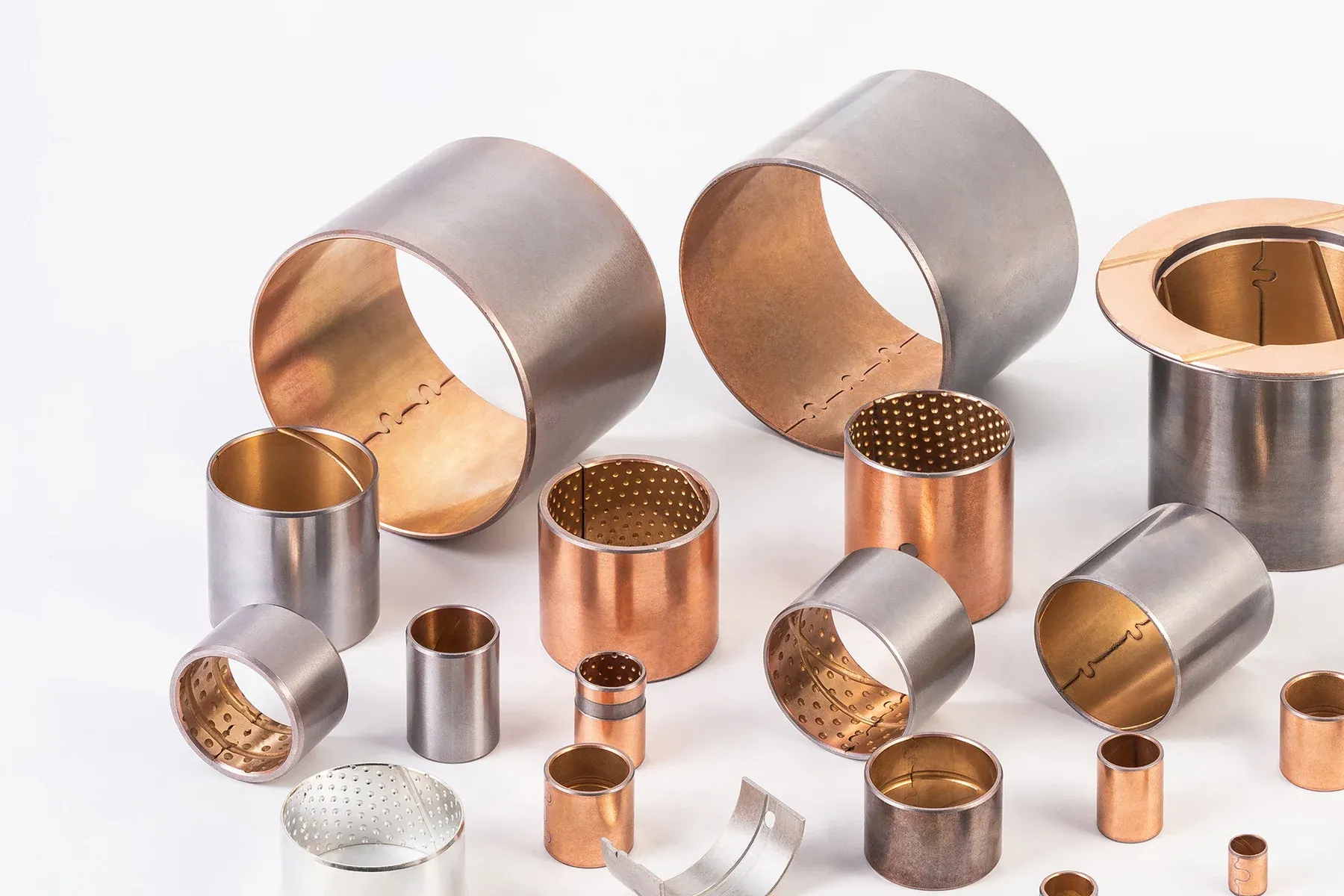
Bimetal bushings
Rod-eye and clevis bushings under full cylinder force with periodic greasing.
JBM-800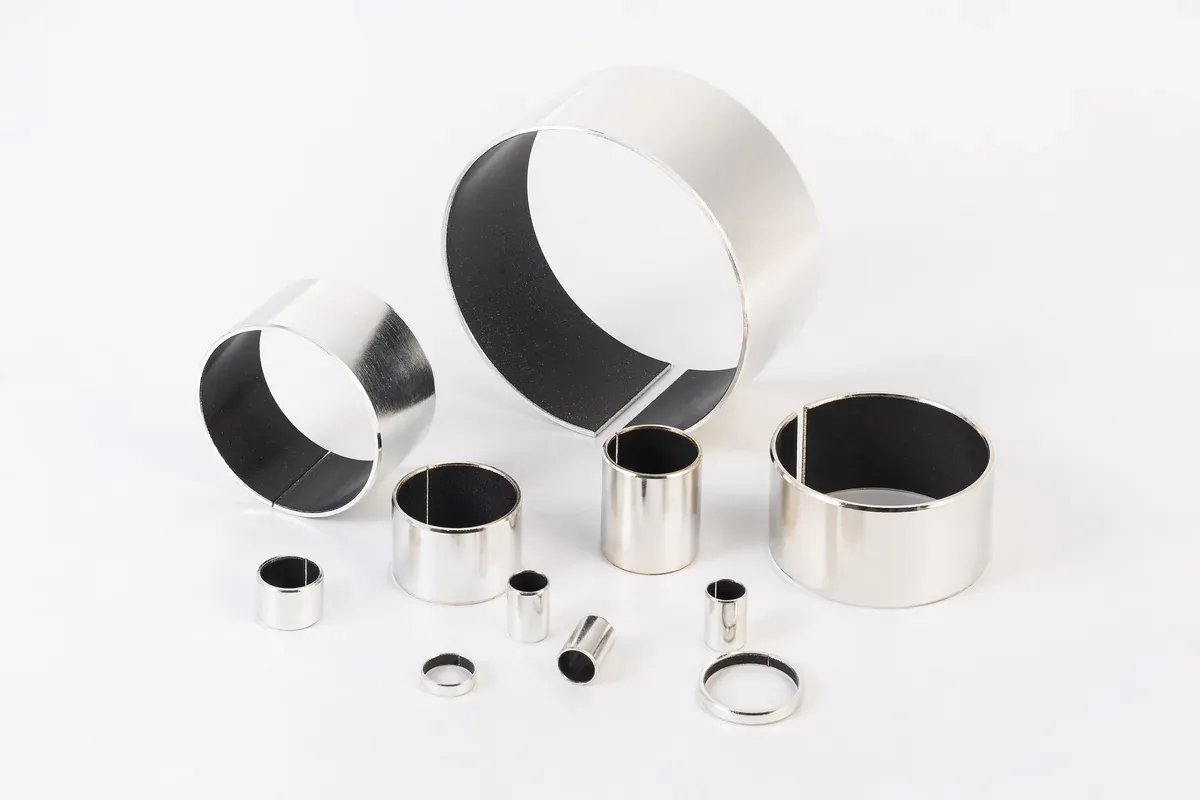
PTFE composite bushings
Gland bearings and piston wear rings running in hydraulic oil at rod speed.
JBM-10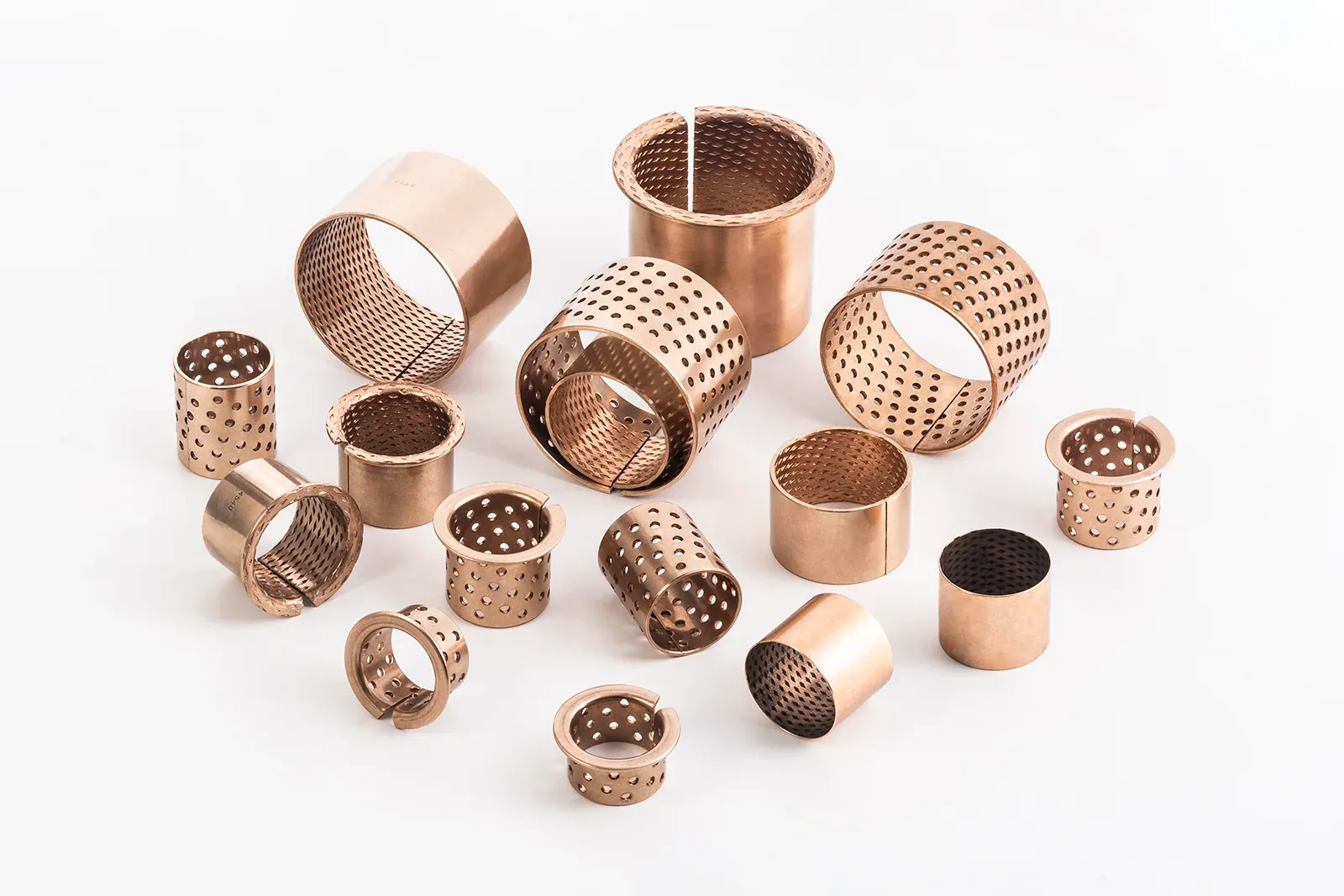
Wrapped bronze bushings
CuSn8 with grease pockets for trunnions and moderately loaded eyes.
JBM-090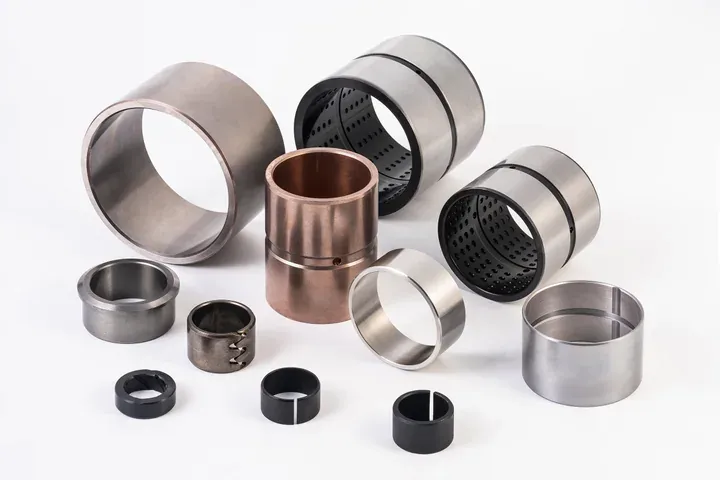
Hardened steel bushings
Eyes and clevises that see shock and dirt on construction and mining cylinders.
JBM-ST
Rod-eye, clevis and trunnion bushings
The eye at the rod end and the clevis or cap eye at the base end each hold a pin bushing. Both oscillate through a limited angle every stroke under the full cylinder force, which on mobile machinery gives specific loads from 30 to well over 100 N/mm², and both live outside: dust, water, sometimes no grease for months. Trunnion mounts on the barrel see the same force with less angular motion.
For heavy, shock-loaded cylinders on excavators and loaders the eye bushing is hardened steel, matched to a hardened pin and greased through the pin. For general mobile and industrial cylinders the bimetal bushing (steel back, CuPb10Sn10 lining) is the usual choice: 150 N/mm² dynamic, conformable, forgiving of brief starvation. Wrapped bronze bushings (CuSn8, 120 N/mm² static) are the economical option for medium loads with grease; graphite-plugged bronze is used where the joint will never be greased; PTFE composite where the load is moderate and maintenance-free operation is required.
| Position | Duty | Bushing | Rating |
|---|---|---|---|
| Rod eye, heavy shock | Oscillating, dirt, greased | Hardened steel JBM-ST | 250 N/mm², 0.1 m/s |
| Rod eye / clevis, general | Oscillating, greased | Bimetal JBM-800 | 150 N/mm² dynamic, 3.5 m/s greased |
| Rod eye / clevis, medium | Oscillating, greased | Wrapped bronze CuSn8 | 120 N/mm² static, 40 N/mm² dynamic |
| Clevis, never greased | Oscillating, dry | Graphite-plugged bronze 650 | 50 N/mm², 0.5 m/s dry |
| Eye, light, maintenance-free | Oscillating, dry | PTFE composite JBM-10 | 60 N/mm² oscillating, 250 static |
| Trunnion | Small arc, high load | Cast bronze C93200 or bimetal, flanged | 45 N/mm² static greased |
Gland bearing and piston wear ring
Inside the cylinder the rod is guided by a bearing in the gland (head) and the piston by a wear ring or guide band in the barrel. Both run in the hydraulic oil, both see the side load from the mounting misalignment and the weight of the rod rather than the cylinder force, and both move at rod speed, up to several metres per second. Their job is to keep the seals concentric and to prevent metal-to-metal contact between rod and gland or piston and barrel.
PTFE composite bushings (JBM-10 and the hydraulic-cylinder variant JBM-1D) are used as gland bearings: the oil lubricates and cools them, the speed limit rises above 3 m/s, and the steel back gives a precise press fit in the gland. POM composite and PTFE strip cut to length serve as piston wear rings. Neither must contaminate the oil, so the running layers are chosen for the fluid: mineral oil, water-glycol, HFC or bio-oils.
Fits, clearance and misalignment
Pin bushings are pressed into the eye (H7 bore) and run on a pin of e7 or e8 tolerance; the running clearance is generous, 0.1–0.3 mm on typical mobile-machinery pins, so that grease reaches the loaded arc. Where the cylinder is mounted between structures that flex, the angular misalignment can exceed what a plain bushing tolerates (roughly 0.5° on a full-length sleeve) and a spherical plain bearing is used at the eye instead; a shorter bushing or a crowned pin are the intermediate options.
Gland bearings are sized for the rod diameter with a small clearance and the bore is finished after pressing only on solid bronze types; PTFE composite glands are finished to size before assembly. Seal grooves and the bearing must not share the same land.
What to put in the enquiry
For pin bushings: pin diameter and hardness, eye bore, length, cylinder force and greasing. For gland bearings and wear rings: rod or piston diameter, groove dimensions, speed, fluid and pressure. Or send the cylinder drawing and we identify the bearings.
Frequently asked questions
What bushings are used in hydraulic cylinders?
Pin bushings in the rod eye and clevis (hardened steel, bimetal, wrapped bronze or graphite bronze) and, inside, a gland bearing and piston wear ring in PTFE or POM composite running in the oil.
Bushing or spherical bearing at the rod eye?
A plain bushing when the mounting is stiff and aligned; a spherical bearing when the structure flexes or the pin is not parallel to the mating eye. Plain bushings carry more load per size and cost less.
Can a PTFE bushing run in hydraulic oil?
Yes. Oil lubrication raises the JBM-10 speed limit above 3 m/s and the load capacity is unchanged; JBM-1D is the cylinder-specific variant. Confirm the fluid type for the running layer.
What load does a cylinder eye bushing carry?
The full cylinder force divided by pin diameter × bushing length. Design to the dynamic rating of the material: 150 N/mm² bimetal, 120 N/mm² static wrapped bronze, 250 N/mm² hardened steel at 0.1 m/s.
Do you supply complete cylinder parts?
Bushing MFG supplies the plain bearings: pin bushings, gland bearings and wear rings. Seals, rods and barrels are not our products.
Send the joint, not just the part.
Pin diameter, load, motion, lubrication and environment: our engineers reply within 12 hours with a material, a size and a quotation. Free samples, no minimum order.