
Composite vs bronze vs bimetal bushings
The three main types of plain bushing differ in construction and lubrication route. Composite bushings use a polymer running layer on a steel back; bronze bushings use wrapped, sintered, cast or graphite-plugged bronze; bimetal bushings bond a bearing alloy to a steel back. Choose by lubrication, wall space, motion and exact part geometry.
Start with the lubricant source: dry running points to PTFE composite or graphite bronze; grease at assembly to POM composite or pocketed wrapped bronze; grease or oil in service to bimetal or cast bronze. Then compare wall space, motion, counterface and the geometry the drawing needs.
- Composite (JBM-10 PTFE, JBM-20 POM): thin steel-backed sleeves, 60 N/mm² moving, dry or greased at assembly
- Bronze: four mechanisms under one name: wrapped (40), cast (25 greased), sintered (14, oil-impregnated), graphite-plugged (50–100, dry)
- Bimetal (JBM-800 series): steel back with sintered bearing alloy, 150 N/mm², grease or oil in service
- Thin-wall press fit is available in all three; seams, installed bores and lubricant paths are not interchangeable
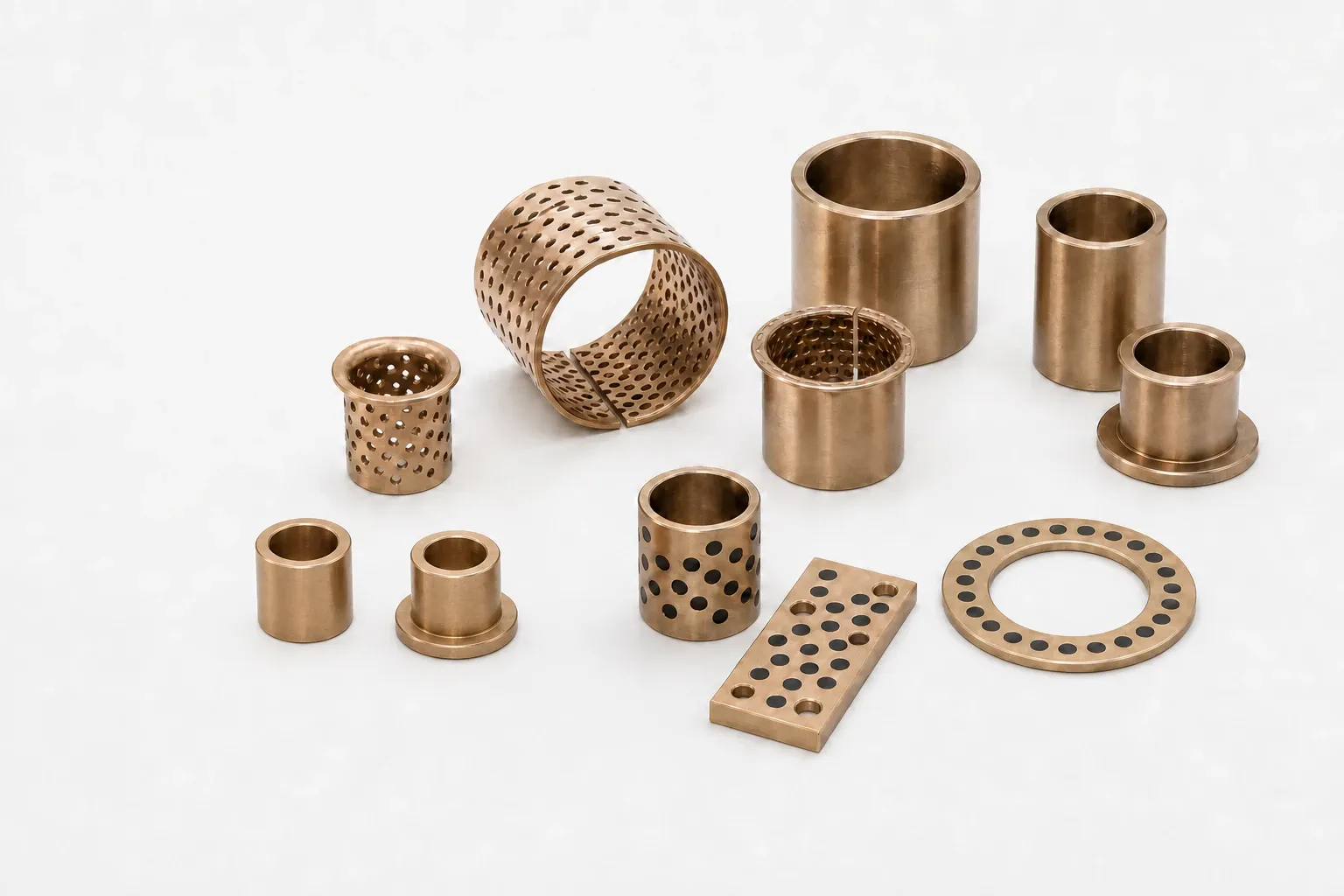
What is a composite bushing?
A composite bushing combines materials so the structural body and the sliding surface perform different jobs. Metal-backed PTFE composite (JBM-10) uses a polymer overlay for dry running; POM composite (JBM-20) uses a pocketed polymer layer with assembly grease; bronze-mesh PTFE (JBM-FR) uses a flexible wire carrier for reciprocating motion. The routes should not inherit one another's operating assumptions.
What is a bronze bushing?
A bronze bushing uses bronze as the bearing body or running material. Wrapped bronze (JBM-090 / 092) forms a thin split wall from CuSn8 strip; cast or solid bronze (JBM-600 series) is machined from dense stock; sintered bronze (JBM-700) retains oil in a porous body; graphite-plugged bronze (JBM-650) carries solid lubricant in a cast body. Those are four different bearing mechanisms under one broad name, with moving load ratings from 14 to 100 N/mm².
What is a bimetal bushing?
A bimetal bushing bonds a named bearing-alloy layer to a steel backing. The steel supports a thin sintered copper-alloy or aluminium-tin running layer; JBM-800 through JBM-850 use different bearing-layer alloys and lubrication conditions, so “bimetal” alone is not a complete specification. With CuPb10Sn10 (JBM-800) the bushing carries 150 N/mm² moving and runs to 3.5 m/s on grease or 8 m/s on oil.
How do composite, bronze and bimetal bushings compare?
Start with the lubricant source, then compare wall space, motion, counterface and required geometry.
| Selection factor | Composite | Bronze | Bimetal |
|---|---|---|---|
| Construction | Steel back, sintered bronze interlayer, PTFE or POM running layer | Wrapped strip, dense machined wall, porous sintered body or plugged cast metal | Steel back with a sintered copper-alloy or aluminium-tin layer |
| Lubrication route | PTFE runs dry; POM is greased at assembly | Wrapped and cast need external grease or oil; sintered retains oil; plugged uses solid lubricant | Grease or oil matched to the bearing-layer alloy |
| Load, moving | 60 N/mm² (140 for POM with oil) | 25 cast greased · 40 wrapped · 14 sintered · 50–100 graphite | 150 N/mm² (JBM-800) |
| Speed | 2–2.5 m/s | 0.5 cast greased · 2 wrapped · 6 sintered · 0.5 graphite dry | 3.5 m/s grease, 8 m/s oil |
| Temperature | −195 to +280 °C PTFE; −40 to +130 °C POM | −40 to +250 °C cast; −100 to +200 wrapped; to 400 graphite in Al/Sn bronze | Set by the lubricant |
| Wall | 1–2.5 mm | 1–2.5 mm wrapped; any wall machined | 1–2.5 mm |
| Geometry | Thin sleeves, flanges, washers, strips | Thin wrapped forms; any machined shape; plugged plates and rings | Thin sleeves, flanges, half bearings, thrust plates |
| Shaft | Unhardened acceptable (PTFE) | Unhardened for cast; hardened for wrapped and graphite | Hardened, ≥ 53 HRC (≥ 45 for JBM-810) |
| Best reason to choose it | No lubrication or very low maintenance | A bronze body, a thick wall or machined lubricant features | Highest load per wall thickness with lubrication |
| Common mistake | Calling every composite bearing lubrication-free | Treating every bronze bushing as the same product | Specifying “bimetal” without naming the bearing-layer alloy |
Which bushing types need grease or oil?
The product name does not answer this by itself; lubrication follows the exact construction. PTFE composite can start dry: use it when routine grease is excluded and the shaft can support transfer-film formation. POM composite starts with grease: JBM-20 stores assembly grease in a pocketed running surface for oscillating and low-speed rotary duty. Wrapped and cast bronze need an external supply: grease or oil must reach the sliding surface through pockets, holes, grooves or an oil feed. Sintered bronze carries its own oil and graphite bronze its own solid lubricant. Bimetal needs a defined oil or grease plan; keep the lubricant condition with the selected bearing-layer alloy and do not transfer one model's values to another.
How do load, motion and contamination change the choice?
Construction only narrows the field; the complete duty decides whether the running surface can form and retain its lubricant film. Slow oscillation and dry duty: a PTFE composite route may fit when grease is unavailable, but shaft finish, edge loading and contamination still govern wear; above 60 N/mm² move to graphite bronze. Lubricated metal-on-metal duty: bronze or bimetal becomes the stronger starting route when oil or grease is dependable and the drawing calls for a named metal construction; name the alloy, define how lubricant reaches the interface, and check shock, reversal and misalignment. Dusty, abrasive sites favour dry-running surfaces (PTFE, graphite bronze) because grease holds grit in the contact.
Which construction fits a thin-wall housing?
Composite, wrapped bronze and bimetal can all use thin press-fit walls of 1–2.5 mm, but their seams, installed bores and lubrication routes are not interchangeable: check press fit and installed clearance, confirm the seam or joint, and use form-specific dimensions. Machined or drawing-specific design suits solid bronze and graphite-plugged bronze, which take thicker or specially machined geometry when the grade and lubricant layout are defined: name the material, control grooves, holes and locating features, and specify the finished clearance.
Can composite, bronze and bimetal bushings replace one another?
Not from nominal size or product name alone. A substitution can change the wall, joint, installed clearance, counterface and lubrication method. Match the complete geometry first: ID, OD, length, flange, wall, seam, grooves, holes and locating features. Then compare motion, load direction, lubricant access, contamination and temperature. Use the exact product data for the selected form: a cylindrical sleeve rating does not automatically apply to a flange or thrust face, and separate maximum values are not one simultaneous operating point.
Frequently asked questions
Which bushing material is best?
There is no universal winner. Start with lubrication, motion, geometry, counterface and environment, then compare the exact JBM model; the selection guide walks through the five filters.
Are all composite bushings self-lubricating?
No. PTFE composite runs dry, while JBM-20 POM composite requires grease at assembly. Other composite constructions use different mechanisms.
What is a bimetal bushing?
A steel-backed plain bearing with a sintered bearing layer such as CuPb10Sn10, CuSn10 or AlSn20Cu. The selected alloy and lubricant plan govern the route.
Can bronze replace a composite bushing?
Not by material name alone. Wall, fit, lubrication, counterface, temperature and geometry must all be rechecked; a greased bronze bushing in a joint designed for dry running fails on lubrication, not on load.
Which bushing type carries the highest load?
Bimetal at 150 N/mm² moving and hardened steel at 250 N/mm² (very low speed) carry the most; composites 60 (140 for oiled POM), graphite bronze 50–100, wrapped bronze 40, greased cast bronze 25. Compare the exact model and its lubrication condition; maxima are not simultaneous.
Not sure which type? Send the joint.
Dimensions, load, motion, lubrication, temperature and environment. We return the construction that fits, with alternatives. Samples are free in every material.