
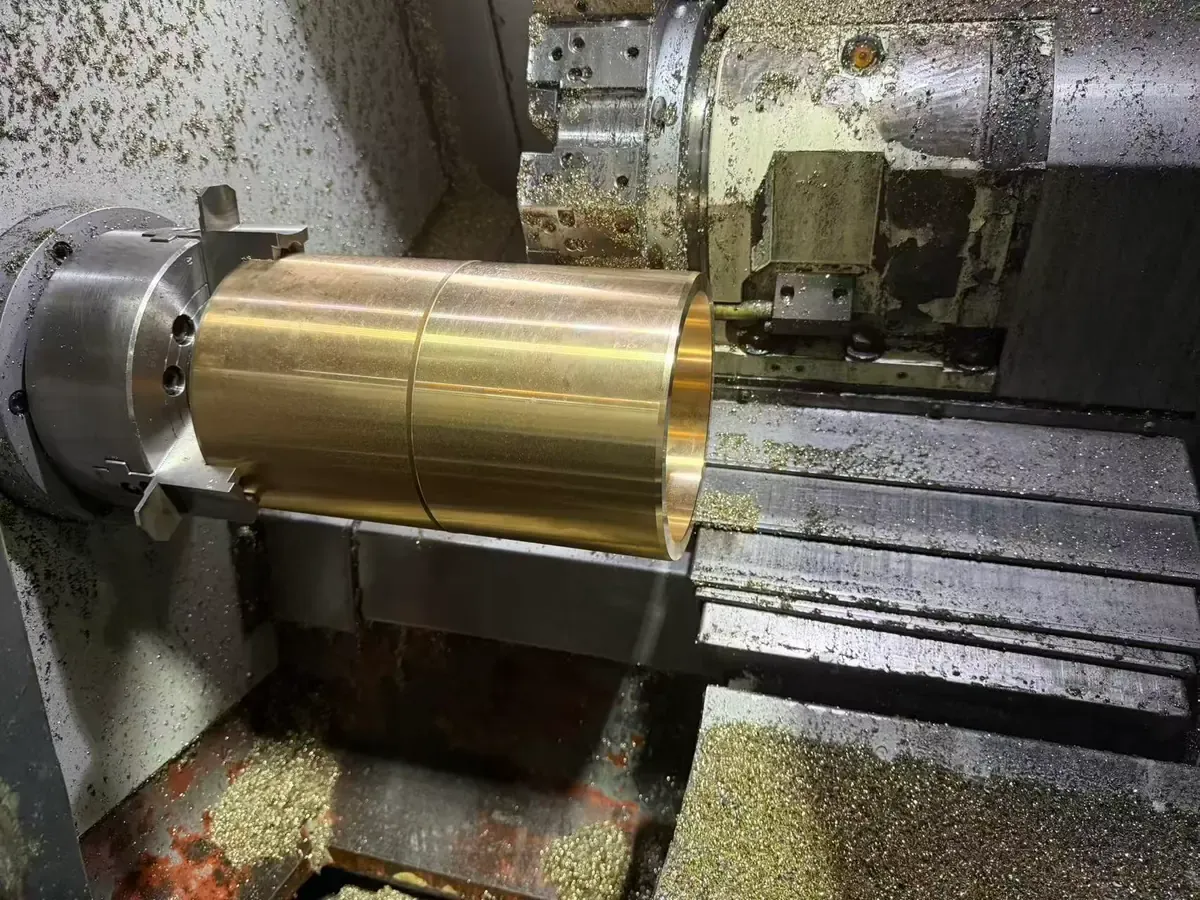
C93200 / SAE 660 bearing bronze
The general-purpose bearing bronze and the standard alloy of the JBM-600 machined bushing series. This page gives its designations, casting routes, composition, properties, bearing limits and the applications in which its 7 % lead content rules it out.
- 65–75 HBHardness
- 240 N/mm²Tensile strength, typical
- 45 / 25 N/mm²Static / moving load, greased
- −40…+250 °COperating temperature
C93200 is a cast leaded tin bronze with nominal 83 % copper, 7 % tin, 7 % lead and 3 % zinc. It is selected for machined bushings because it cuts cleanly, conforms to minor misalignment and tolerates short lubrication interruptions, but it requires external oil or grease.
- Cast high-leaded tin bronze; UNS C93200, SAE 660, CDA 932, 83-7-7-3
- 65–75 HB, 240 N/mm² tensile (typical), machinability rating 70
- As a greased bushing: 45 N/mm² static, 25 N/mm² moving, 0.5 m/s; −40 to +250 °C
- External oil or grease required; the lead gives an emergency margin, not dry running
- Bushing MFG series JBM-600; continuous cast to ASTM B505 or centrifugal to ASTM B271
Bushings machined from C93200
The JBM-600 series is C93200 unless the drawing says otherwise: sleeves and flanged bushings to ISO 4379, thrust washers, and any geometry to drawing.
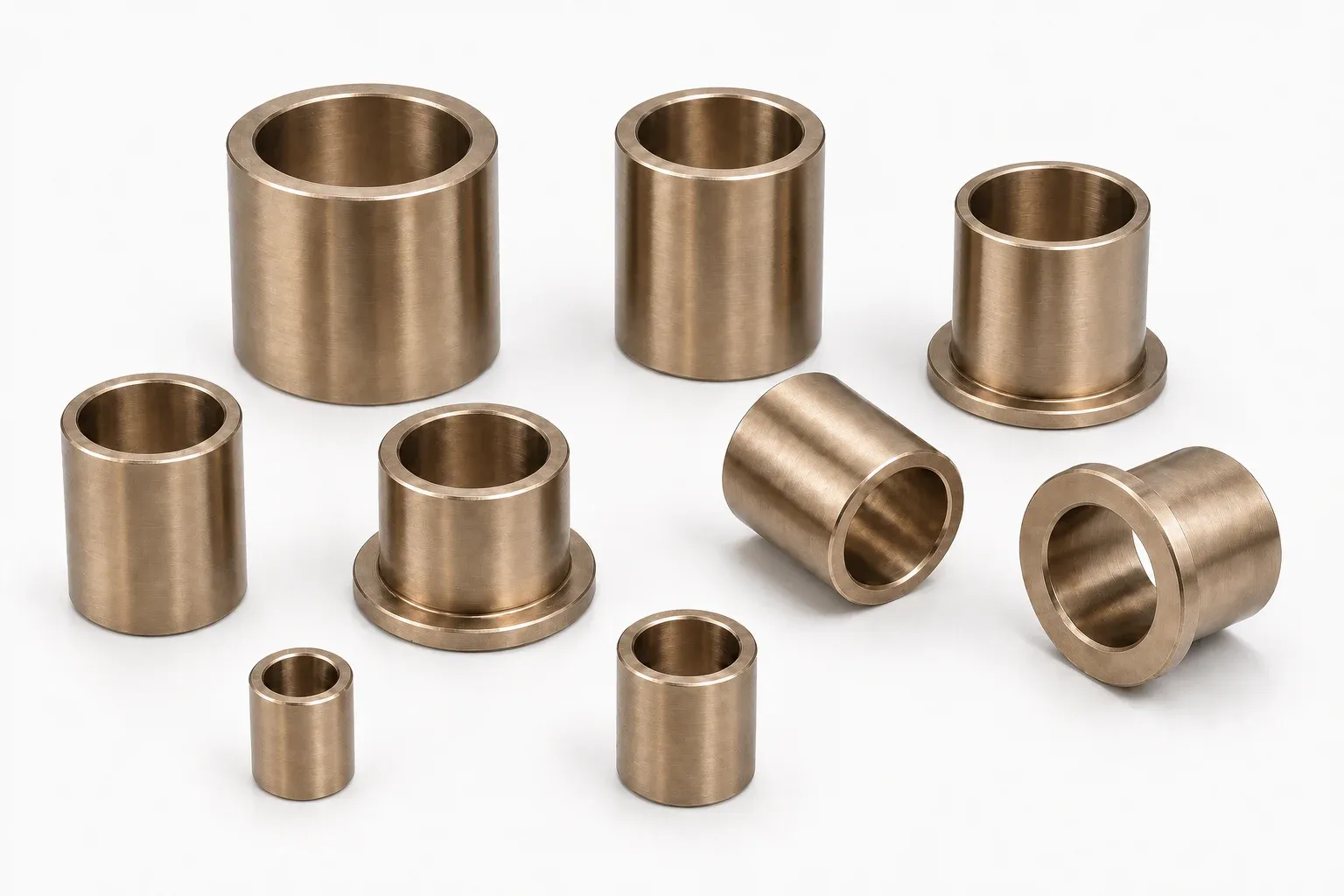
Cast bronze bushings
Machined sleeves and flanged bushings, Ø3–1000 mm, from continuous- or centrifugal-cast stock.
JBM-600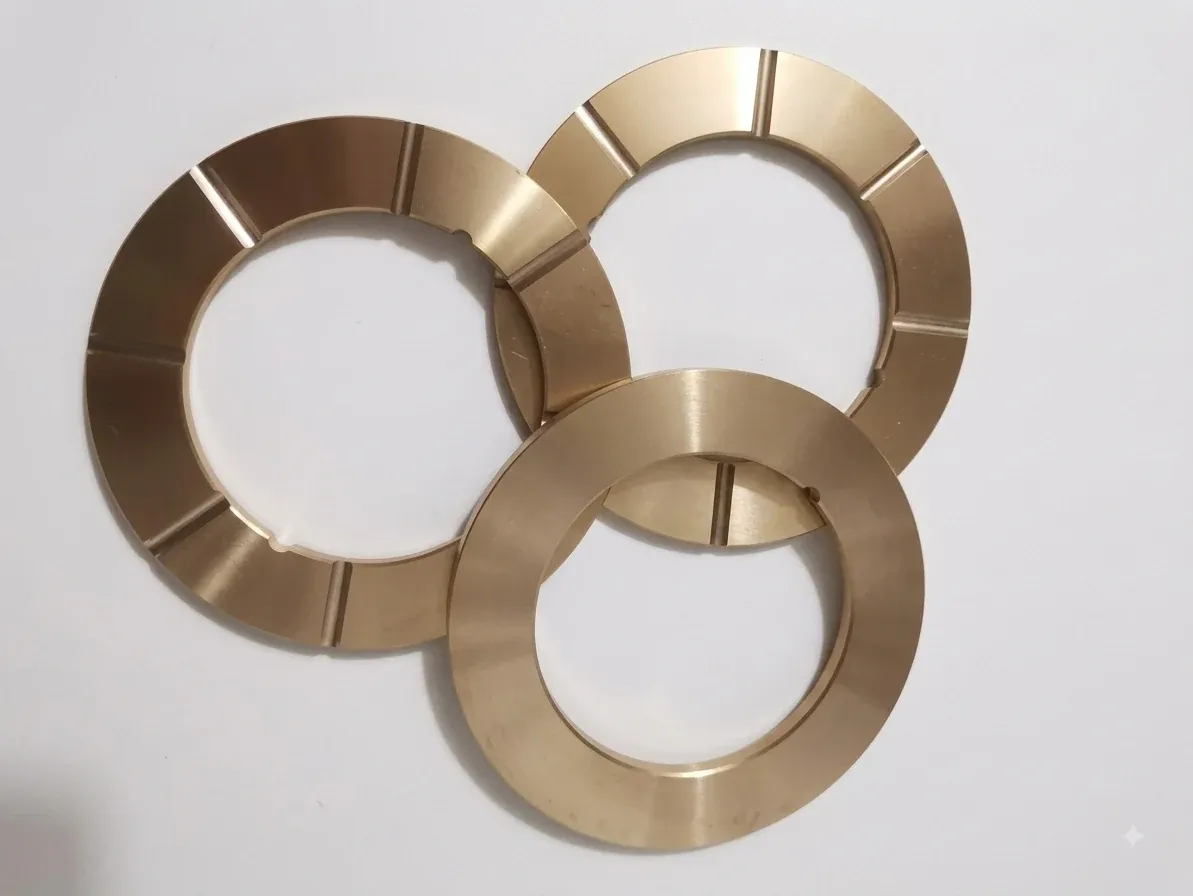
Bronze thrust washers
Plain and grooved washers for axial location under grease or oil.
JBM-600Custom bushings to drawing
Oil holes, grooves, flanges, threads and non-standard walls; samples in 3–5 days.
To drawing
Equivalent designations and product standards
C93200 is the UNS designation; SAE 660 is the name most drawings use. The other systems below identify the same alloy. Product standards: ASTM B505 for continuous cast, ASTM B271 for centrifugal cast, ASTM B30 for ingot and ASTM B763 for copper-alloy sand castings.
| System | Designation |
|---|---|
| UNS | C93200 |
| Common name | C932, bearing bronze, 83-7-7-3 |
| SAE | SAE 660 under SAE J461 and J462 |
| EN (nearest) | CuSn7Zn4Pb7-C (CC493K) |
| Federal | QQ-C-390 Alloy E7 |
| Military | MIL-B-11553 Composition 12 |
| CDA | CDA 932 |
| Ingot | No. 315 |
| Bushing MFG series | JBM-600 |
Continuous cast or centrifugal cast?
ASTM B505 and ASTM B271 describe different casting processes, not different copper-alloy grades. Part size and wall section normally decide the route. Centrifugal casting spins the mould so the melt is driven against the wall; lighter impurities migrate inward and are removed during machining, which is valuable in large rings but unnecessary for a small cylindrical bushing.
Specify the casting standard on the drawing instead of writing C93200 alone: the process standards carry their own acceptance requirements. ASTM B505 minimums for C93200 are 207 N/mm² (30 ksi) tensile, 110 N/mm² (16 ksi) yield at 0.5 % extension and 8 % elongation in 50 mm.
| Selection factor | ASTM B505 continuous cast | ASTM B271 centrifugal cast |
|---|---|---|
| Typical use | Bores up to about 180 mm | Bores above about 180 mm |
| Starting form | Bar, tube and shaped stock | Large rings and heavy-wall sleeves |
| Why it is selected | Economical, repeatable stock for smaller parts | Dense walls in large hollow sections without a core |
Chemical composition
The dispersed lead phase is why C93200 reaches a machinability rating of 70 and cuts without the tooling load of harder unleaded bronzes. Lead also improves thermal conductivity and can smear briefly if the oil supply stops; that is a failure margin, not permission to run dry. The copper–tin structure provides the bearing body while zinc supports castability and strength.
| Element | ASTM B505 range | Nominal |
|---|---|---|
| Copper, Cu | 81.0–85.0 % | 83 % |
| Tin, Sn | 6.3–7.5 % | 7 % |
| Lead, Pb | 6.0–8.0 % | 7 % |
| Zinc, Zn | 1.0–4.0 % | 3 % |
| Nickel, Ni | 1.0 % max | — |
| Iron, antimony, phosphorus, sulfur | Trace limits | — |
Mechanical, physical and bearing properties
Typical as-cast values from the alloy standards, followed by the bearing limits Bushing MFG publishes for a greased C93200 bushing on a steel shaft under boundary lubrication, which is how almost all bronze bushings actually run. Load, speed and temperature are separate limits, not a working point; higher sliding speeds are possible only with a full oil film and are rated case by case.
| Property | Value |
|---|---|
| Tensile strength (typical) | 240 N/mm² |
| Yield strength, 0.5 % extension | 125 N/mm² |
| Elongation | 15–20 % |
| Hardness | 65–75 HB |
| Density | 8.93 g/cm³ |
| Machinability (free-cutting brass = 100) | 70 |
| Operating temperature | −40 to +250 °C |
| Specific load, static, greased | 45 N/mm² |
| Specific load, moving, greased | 25 N/mm² |
| Sliding speed, greased | 0.5 m/s |
| Coefficient of friction, greased | 0.08–0.15 |
| Fits | Housing H7, shaft e7–e8 |
| Lubrication | Continuous or periodic oil or grease required |
Material properties are typical values per ASTM B505; bearing limits are the owner-confirmed envelope for greased cast bronze bushings (2026-08-07). Grade-specific and hydrodynamic ratings on request.
Where the 7 % lead content rules it out
Lead is not a bearing-performance defect in C93200; it is a compliance constraint set by the finished equipment and market. A pin joint on general machinery can use C93200. A potable-water pump, a food-processing line or a product within RoHS or ELV scope needs a different material or a current documented exemption.
This engineering summary is not legal advice. Regulations and exemptions change; confirm current market and end-use requirements with the responsible compliance function.
| Application | Relevant restriction | C93200 status |
|---|---|---|
| General industrial machinery | No product-specific lead restriction | Commonly usable |
| EU electrical and electronic equipment | RoHS copper-alloy exemption capped at 4 % lead | Exceeds the cap |
| EU vehicle applications | ELV copper-alloy exemption uses a similar cap | Check current exemption scope |
| US drinking-water wetted surfaces | 0.25 % weighted-average lead (SDWA / NSF 61 / NSF 372) | Not permitted |
| Food-contact equipment | Jurisdiction and contact conditions vary | Usually not permitted |
| EU REACH articles | Lead is an SVHC above the 0.1 % notification threshold | Notification duties may apply |
Lead-free cast bronze alternatives
CuSn10 (C90500, JBM-610) is the closer substitution where alignment and lubrication are controlled. CuSn12 carries more load and resists wear better at slow speed, but its higher hardness and lower machinability raise cycle time. Neither unleaded route keeps the lead phase that makes SAE 660 conformable and temporarily forgiving during an oil interruption: if lubrication is genuinely unreliable, change the bearing construction rather than only the alloy.
Lead-free constructions in other product lines: wrapped CuSn8 (JBM-090) for higher load with periodic grease, bimetal CuSn10 and CuSn6.5P (JBM-830 / 840) for high dynamic load, and stainless-backed PTFE (JBM-1S) where documented material compliance is required in dry running.
| Selection factor | C93200 / SAE 660 | CuSn10 | CuSn12 |
|---|---|---|---|
| Lead | ≈ 7 % | None | None |
| Tin | ≈ 7 % | ≈ 10 % | ≈ 12 % |
| Hardness | 65–75 HB | Higher | Highest of the three |
| Strength | 240 N/mm² | Higher | Highest of the three |
| Machinability | Rating 70 | Lower | Lowest |
| Conformability | Best | Moderate | Lower |
| Emergency lubricity | Yes, from lead | None | None |
| Relative part cost | Baseline | Higher | Highest |
SAE 660, SAE 841 or wrapped CuSn8?
The manufacturing route creates the practical difference between these three bronze bearing choices. Choose SAE 660 when the load is moderate, an oil or grease route exists, the wall must be thick or the bore needs final machining after fitting. Choose the sintered SAE 841 route (JBM-700) at light load where a compact bearing needs a finite internal oil charge and will not be relubricated. Choose wrapped CuSn8 (JBM-090) where load is high, speed is low, radial space is tight and periodic grease reaches the pockets or holes.
| Selection factor | C93200 / SAE 660 (JBM-600) | SAE 841 sintered (JBM-700) | CuSn8 wrapped (JBM-090) |
|---|---|---|---|
| Manufacturing route | Cast, then machined | Pressed, sintered, oil-impregnated | Cold rolled from strip |
| Hardness | 65–75 HB | Low | 110–150 HB |
| Static load | 45 N/mm² greased | Light-duty route | 120 N/mm² |
| Sliding speed | 0.5 m/s greased; more with a full oil film | Moderate, light load | 2 m/s lubricated |
| Lubrication | External oil or grease required | Finite internal oil charge | Grease retained in pockets or fed through holes |
| Wall thickness | Machinable to the drawing | Moderate, compact wall | 1.0–2.5 mm |
| Re-machinable after fitting | Yes | No | Yes, within the strip thickness |
Corrosion and machining notes
C93200 is not subject to dezincification and provides reasonable resistance to seawater and brine. Aluminium bronze and silicon bronze remain better choices for continuous aggressive chemical exposure, cavitation or severe seawater service.
The machinability rating of 70 is the highest among common bearing bronzes: lead breaks the chip, allowing clean cutting at speed without the built-up edge of harder unleaded grades. Interference in an H7 housing reduces the free bushing bore; where the design permits final machining after installation, finish the bore in the pressed housing rather than machining the whole running clearance into the loose part.
Applications and product routes
General machinery bushings and bearings; pump and cylinder components; machine-tool bearing positions; earthmoving and construction equipment; light-duty gears, sprockets and impellers; wear strips, plates and thrust washers. As a bushing C93200 is supplied machined to ISO 4379 or to drawing in the JBM-600 series (sleeves, flanged bushings, thrust washers, wear plates), Ø3–1000 mm.
Frequently asked questions
What is C93200 equivalent to?
C93200 is the UNS designation for SAE 660 bearing bronze. Other designations include CDA 932, QQ-C-390 Alloy E7, MIL-B-11553 Composition 12, the nominal composition 83-7-7-3 and, nearest in EN, CuSn7Zn4Pb7-C.
Is SAE 660 a phosphor bronze?
No. SAE 660 is a leaded tin bronze containing about 7 % lead. Phosphor bronzes such as CuSn8 contain phosphorus and essentially no lead, and belong to a different alloy group.
Does C93200 contain lead?
Yes, approximately 7 %. It remains usable in general industrial machinery but is not suitable for drinking-water contact and can fall outside RoHS, ELV or food-contact requirements.
Can C93200 run without lubrication?
No. C93200 requires an external oil or grease supply. Its lead content provides a short emergency margin during a lubrication interruption, not a dry-running operating mode.
How much load can a C93200 bushing carry?
As a greased bushing, 45 N/mm² static and 25 N/mm² moving at up to 0.5 m/s, −40 to +250 °C. Higher speeds need a full oil film and are rated case by case.
Why is C93200 widely used if it is not the strongest bronze?
It machines cleanly at a rating of 70, conforms to small alignment errors and degrades progressively instead of seizing suddenly. Those properties often matter more than peak strength in general machinery.
Specify the alloy and the casting route.
Send the drawing, finished dimensions, casting standard, load, speed, lubrication, environment and quantity. Non-standard and thick-wall parts are machined from continuous- or centrifugal-cast stock; samples in 3–5 days.