
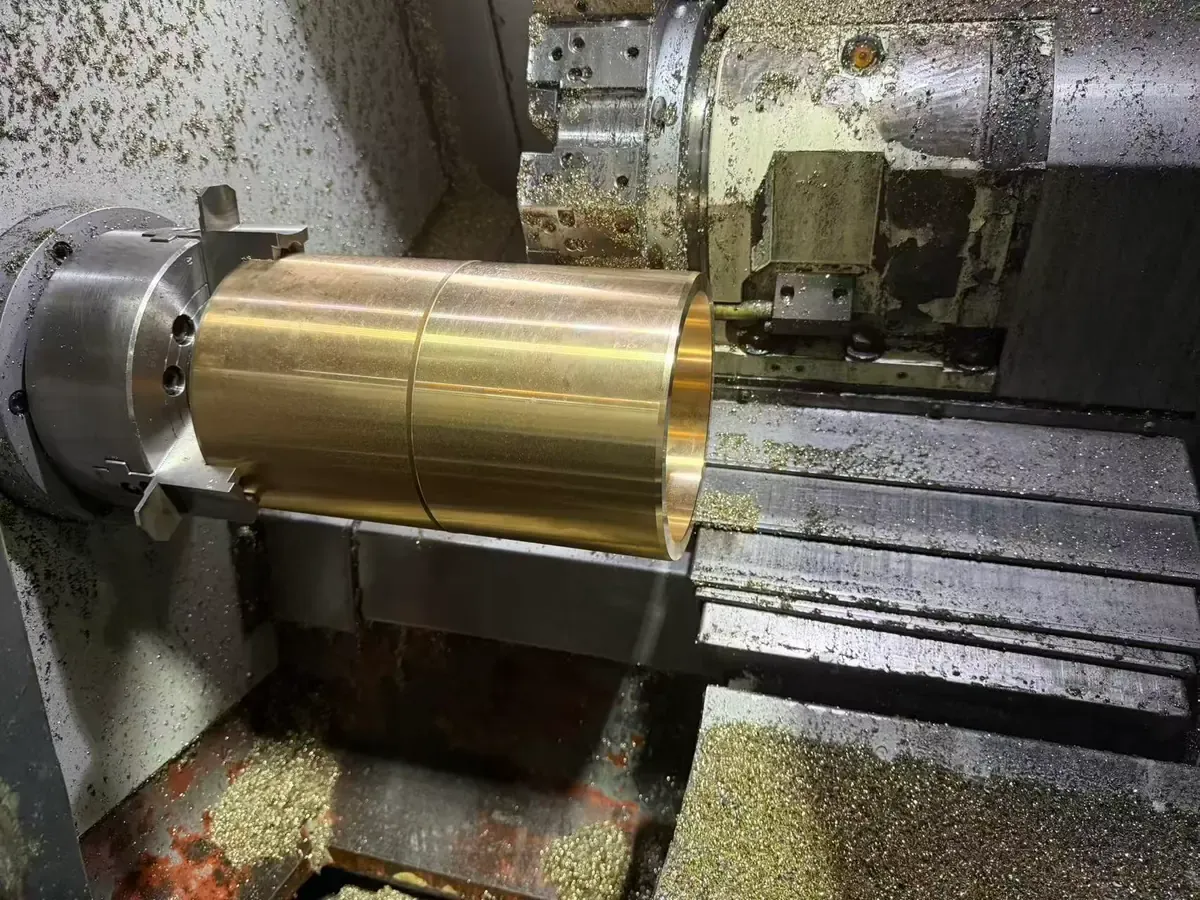
Bronze bushing material chart
“Bronze” on a drawing is not a specification. The bearing bronzes span 60 to 225 HB and 200 to 760 N/mm², and the right one depends on load, speed, lubrication and the shaft. This chart gives the alloys Bushing MFG machines into bushings, their standard designations, properties and the duty each is chosen for.
- 8Bearing bronzes compared
- 55–225 HBHardness range
- 200–760 N/mm²Tensile strength range
- 45 / 25 N/mm²Greased cast bronze, static / moving
Bearing bronzes fall into five groups: leaded tin bronzes (C93200 / SAE 660, C93700, C93800) for general and poorly lubricated service; tin bronzes and gunmetals (C90500, C90700, CuSn12) for higher load and lead-free requirements; red brass C83600 for low load in water; aluminium bronzes (C95400, C95500) for heavy, slow loads against hardened shafts; and the high-strength brass C86300 for extreme load at very low speed. C93200 is the default; the others are chosen when it falls short.
- Specify the UNS (C93200), EN (CuSn7Zn4Pb7-C, CC493K) or SAE (660) number, never the word bronze or a trade name
- Hardness and strength rise from C93800 (55 HB) through C93200 (65–75) and C90500 (75–85) to C95400 (160–180) and C86300 (225)
- Higher hardness demands a harder shaft: unhardened steel is acceptable for the leaded bronzes; C95400 and C86300 need ≥ 300 HB
- Greased cast bronze bushings are rated 25 N/mm² moving, 45 N/mm² static, 0.5 m/s, −40 to +250 °C; alloy-specific limits on request
Bronze bushing alloy groups
Machined from cast bar, rolled from strip, plugged with graphite or pressed from powder: the alloy is one choice, the construction the other.
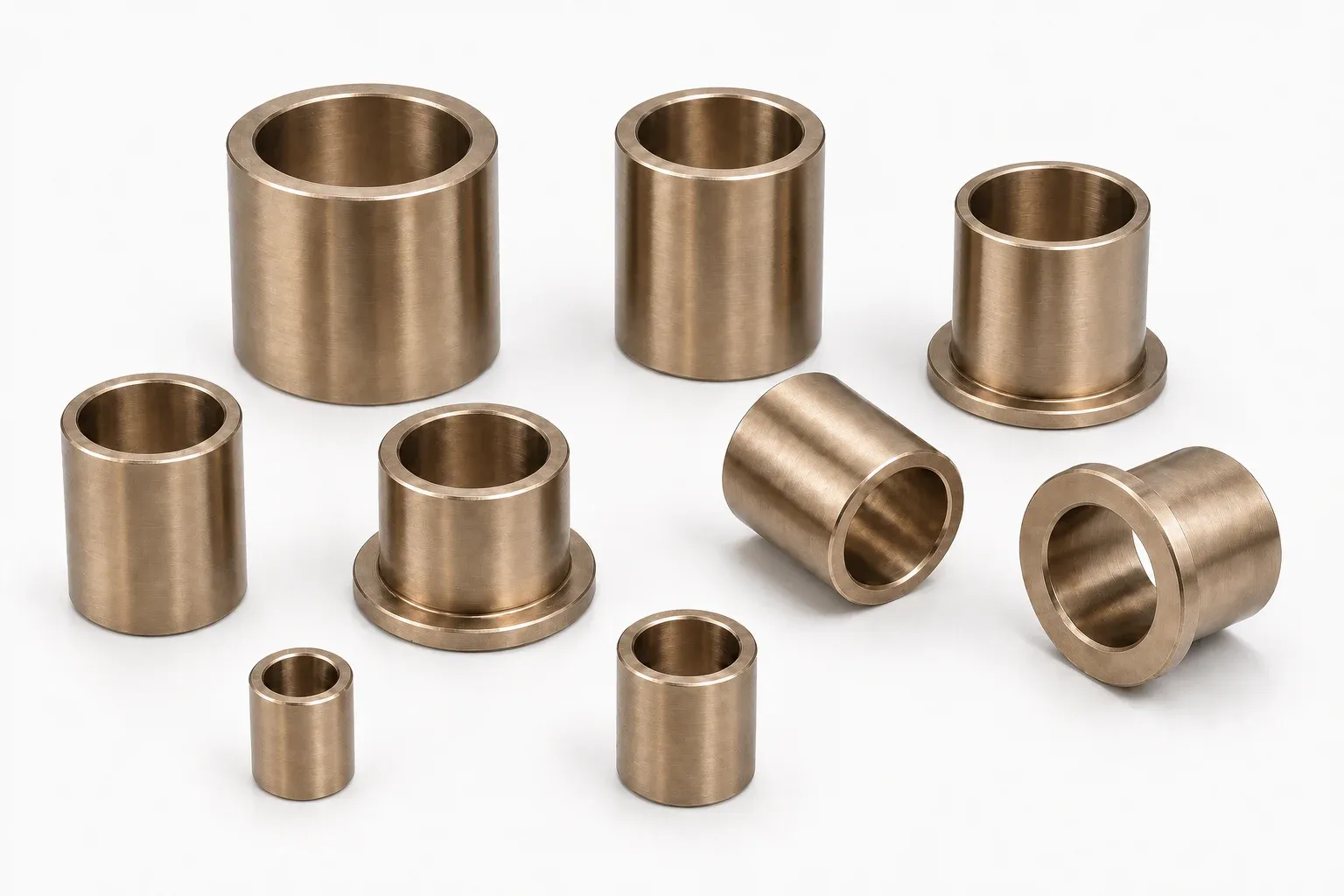
Cast bronze bushings
Machined from C93200 by default; any alloy on this page to drawing.
JBM-600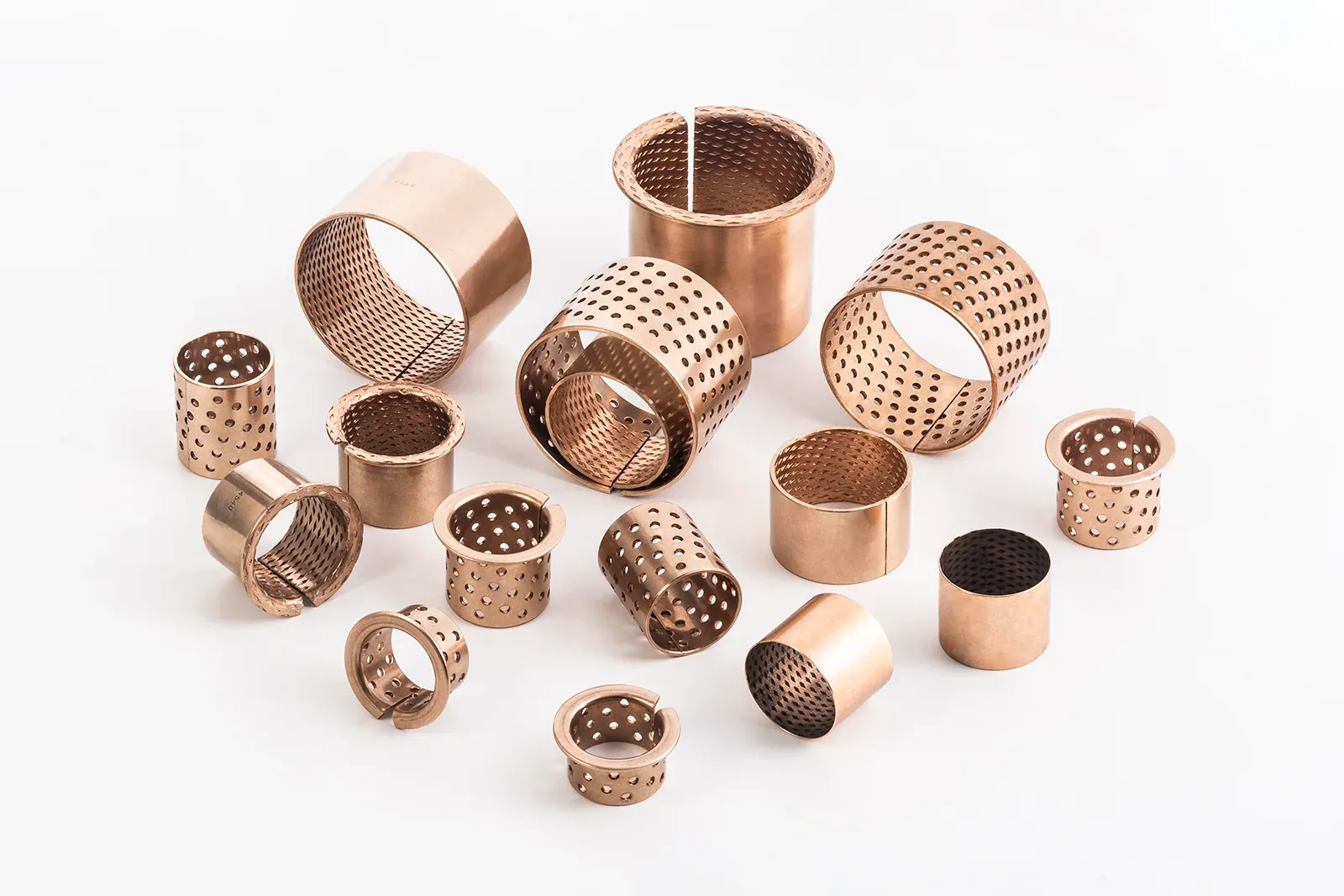
Wrapped bronze bushings
CuSn8 strip rolled into thin-wall sleeves with grease pockets, ISO 3547 sizes.
JBM-090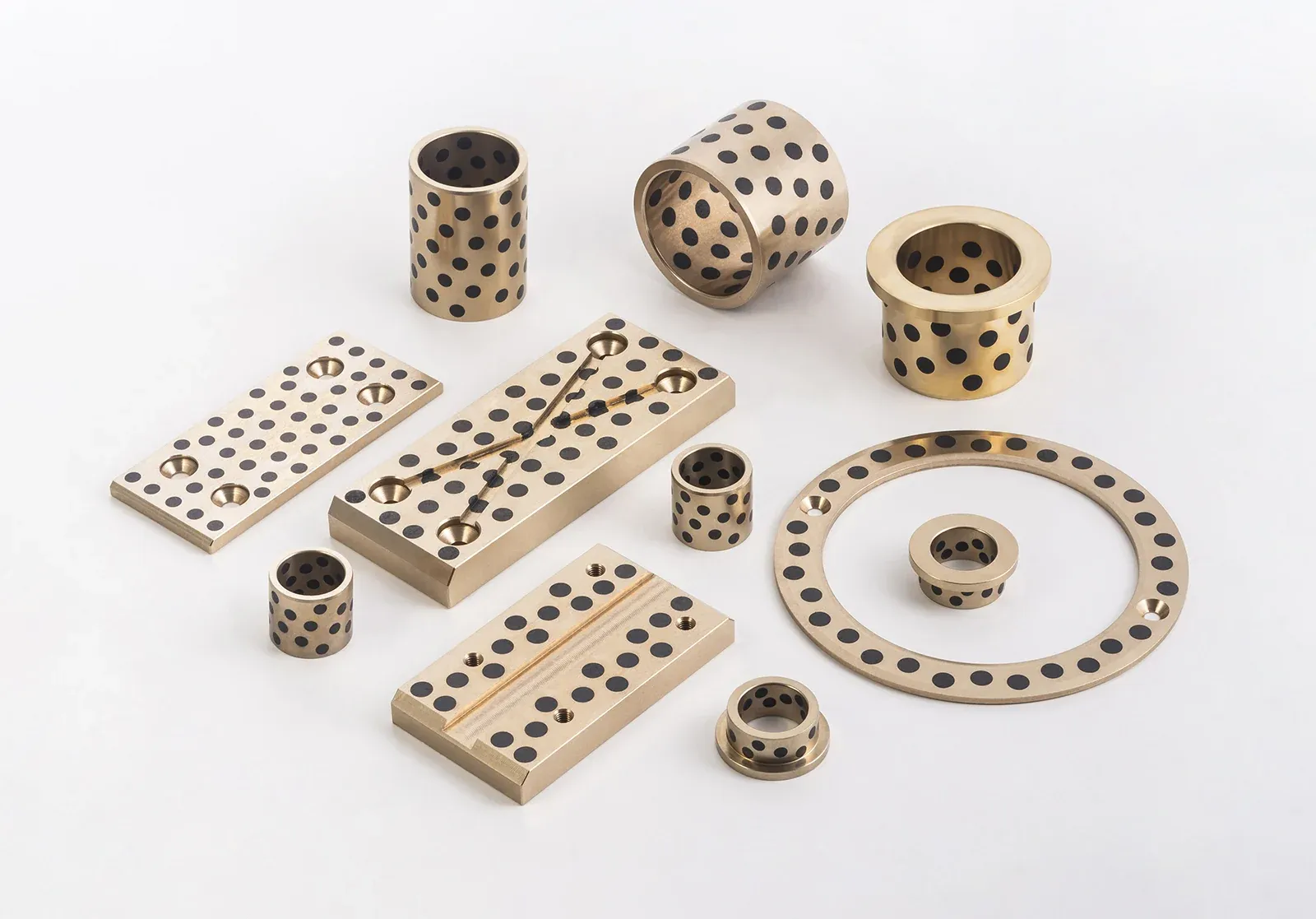
Graphite bronze bushings
High-strength brass, aluminium or tin bronze body with solid-lubricant plugs.
JBM-650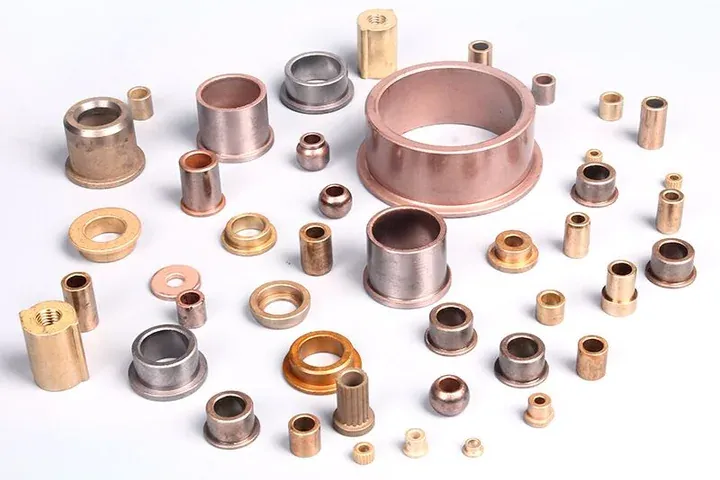
Sintered bronze bushings
Porous Cu-Sn pressed from powder and impregnated with oil for small, quiet bearings.
JBM-700
Specification chart
Composition ranges and minimum mechanical properties are those of the casting standards, ASTM B505 (continuous cast) and EN 1982; typical values are as-cast. Machinability is the CDA rating with free-cutting brass C36000 = 100.
| UNS | SAE / EN | Group | Nominal composition | Hardness HB | Tensile min / typ. | Machinability | Character |
|---|---|---|---|---|---|---|---|
| C93200 | SAE 660 · CuSn7Zn4Pb7-C (CC493K) | Leaded tin bronze | Cu 83 · Sn 7 · Pb 7 · Zn 3 | 65–75 | 207 / 240 N/mm² | 70 | General-purpose bearing bronze; conformable, embeds dirt, tolerates short lubrication gaps |
| C93700 | SAE 64 · CuSn10Pb10-C (CC495K) | Leaded tin bronze | Cu 80 · Sn 10 · Pb 10 | 60–70 | 207 / 240 | 80 | High lead for poor or intermittent lubrication, dirt and shock |
| C93800 | SAE 67 · CuSn7Pb15-C (CC496K) | High-leaded tin bronze | Cu 78 · Sn 7 · Pb 15 | 50–60 | 172 / 200 | 80 | Very poor lubrication, soft shafts, acidic mine water |
| C90500 | SAE 62 (gunmetal) | Tin bronze | Cu 88 · Sn 10 · Zn 2 | 75–85 | 275 / 310 | 30 | Higher load with good lubrication; lead-free |
| CuSn12-C | CC483K (nearest C90800) | Tin bronze | Cu 88 · Sn 12 | 80–95 | 260 / 280 | 30 | Heavy load, low speed, worm wheels; lead-free |
| C83600 | SAE 40 · CuSn5Zn5Pb5-C (CC491K) | Leaded red brass | Cu 85 · Sn 5 · Zn 5 · Pb 5 | 55–65 | 200 / 255 | 84 | Low load, water, valves and pump parts |
| C95400 | CuAl10Fe2-C (CC331G) | Aluminium bronze | Cu 85 · Al 11 · Fe 4 | 160–180 | 515 / 585 | 60 | Heavy load, slow speed, hardened shaft, seawater |
| C95500 | CuAl10Fe5Ni5-C (CC333G) | Nickel-aluminium bronze | Cu 81 · Al 11 · Ni 4 · Fe 4 | 190–200 | 620 / 690 | 50 | Highest strength aluminium bronze; marine, heavy industry |
| C86300 | SAE 430B · CuZn25Al5Mn4Fe3-C (CC762S) | High-strength brass (“manganese bronze”) | Cu 63 · Zn 25 · Al 6 · Mn 3 · Fe 3 | 225 | 758 / 800 | 8 | Extreme load at very low speed; hardened shaft essential |
Standard values (ASTM B505 / EN 1982 / CDA). Owner-approved copy exists for C93200 and C86300; the other grades are drafted from the published standards and confirmed at quotation.
The five groups and when each is chosen
Leaded tin bronzes are the workhorses. The lead is insoluble in the copper-tin matrix and sits as soft islands that smear across the surface when the oil film thins, which is why C93200 survives the lubrication gaps of real machinery and why C93700 and C93800, with more lead, survive worse ones. They are soft enough to run on unhardened shafts and embed dirt instead of scoring.
Tin bronzes and gunmetals drop the lead. C90500 and CuSn12-C are harder and stronger, carry more load and are the answer to lead-free requirements, but they are less forgiving of lubrication failure and harder to machine. Red brass C83600 is the low-cost, low-load member for water and valve parts.
Aluminium bronzes are a different class: 160–200 HB, over 500 N/mm², corrosion resistant in seawater. They carry very heavy loads at low speed but need a hardened shaft (≥ 300 HB) and reliable lubrication because they do not embed and do not smear. C86300, sold as manganese bronze, is metallurgically a high-strength brass and is the hardest of all at 225 HB; it is for presses, rolling mills and the like, where the load is extreme and the speed is near zero.
Bearing limits are not material properties
The chart gives material properties from the alloy standards. What a bushing can carry is a bearing limit that also depends on lubrication, speed, shaft and heat flow. The general limits confirmed for Bushing MFG greased cast bronze bushings are 25 N/mm² moving, 45 N/mm² static, 0.5 m/s, friction 0.08–0.15, −40 to +250 °C, with H7 housing and e7–e8 shaft fits. Aluminium bronze and C86300 carry more at lower speed; specific figures are given with the quotation.
Selection by duty
A rule of thumb that covers most enquiries; the exceptions are handled at quotation.
| Duty | First choice | Alternative |
|---|---|---|
| General machinery, greased or oiled | C93200 / SAE 660 | CuSn7Zn4Pb7 continuous cast in any size |
| Poor, intermittent or dirty lubrication; shock | C93700 / SAE 64 | C93800 / SAE 67 for the worst cases |
| Lead-free requirement | C90500 / SAE 62 | CuSn12-C, CuSn10-C |
| Low load in water | C83600 / SAE 40 | C90500 |
| Heavy load, slow, hardened shaft, seawater | C95400 | C95500 for the highest strength |
| Extreme load, near-zero speed | C86300 / SAE 430B | C95500 |
| No lubrication possible | Graphite-plugged bronze (see product page) | Sintered oil-impregnated bronze for light duty |
How to specify
Write the alloy number and the standard: “C93200 per ASTM B505” or “CuSn7Zn4Pb7-C per EN 1982”. Trade names (Rg7, SAE 660, 83-7-7-3, bearing bronze) are useful as cross-references but not as the specification. Add the casting method if it matters (continuous cast is standard for bushings; centrifugal for large diameters) and any certificate you need: a mill certificate for composition and mechanical properties is standard, a material declaration for lead content on request.
On Bushing MFG drawings and quotations the machined copper-alloy bushings carry a JBM-600 series number in front of the alloy: JBM-600 for the leaded tin bronzes (C93200, C93700, C93800), JBM-610 for the unleaded tin bronzes (C90500, CuSn12-C), JBM-620 for the aluminium bronzes (C95400, C95500), JBM-630 for high-strength brass C86300 and JBM-640 for free-cutting brass C36000. The series identifies the alloy group; the alloy number remains the specification.
Frequently asked questions
What is the best bronze for bushings?
C93200 / SAE 660 for general duty with grease or oil. C93700 for poor lubrication, C90500 or CuSn12 for higher load or lead-free, C95400 aluminium bronze for heavy slow loads against a hardened shaft, C86300 for extreme load at near-zero speed.
What is SAE 660 bronze?
The SAE designation for C93200, leaded tin bronze CuSn7Zn4Pb7 (Cu 83, Sn 7, Pb 7, Zn 3), 65–75 HB, the standard bearing bronze. EN 1982 calls it CC493K; the German trade name is Rg7.
Is manganese bronze really bronze?
No. C86300 “manganese bronze” is a high-strength brass with 25 % zinc and 6 % aluminium. It is the hardest bushing alloy (225 HB) and is used for extreme loads at very low speed on hardened shafts.
Which bronze bushing alloys are lead-free?
C90500, C90700, CuSn12-C and CuSn10-C tin bronzes, and the aluminium bronzes C95400 and C95500. They carry more load than C93200 but need reliable lubrication and, for aluminium bronze, a hardened shaft.
What shaft hardness does a bronze bushing need?
Unhardened steel of 150–200 HB is acceptable for the leaded tin bronzes. Aluminium bronze and C86300 need a hardened or hard-chromed shaft of at least 300 HB.
Not sure which bushing? Send the joint.
Dimensions, load, speed, lubrication and environment: our engineers reply within 12 hours with a material proposal and a quotation. Free samples, no minimum order.