
Brass vs bronze bushings: how to choose
Brass and bronze are both copper alloys and both are yellow, which is where the similarity ends for a bearing. Bronze bushings are the standard for loaded sliding surfaces; brass bushings suit light duty where machinability and price matter more than wear life. The alloy grade decides, not the name.
Bronze bushings (copper-tin alloys such as C93200 / SAE 660) are chosen for loaded, lubricated sliding surfaces because tin bronze wears slowly, embeds dirt, and does not seize on steel. Brass bushings (copper-zinc alloys such as C36000) are cheaper and machine faster but are softer in wear and prone to dezincification in water, so they are used for light-duty guides, spacers and low-load pivots.
- Brass = copper + zinc (typically 30–40 % Zn). Bronze = copper + tin (5–12 % Sn), often with lead or zinc; aluminium bronze replaces tin with aluminium.
- Bearing bronze C93200: 65–75 HB, 240 N/mm² tensile; as a greased bushing 45 N/mm² static, 25 N/mm² moving, 0.5 m/s. Free-cutting brass C36000: about 80–120 HB, 340–470 N/mm² tensile, no published bearing rating.
- Brass costs less per kilogram than tin bronze and machines at rating 100 (bronze C93200: 70).
- Trade names mislead: “manganese bronze” C86300 is metallurgically a high-strength brass (25 % zinc). Specify the UNS or EN number.
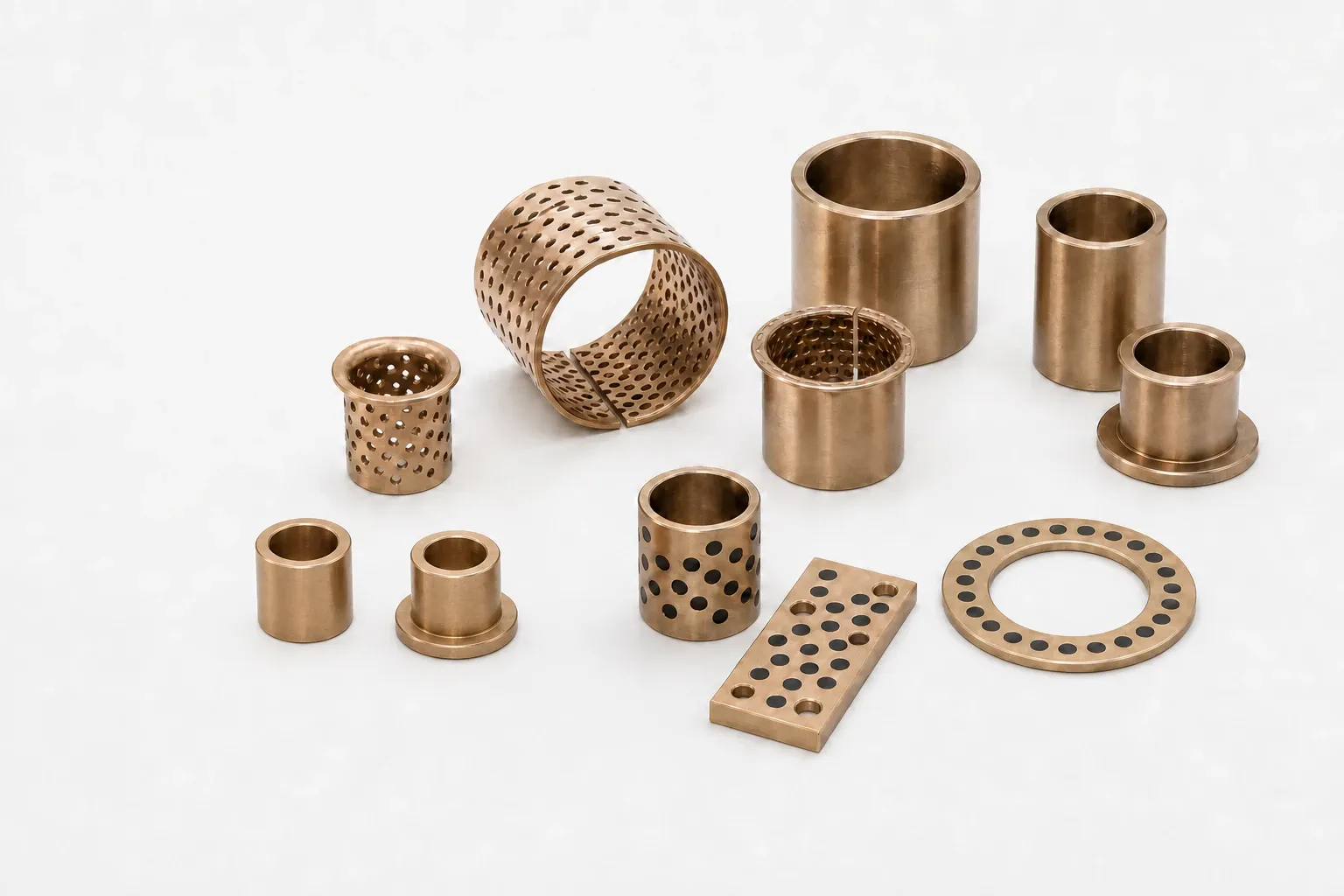
What is the difference between brass and bronze?
Brass is an alloy of copper and zinc. Bronze was originally copper and tin, and the name now covers the copper alloys whose main addition is anything other than zinc or nickel: tin bronze, leaded tin bronze, aluminium bronze, silicon bronze, phosphor bronze. For bushings the relevant bronzes are the tin bronzes and the aluminium bronzes.
The alloying element sets the behaviour of the sliding surface. Tin hardens the copper matrix and forms a structure that resists adhesive wear against steel; lead, where present, smears into a soft film that helps the bearing survive a moment without oil. Zinc mainly makes copper cheaper, stronger and easier to machine; it adds nothing to bearing performance and above about 15 % it exposes the alloy to dezincification in wet service.
Reference alloys used in bushings
Nominal values from the alloy standards (ASTM B505 for the cast bronzes, ASTM B16 for C36000). Hardness for brass depends on temper.
| Alloy | Group | Nominal composition | Hardness | Tensile strength | Typical bushing use |
|---|---|---|---|---|---|
| C93200 · SAE 660 | Leaded tin bronze | Cu 83 · Sn 7 · Pb 7 · Zn 3 | 65–75 HB | 240 N/mm² | General machined bushings, lubricated |
| C93700 · SAE 64 | High-leaded tin bronze | Cu 80 · Sn 10 · Pb 10 | 60–70 HB | 240 N/mm² | Poor-lubrication and dirty service |
| C90500 · SAE 62 | Tin bronze (gunmetal) | Cu 88 · Sn 10 · Zn 2 | 75–85 HB | 310 N/mm² | Higher load, good lubrication |
| C95400 | Aluminium bronze | Cu 85 · Al 11 · Fe 4 | 160–180 HB | 585 N/mm² | Heavy load, slow speed, hardened shaft |
| C86300 · SAE 430B | High-strength brass (“manganese bronze”) | Cu 63 · Zn 25 · Al 6 · Mn 3 · Fe 3 | 225 HB | 758 N/mm² | Extreme load, very low speed |
| C36000 | Free-cutting brass | Cu 61.5 · Zn 35.5 · Pb 3 | 80–120 HB | 340–470 N/mm² | Light-duty guides, spacers, fittings |
| CuZn39Pb3 · CW614N | Free-cutting brass (EN) | Cu 58 · Zn 39 · Pb 3 | 90–130 HB | 360–500 N/mm² | Light-duty guides, European drawings |
Why bronze is the bearing material and brass is not
A bushing lives or dies by three properties: how it wears against the shaft, how it behaves when the lubricant film thins, and how it handles the hard particles that always find their way into a joint. Tin bronze is good at all three. It is soft enough to embed grit rather than score the shaft, hard enough to hold its bore, and its copper-tin structure has low affinity for steel so it does not weld to the shaft under boundary lubrication. Leaded grades add an emergency film; aluminium bronzes trade some of that forgiveness for much higher load capacity.
Brass has none of these mechanisms by design. Free-cutting brass is hard for a copper alloy, but its hardness comes from zinc and is not matched by wear resistance: against a steel shaft under load it galls and wears faster than SAE 660, and the wear debris is abrasive. It has no published bearing load or speed rating in the bronze standards. Where it works is where the load is light, the motion is occasional and the price of the part matters: door and gate pivots, jigs and fixtures, spacers, guide bushes for low-force linear motion, and decorative or electrical hardware.
Brass and bronze bushings compared
| Property | Bronze bushing (C93200 reference) | Brass bushing (C36000 reference) |
|---|---|---|
| Wear against steel shaft | Low; tin bronze is the reference bearing alloy | Higher; galls under load, abrasive debris |
| Specific load, greased | 45 N/mm² static, 25 N/mm² moving (cast C93200); 120 / 40 N/mm² CuSn8 wrapped; higher for aluminium bronze | Not rated as a bearing material |
| Sliding speed | 0.5 m/s greased; higher only with a full oil film, rated case by case | Light duty only |
| Behaviour when lubricant fails | Leaded grades smear and survive briefly | Seizes |
| Embeds dirt | Yes, protects the shaft | Poorly |
| Corrosion in water | Good (tin bronze); dezincification not an issue | Dezincification above ~15 % Zn unless inhibited |
| Machinability (C36000 = 100) | 70 | 100 |
| Relative material cost | Higher (tin) | Lower (zinc) |
| Colour | Reddish-brown to golden | Bright yellow |
When a brass bushing is the right choice
Brass earns its place where the part is a guide or a spacer rather than a bearing that carries continuous load.
- Light radial load, slow or occasional motion: hinges, gate and door pivots, hand-operated levers, adjusters.
- Guide bushes for low-force linear motion where a clean bore matters more than wear life.
- Parts that are machined in large numbers from bar and where cycle time dominates cost.
- Electrical or thermal hardware where conductivity and a bright finish are wanted.
- Dry or lightly oiled indoor service; not wet, not marine, not in ammonia atmospheres.
If the drawing says “brass” for a loaded bushing, ask why. Often it means “yellow metal” and the original part was bronze.
When a bronze bushing is the right choice
Bronze is the default for any bushing that carries load while it moves. The construction then follows the lubrication available.
- Cast and machined bronze (C93200, C90500, C95400): pivots, rams, gearboxes and pumps with grease or oil; any size, any drawing.
- Wrapped bronze (CuSn8 strip with pockets or holes): thin-wall, high-load pins in construction and agricultural machinery, greased.
- Graphite-plugged bronze: where relubrication is impossible or the temperature kills grease, at slow speed.
- Sintered bronze, oil-impregnated: small motors, appliances and conveyors that never see a grease gun.
- Steel-backed bimetal with a bronze layer: automotive and hydraulic components where the housing is thin and the volume is high.
Can you tell brass from bronze by colour?
Not reliably. Fresh brass is bright yellow, tin bronze is warmer and browner, aluminium bronze is golden, and C86300 “manganese bronze” is dark brown although it is a brass. Oil, oxidation, plating and lighting blur all of these. If the alloy matters, read it off the drawing or a material certificate; a handheld XRF analyser identifies it in seconds when no paperwork exists. A magnet tells you nothing: neither alloy is magnetic.
The naming is the trap. “Bearing bronze” (C93200), “commercial bronze” (C22000, a 10 % zinc brass), “architectural bronze” (C38500, a leaded brass) and “manganese bronze” (C86300, a 25 % zinc brass) are all sold under the word bronze. Only the UNS, EN or GB number is a specification.
Can brass replace bronze in a bushing?
Only downward in duty. A brass bushing can replace a bronze one in a lightly loaded pivot if the customer accepts a shorter life; a bronze bushing can always replace a brass one at higher cost. Replacing SAE 660 with free-cutting brass in a loaded, lubricated joint will show up as a scored shaft within months.
Where the question is really about cost, there are better routes than changing the alloy group: a wrapped CuSn8 bushing uses a fraction of the bronze of a machined sleeve; a steel-backed bimetal bushing puts a thin bronze layer on a cheap steel shell; a sintered bronze bushing is pressed to size with no machining. We quote these alongside the machined part when the drawing allows.
Put the alloy number, the shaft material and hardness, the lubrication method and the load on the enquiry. Those five items decide the material.
Frequently asked questions
Is bronze stronger than brass?
Not as a rule. Free-cutting brass (340–470 N/mm²) is stronger in tension than bearing bronze C93200 (240 N/mm²), while aluminium bronze (585 N/mm²) and the high-strength brass C86300 (758 N/mm²) beat both. Strength is not what makes a bearing material; wear behaviour against steel and tolerance of poor lubrication are.
Which is better for a bushing, brass or bronze?
Bronze for any bushing that carries load while it moves, because tin bronze wears slowly, embeds dirt and does not seize on a steel shaft. Brass for light-duty guides, spacers and pivots where machining cost matters more than wear life.
Is C93200 / SAE 660 brass or bronze?
Bronze: a leaded tin bronze with about 83 % copper, 7 % tin, 7 % lead and 3 % zinc. It is the most common machined bushing alloy in North America.
Why is manganese bronze not a bronze?
C86300 contains about 25 % zinc and no tin, so metallurgically it is a high-strength brass. The trade name survives from the foundry industry. It is an excellent extreme-load bearing alloy against a hardened shaft, but it dezincifies in aggressive water like other brasses.
Which costs more, brass or bronze bushings?
Bronze, in most cases. Tin costs several times more than zinc per kilogram, and bronze machines more slowly (rating 70 against 100). For high volumes a wrapped or bimetal bronze construction usually closes the gap.
Does bronze or brass corrode in water?
Tin bronze resists fresh and sea water well, which is why it is used for marine bushings and pump parts. Brass with more than about 15 % zinc suffers dezincification unless it is an inhibited grade.
Send the drawing. We answer within 12 hours.
Dimensions, material or just the application: our engineers reply with a material proposal and a quotation. Free samples of standard and custom parts, no minimum order.