
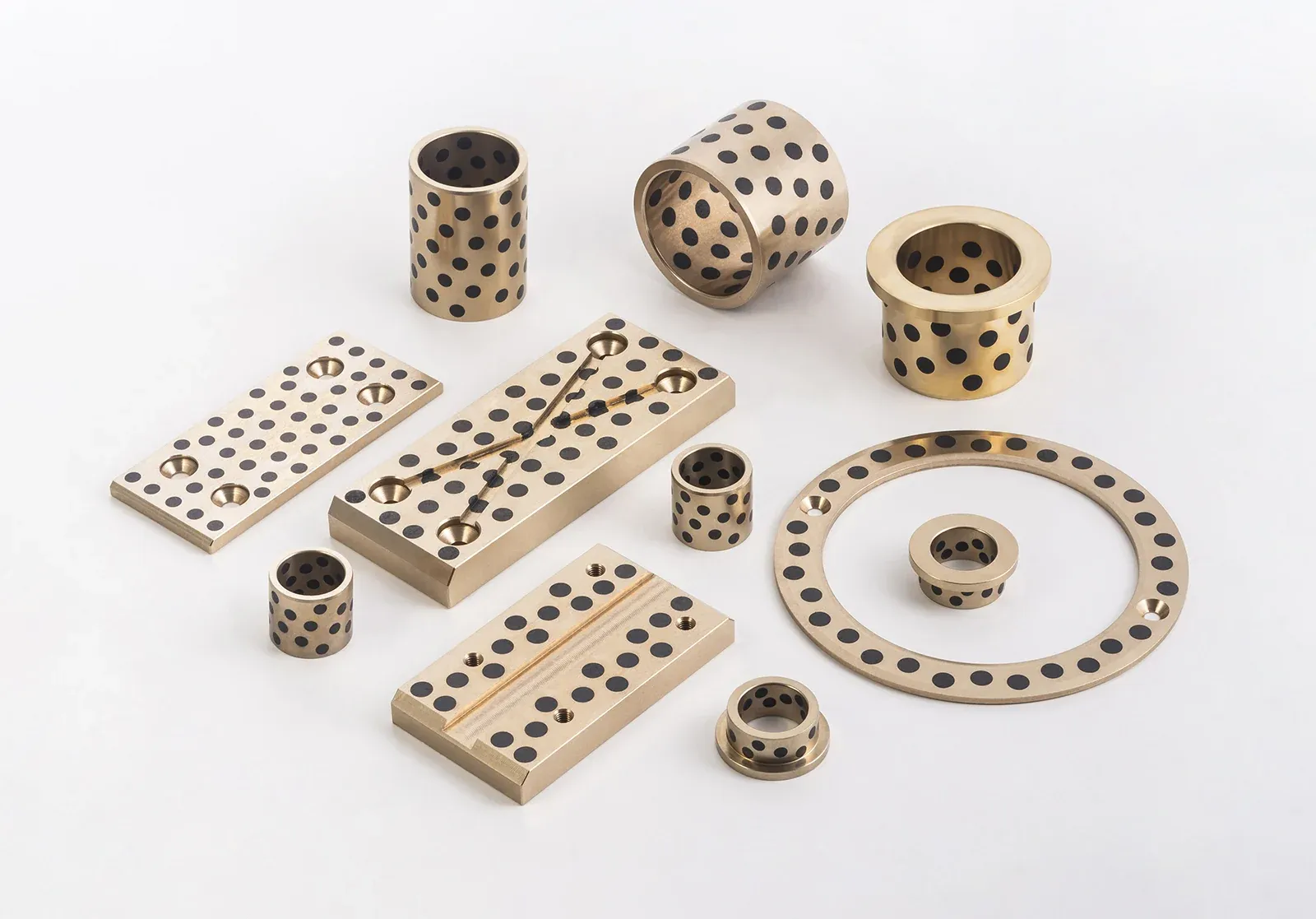
C86300 / SAE 430B manganese bronze
The hardest bearing alloy Bushing MFG machines, and the base metal of the graphite-plugged 650 series. Sold as manganese bronze, it is a high-strength brass: this page gives its identity, composition, properties, bearing boundaries, machining cost and corrosion limits.
- 225 HBHardness, typical
- 758 N/mm²Tensile strength, minimum
- 8Machinability rating (brass = 100)
- ≈ 200 °CContinuous temperature
C86300 is a cast high-strength copper-zinc alloy with 758 N/mm² minimum tensile strength and about 225 HB hardness. It serves extreme-load, very-low-speed bearing positions and graphite-plugged bushings, but it needs a hardened shaft and protection from dezincification in aggressive wet service.
- Cast high-tensile manganese brass; UNS C86300, SAE 430B, CuZn25Al5Mn4Fe3-C / CC762S, ZCuZn25Al6Fe3Mn3
- 758 N/mm² (110 ksi) tensile and 427 N/mm² (62 ksi) yield minimum; 225 HB typical
- Machinability rating 8 (free-cutting brass = 100; C93200 = 70)
- Continuous temperature about 200 °C; performance declines above about 260 °C
- No intentional lead; Pb 0.20 % max. Bushing MFG series JBM-630; graphite-plugged as grade 650
Bushings made from C86300
Solid machined bushings for extreme load at very low speed, and the base body of the graphite-plugged 650 series.
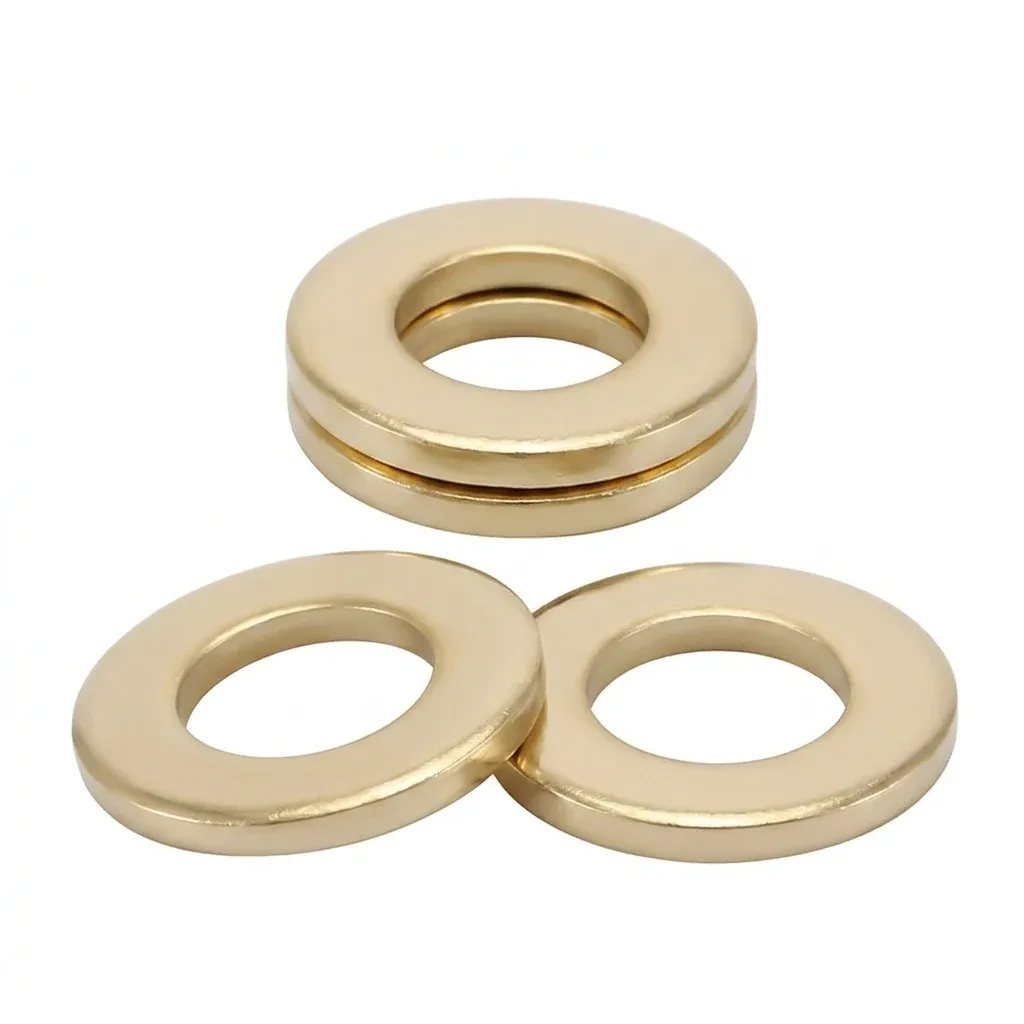
Brass bushings
Solid C86300 sleeves and flanged bushings for crushers, presses and heavy pivots against a hardened shaft.
JBM-630Graphite bronze bushings
C86300-class body with solid-lubricant plugs: 50–100 N/mm² without grease.
JBM-650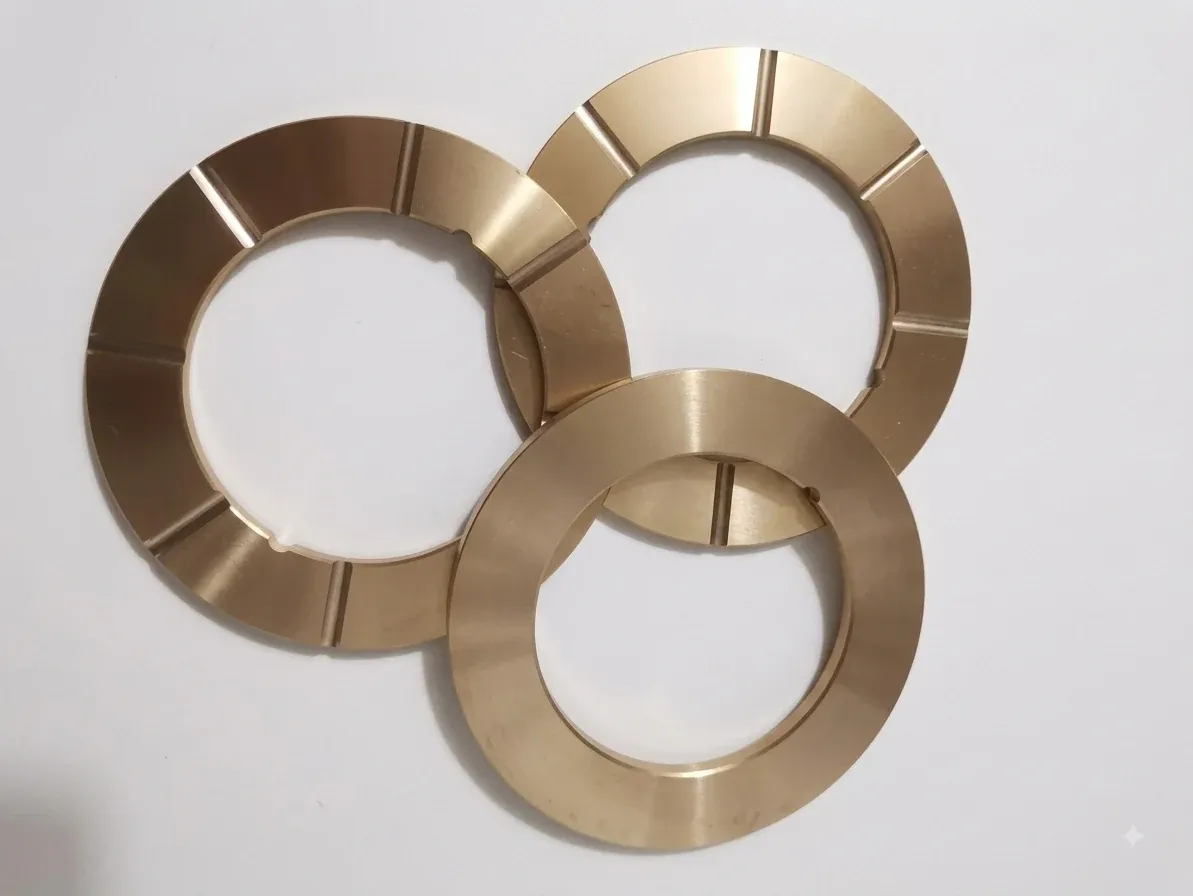
Thrust washers
Heavy, slow axial positions on slewing tables and gates.
Bronze & brass
C86300 is a brass, not a tin bronze
Bronze normally describes a copper–tin alloy. C86300 contains 22–28 % zinc and essentially no tin, so it is a high-strength brass with aluminium, iron and manganese additions; the manganese gives the alloy its characteristic dark-brown tone. The distinction matters because engineers often expect a material called bronze to resist dezincification, and C86300 does not. Review the environment before specifying it for wet or marine service.
Chinese copper–manganese designations QMn1.5 and QMn5 are different binary alloys; the matching Chinese cast designation for C86300 is ZCuZn25Al6Fe3Mn3. Product standards: ASTM B505 continuous cast, ASTM B271 centrifugal cast, ASTM B147 alloy 8C sand cast and ASTM B22 bridge-plate designations.
| System | Designation |
|---|---|
| UNS | C86300 |
| CDA | CDA 863 |
| SAE | SAE 430B under SAE J461 and J462 |
| Common names | High-tensile manganese bronze; high-strength yellow brass |
| EN | CuZn25Al5Mn4Fe3-C / CC762S |
| GB (China) | ZCuZn25Al6Fe3Mn3 |
| AMS | AMS 4862 |
| Federal | QQ-C-390 Alloy 86300 |
| Military | MIL-C-15345 Alloy 6; MIL-C-22229 Composition 8 |
| Ingot | No. 424 |
| Bushing MFG series | JBM-630 (machined); grade 650 (graphite-plugged, JBM-650) |
Chemical composition and strength mechanism
The alpha–beta copper–zinc structure provides the main strength; aluminium strengthens the alloy and forms a protective oxide film; iron refines the grain while manganese adds strength and deoxidises the melt. C86300 is not heat treatable: its properties come from chemistry and casting control, so heat treatment cannot restore strength lost to a poor casting. It is not a leaded alloy, which makes it a route when the roughly 7 % lead in C93200 / SAE 660 is not acceptable.
| Element | ASTM B505 range | Nominal |
|---|---|---|
| Copper, Cu | 60.0–66.0 % | 63 % |
| Zinc, Zn | 22.0–28.0 % | 25 % |
| Aluminium, Al | 5.0–7.5 % | 6 % |
| Manganese, Mn | 2.5–5.0 % | 3 % |
| Iron, Fe | 2.0–4.0 % | 3 % |
| Lead, Pb | 0.20 % max | — |
Mechanical and physical properties
Use about 200 °C as the continuous ceiling. Performance declines significantly above roughly 260 °C as creep resistance falls; aluminium bronze is the better copper-alloy route for genuinely hot service.
| Property | Value |
|---|---|
| Tensile strength, minimum | 758 N/mm² (110 ksi) |
| Yield strength, 0.5 % extension, minimum | 427 N/mm² (62 ksi) |
| Elongation, minimum | 14 % |
| Hardness | 225 HB typical (3000 kg) |
| Compressive strength, 0.1 % | 345 N/mm² |
| Impact strength | 19 J/cm² |
| Density | 7.8 g/cm³ |
| Elastic modulus | 105 000 N/mm² |
| Thermal conductivity | 87.8 W/(m·K) |
| Thermal expansion | 21.2 × 10⁻⁶ K⁻¹ |
| Machinability rating | 8 |
| Continuous temperature | ≈ 200 °C; declining above ≈ 260 °C |
Machinability rating 8 changes the part cost
C86300 is hard, tough and contains no lead phase to break the chip. It cuts slowly, wears tooling and takes more work to finish than a leaded tin bronze, whose rating is 70. Allow longer machining cycles and higher tooling cost for complex geometry; prefer simple cylindrical and flanged forms when the application allows; start from a near-net cast section rather than a large solid billet. Graphite-plugged versions use drilled pockets instead of long machined lubrication grooves.
Bearing limits and the hardened-shaft requirement
C86300 is a very-high-load, very-low-speed material, not a general-purpose dry-running bushing alloy. At about 225 HB it can wear common unhardened shafting: specify and verify a hardened mating surface rather than allowing the shaft to become the sacrificial component. Low conformability and embeddability also make it sensitive to hard particles; seal the joint in dirty environments or use the graphite-plugged construction, whose solid-lubricant pockets provide space for small debris. Bearing limits for a plain C86300 bushing are issued with the quotation.
| Selection factor | Requirement |
|---|---|
| Load | Very high; the highest in the copper bearing range |
| Speed | Low; unsuitable for high-speed dry friction |
| Lubrication | Reliable external lubrication in a plain C86300 bearing; solid lubricant in the plugged version |
| Mating shaft | Hardened surface required; harder than the 225 HB bushing |
| Environment | Keep abrasive particles out of the joint |
Dezincification is the cost of the zinc content
Warm saline water, acidic conditions and aggressive oxidising media can selectively remove zinc from C86300, leaving a porous copper-rich skeleton. The component may keep its outside shape while losing mechanical strength, which makes the damage difficult to detect without inspection. Protective plating or coating lowers the exposure risk; for continuous seawater immersion, aluminium bronze is the more reliable specification.
This is the sharpest difference from tin bronze: C93200 is not subject to dezincification and handles brine more comfortably despite its much lower strength.
C86300 against the alternatives
Choose C86300 when load is extreme and speed is near zero. Choose SAE 660 when speed, conformability or machining economy matters. Use aluminium bronze where heat or corrosion controls the design.
A graphite-plugged bushing needs a metal body that carries very high pressure at low speed while the embedded graphite handles lubrication; C86300 fits that split of work, which is why the CuZn25Al5Mn4 grade 650 is the standard base of the plugged series. The plug pockets improve debris accommodation and remove the external lubrication requirement.
| Selection factor | C86300 | C93200 / SAE 660 | Aluminium bronze |
|---|---|---|---|
| Alloy group | Manganese brass | Leaded tin bronze | Aluminium bronze |
| Tensile strength | 758 N/mm² minimum | 240 N/mm² | High |
| Hardness | 225 HB | 65–75 HB | High |
| Machinability | 8 | 70 | Low |
| Speed capability | Very low | 0.5 m/s greased; more with a full oil film | Moderate |
| Conformability | Poor | Excellent | Poor |
| Dezincification | Susceptible | Not susceptible | Not susceptible |
| Continuous temperature | ≈ 200 °C | ≈ 250 °C | Highest |
| Lead | No intentional addition; Pb 0.20 % max | ≈ 7 % | None |
| Shaft requirement | Hardened, essential | Modest | Hardened |
Casting standards and product forms
ASTM B505 continuous casting covers smaller bar, tube and shaped stock; ASTM B271 centrifugal casting serves large rings and heavy-wall sleeves where centrifugal force produces a dense wall. ASTM B147 alloy 8C identifies sand-cast material and ASTM B22 covers bridge-plate designations. Put both the alloy and the required casting standard on the drawing.
Typical uses: slow-speed heavy-load bearings and bushings; graphite-plugged bushings and wear plates; screw-down nuts, gibs and cams; hydraulic-cylinder components; bridge pins and plates; steel-mill and rolling equipment; wear rings, forming dies and pulp-and-paper machinery; large valve stems and marine hardware with environmental protection. Bushing MFG machines it as the JBM-630 series and supplies the plugged grade 650 in the standard graphite-bronze sizes.
Frequently asked questions
Is C86300 a bronze or a brass?
Metallurgically it is a brass because it is a copper-zinc alloy containing about 25 % zinc and essentially no tin. “Manganese bronze” is the established trade name; high-strength yellow brass is the accurate description.
What is C86300 equivalent to?
C86300 is the UNS designation, SAE 430B the SAE designation, CuZn25Al5Mn4Fe3-C / CC762S the EN equivalent and ZCuZn25Al6Fe3Mn3 the Chinese cast-alloy designation.
Does C86300 contain lead?
C86300 is not a leaded bearing alloy. ASTM B505 limits incidental lead to 0.20 % maximum, far below the nominal 7 % lead in C93200 / SAE 660.
Why is C86300 expensive to machine?
Its machinability rating is 8 on a scale where free-cutting brass is 100. The alloy is hard, tough and contains no lead phase to break the chip, so complex geometry needs longer cycles and higher tooling cost.
Can C86300 be used in seawater?
With caution. Its 22–28 % zinc content creates a dezincification risk in warm saline conditions. Protective plating can help, but aluminium bronze is the better route for continuous seawater immersion.
Does C86300 need a hardened shaft?
Yes. At about 225 HB an unhardened shaft can become the wearing member. Specify and verify a hardened mating surface for a C86300 bearing.
Send the alloy callout and the finished-part drawing.
Include the casting standard, dimensions, load, speed, shaft hardness, lubrication, temperature, environment and quantity. We review the geometry and the manufacturing route before quotation.