
DU vs DX bushings: what is the difference?
Two classic metal-polymer constructions that share a steel back and a sintered bronze interlayer and differ in the running surface, and therefore in the lubrication plan. In the JBM range, compare JBM-10 (PTFE) with JBM-20 (POM), then verify dimensions, fit, counterface and duty before substituting either.
The main difference between DU-type and DX-type bushings is the lubrication system. DU-type uses a PTFE-based sliding layer for dry running; DX-type uses a pocketed POM layer designed to retain grease applied at assembly.
- DU-type: steel back, porous bronze interlayer, PTFE-based overlay; dry running; JBM-10
- DX-type: steel back, porous bronze interlayer, POM layer with grease pockets; greased at assembly; JBM-20
- DU-type runs to 280 °C and −195 °C; DX-type to +130 °C but with higher shock and load tolerance when oiled
- Neither name proves dimensions, fit, liner or duty; cross-reference the complete part
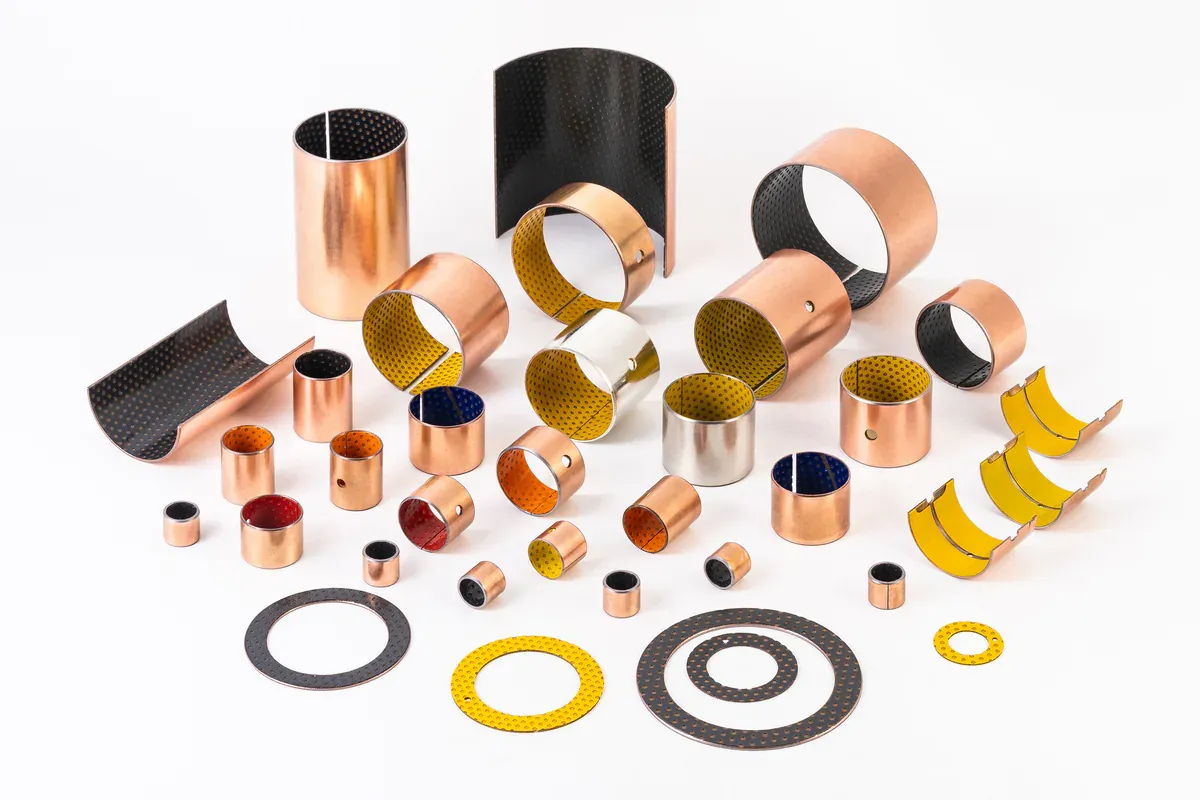
What is a DU-type bushing?
A DU-type bushing is a metal-backed composite plain bearing with a PTFE-based sliding surface. The common construction uses a steel backing, a porous bronze interlayer and a PTFE overlay filled with lead-free additives; the PTFE route is selected when the joint is designed to run without routine grease. DU is a trade name that has become generic; within the JBM range, JBM-10 is the steel-backed PTFE route used for this comparison, with bronze-backed (JBM-1B) and stainless-backed (JBM-1S) variants.
What is a DX-type bushing?
A DX-type bushing is a metal-backed composite plain bearing with a pocketed POM (acetal) running surface. Grease is applied across the POM surface during assembly; the pockets retain and redistribute that lubricant during oscillating or low-speed rotary motion. DX, SF-2 and “DX-type” describe the same route. Within the JBM range, JBM-20 is the pocketed POM bushing used for this comparison.
How do DU-type and DX-type bushings differ?
Both use a metal-backed composite structure; the running surface changes the lubrication plan, the temperature range and the load that can be carried when lubricant is present.
| Selection point | DU / PTFE-type (JBM-10) | DX / POM-type (JBM-20) |
|---|---|---|
| Sliding surface | PTFE-based overlay over a porous bronze interlayer | Pocketed POM layer over a porous bronze interlayer |
| Lubrication plan | Dry running | Grease applied at assembly; boundary lubrication |
| Load, moving | 60 N/mm² (250 static) | 60 N/mm² dry-pocket oscillating, 140 N/mm² oiled (250 static) |
| PV limit | 1.8 N/mm²·m/s long-term dry | 2.8 dry; 22 with oil |
| Temperature | −195 to +280 °C | −40 to +130 °C |
| Best first question | Must this joint run without routine grease? | Can grease remain at the interface during oscillating or low-speed motion? |
| Common mistake | Assuming every PTFE-lined part has the same liner, wall and limits | Treating the pocketed surface as an unrestricted dry-running material |
Where does a DU-type bushing work best?
Use the PTFE route where routine grease is inaccessible, undesirable or deliberately excluded: dry running should be a design requirement, not an assumption made from the part name. Motion still matters, because rotation, oscillation and linear travel create different heat and wear patterns, and starts, stops and dwell time belong in the same duty description. The shaft is part of the bearing system: surface finish, hardness, alignment, housing fit and edge condition affect transfer-film formation, and a PTFE liner cannot compensate for a poor counterface. Match the selected size, form, fit and duty to the JBM-10 product data.
Do DX-type bushings need grease?
Yes. The JBM-20 POM route receives a compatible grease at assembly and retains it in the surface pockets; the pockets are functional reservoirs. The route is most relevant when motion repeatedly sweeps across the same pocketed surface, such as a slow pivot or low-speed rotary joint, and it tolerates shock and edge loading better than PTFE because the POM layer is thicker and tougher. Press fit sets the working bore: use the JBM-20 dimension and tolerance data for the selected size. It is low-maintenance, not lubrication-free; contamination, sealing, lubricant condition and duty determine whether the joint needs later service.
Can a DU-type bushing replace a DX-type bushing?
Not by designation alone. The lubrication plan, construction, dimensions, fit and operating duty all have to match. Start with the physical part: match ID, OD, length, wall, flange, split, holes, grooves and chamfers; two bushings with the same nominal bore can still have different fits and installed clearances. Then match the duty: compare load direction, motion, speed, temperature, lubricant, contamination and counterface, and approve the finished bearing construction, not just the liner label. Keep lubrication conditions with every rating, do not combine unrelated maximum values, and verify compliance requirements separately.
The usual direction of substitution is DX to DU when a greased joint is to become maintenance-free at moderate load, and DU to DX when a dry joint is overloaded or shock-loaded and grease can be applied at assembly.
Frequently asked questions
What is a DU-type bushing made from?
A metal-backed composite bushing with a porous bronze interlayer and a PTFE-based sliding surface. The exact backing, liner and dimensions still belong to the finished product.
What is a DX-type bushing made from?
A metal-backed composite bushing with a porous bronze interlayer and a pocketed POM-based running surface that is greased at assembly.
Does a DX-type bushing need grease?
Yes. For the JBM-20 route grease is applied during assembly and retained in the pockets for boundary-lubricated operation.
Are DU and SF-1 interchangeable?
The labels point to a similar construction route (steel-backed PTFE), but they do not prove identical materials, dimensions, tolerances or performance. Compare the complete part.
Can DX replace DU?
Not by name alone. The lubrication plan changes, and the dimensions, fit, counterface and operating duty must also match.
Send the old part number or drawing for a review.
We compare dimensions, fit and duty against JBM-10 and JBM-20 and return the matching construction. Samples are free.