
PTFE vs POM bushings: which one should you use?
The two steel-backed composite constructions differ in how the running surface is lubricated. PTFE composite is the dry-running route; POM composite uses an initial grease charge held in surface pockets. Final selection also depends on load, speed, temperature, motion, counterface and installed clearance; the polymer name alone does not prove interchangeability.
Choose PTFE composite (JBM-10) when the joint must run without grease and the counterface supports dry sliding; choose POM composite (JBM-20) when grease can be applied at assembly and the joint sees shock, edge loading or higher load at low speed.
- PTFE composite JBM-10: dry, 60 N/mm² moving / 250 static, 2 m/s, PV 1.8, −195 to +280 °C
- POM composite JBM-20: greased at assembly, 60 N/mm² oscillating dry-pocket, 140 N/mm² oiled / 250 static, 2.5 m/s, PV 2.8 dry / 22 oil, −40 to +130 °C
- Neither polymer wins every condition; compare the finished bearing under its stated lubrication
- Same ISO 3547 dimension series; not interchangeable without checking the lubrication plan
What is a PTFE composite bushing?
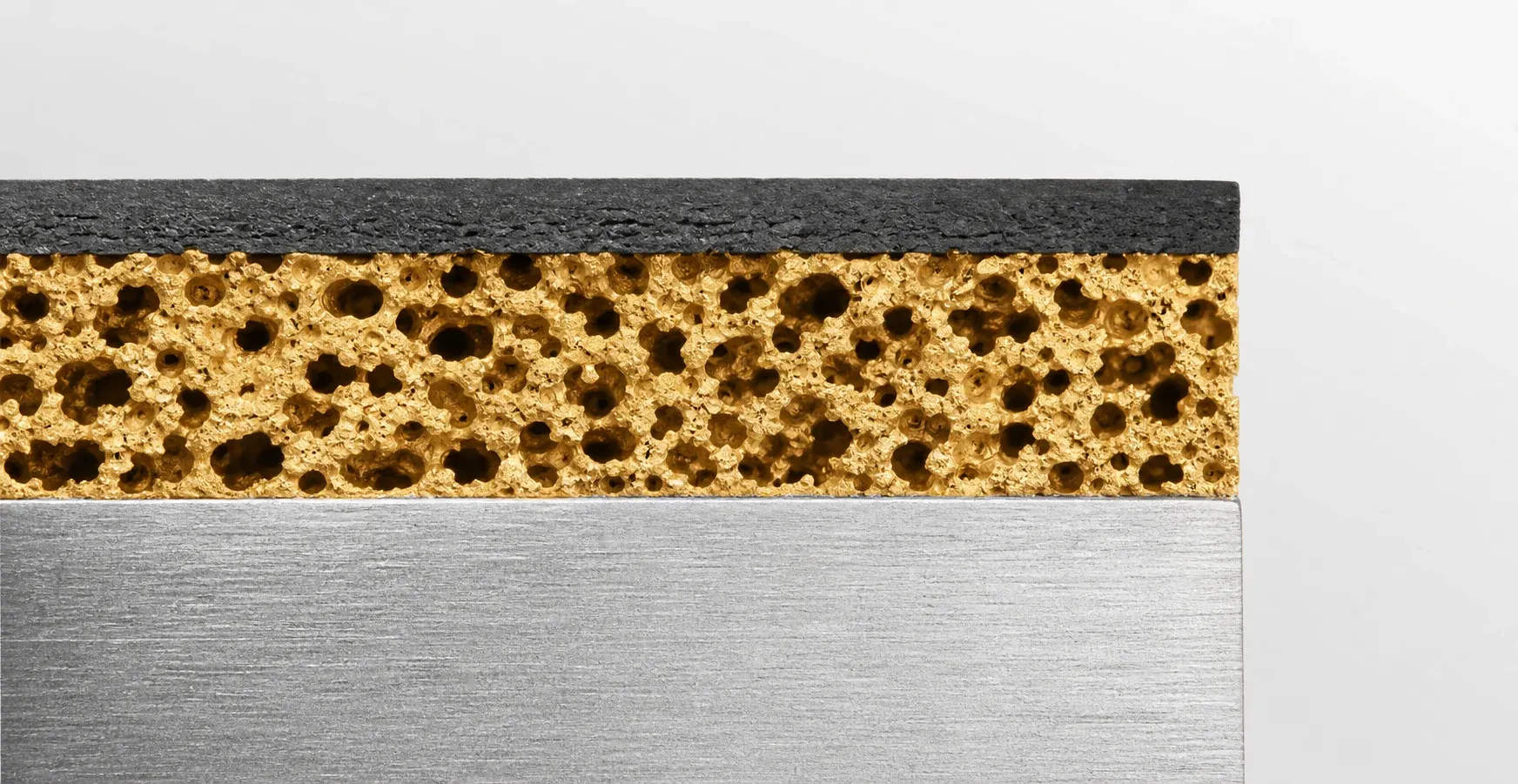
A PTFE composite bushing uses a PTFE-based running surface supported by a structural backing. In JBM-10 a steel backing supports a porous bronze interlayer and a PTFE-based overlay; the sliding surface is selected as a dry-running route for rotary, oscillating or linear motion. The shaft remains part of the bearing system: surface finish, hardness, alignment and edge condition affect transfer-film formation and wear.
What is a POM composite bushing?
A POM composite bushing uses a pocketed POM running layer that receives grease at assembly. JBM-20 uses a steel backing, porous bronze interlayer and POM sliding surface; regularly distributed pockets retain and redistribute the initial grease charge. That mechanism suits oscillating and low-speed rotary duty. It should not be treated as an unrestricted dry-running construction.
How do PTFE and POM bushings compare?
The liner changes the lubrication method, the motion starting point, the temperature range and the service assumptions.
| Selection factor | PTFE composite · JBM-10 | POM composite · JBM-20 |
|---|---|---|
| Running surface | PTFE-based overlay | POM layer with lubricant pockets |
| Assembly lubrication | Dry running; add lubricant only when the product and application allow it | Grease required at assembly |
| Lubricant retention | No grease pockets in the standard sliding face | Pockets retain and redistribute lubricant at the interface |
| Load, moving | 60 N/mm² | 60 N/mm² oscillating on the grease charge; 140 N/mm² with oil |
| Static load | 250 N/mm² | 250 N/mm² |
| Speed and PV | 2 m/s; PV 1.8 N/mm²·m/s long-term dry | 2.5 m/s; PV 2.8 dry, 22 oiled |
| Temperature | −195 to +280 °C | −40 to +130 °C |
| Shock and edge load | Thin liner: sensitive | Thicker, tougher layer: more tolerant |
| Motion starting point | Rotary, oscillating or linear dry-running duty | Oscillating and low-speed rotary boundary-lubricated duty |
| Sizes | Ø6–300 mm sleeves; flanged, washers, strip | Ø10–280 mm split sleeves; flanged, washers, half bearings |
| Common mistake | Calling every PTFE composite bearing maintenance-free | Assuming the pocketed POM layer is meant for unrestricted dry running |
When should you choose a PTFE composite bushing?
Choose PTFE when routine grease is the design constraint and the counterface supports dry sliding: when grease cannot reach the joint, would contaminate the process (food, textile, packaging) or is deliberately excluded from the assembly, and when the temperature is outside the POM range. Calculate the duty as one system: load, sliding speed, motion, starts, stops and temperature interact, and a design point must not be created by combining separate catalogue maxima. Give the liner a suitable counterface, and match the bearing form to the load path, because a sleeve, a flange, a thrust washer and a strip do different jobs.
Do POM composite bushings need lubrication?
Yes, for JBM-20. Grease is part of assembly: apply a compatible lubricant across the running surface before installation. Short, repeated movement suits the design, because the stored grease remains useful where oscillating or low-speed rotary motion repeatedly crosses the same area. Press fit establishes the working bore; use the current JBM-20 housing, shaft and tolerance data for the selected size. Plan for contamination and service: sealing, debris and lubricant condition can become the limit even when the polymer layer is correctly selected. Where oil is present, JBM-20 carries 140 N/mm² and PV 22, well above PTFE, which is why it is the composite for gearbox, hinge and linkage positions on heavy vehicles.
Which material handles load, speed and temperature better?
Neither polymer wins every condition. PTFE has the wider temperature range and runs dry; POM carries more load with oil and takes shock. PTFE and POM resin properties do not predict the complete bearing: the backing, interlayer, liner formulation, motion, shaft and lubricant all change the result. Do not combine separate catalogue maxima into one design point, and remember that a value published for a cylindrical sleeve does not automatically apply to a flange or a thrust washer.
If neither composite mechanism fits, move to a metallic route instead of forcing the material choice: bronze or bimetal when the joint has a dependable grease or oil supply, calls for a named bearing alloy or needs machined lubrication features; graphite bronze for dry running above the PTFE load limit at very low speed.
Can PTFE and POM bushings be interchanged?
Not from dimensions or polymer name alone. Changing the liner also changes the lubrication plan and the running assumptions. Match ID, OD, length, wall, form, installed clearance and counterface before substitution, then compare motion, lubricant access, contamination and temperature for the complete duty. A same-size replacement can still be wrong if the original joint was designed around dry running and the proposed POM part needs assembly grease.
Frequently asked questions
Which has lower friction, PTFE or POM?
PTFE dry (0.02–0.20) is generally lower than POM dry, but friction changes with the finished liner, load, speed, lubricant, shaft, temperature and running condition; greased POM runs at 0.05–0.25.
Does a POM composite bushing need grease?
Yes, for JBM-20. Grease is applied at assembly and retained in its surface pockets.
Can a POM bushing run dry?
Do not treat JBM-20 as an unrestricted dry-running bearing. Its design route is prelubricated boundary operation on the grease charge in the pockets.
Is PTFE always more wear-resistant than POM?
No. Wear depends on the complete bearing system: motion, load, counterface, temperature, contamination and lubrication. Under shock and edge loading POM usually lasts longer; dry and hot, PTFE does.
Are SF-1 and SF-2 material grades?
They are sourcing terms associated with PTFE- (SF-1) and POM-lined (SF-2) steel-backed routes. They do not prove a specific JBM material, tolerance or interchangeability.
Choose from the real lubrication plan first.
Send load, motion, temperature, lubrication and dimensions; we return the composite (or metallic) construction that fits, with the reasoning. Samples are free.