
What is a DU bushing?
DU is the trade name that made the steel-backed PTFE bushing famous, and it is still the word most engineers use for the type. This note explains what is inside one, what it can carry, where it is used, how it differs from a DX bushing, and how to specify an equivalent from Bushing MFG’s JBM-10 range.
A DU bushing is a thin-walled, self-lubricating plain bearing made of three bonded layers: a steel backing for strength, a sintered porous bronze layer for heat conduction and bond, and a PTFE-based running layer 0.01–0.03 mm thick that provides the lubrication. It runs dry, needs no maintenance, and is used by the million in hydraulic cylinders, automotive components, pumps and machinery wherever a slow or oscillating shaft must be supported without grease.
- Construction: low-carbon steel back (about 0.7–2.0 mm), sintered bronze 0.2–0.35 mm, PTFE + fillers 0.01–0.03 mm.
- Ratings (JBM-10 main series): static 250 N/mm²; 60 N/mm² rotating; dry PV 1.8 N/mm²·m/s long-term, 3.6 intermittent; 2 m/s dry; −195 to +280 °C; friction 0.02–0.20.
- Forms: cylindrical (split, wrapped), flanged, thrust washers and strip; standard metric sizes to ISO 3547, inch sizes to drawing.
- DU is a registered trademark (originally Glacier, now GGB). The generic names are steel-backed PTFE bushing, PTFE composite bushing, SF-1; the Bushing MFG equivalent is JBM-10.
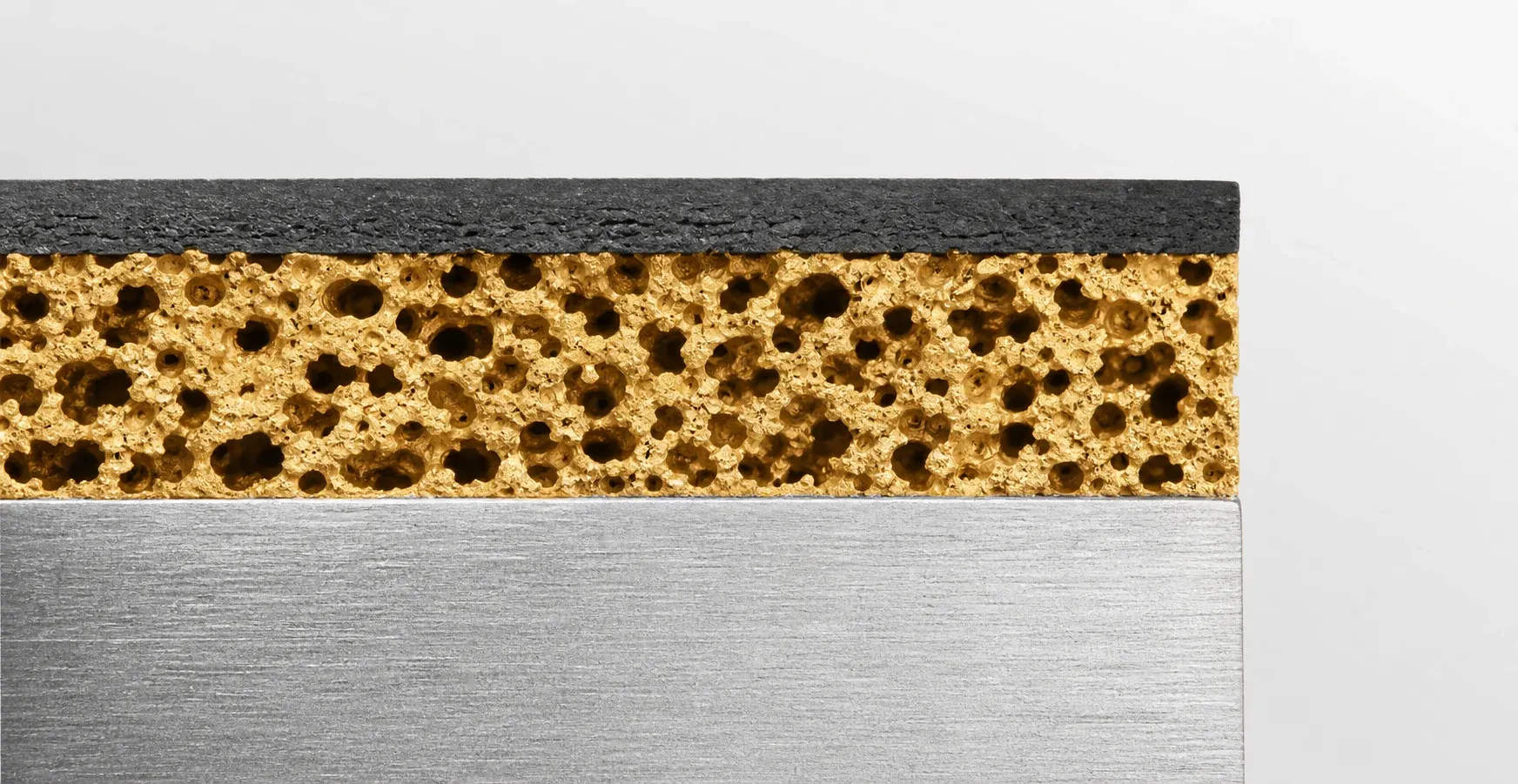
How a DU bushing is built
The bushing starts as a strip. A low-carbon steel strip is copper-plated and a layer of bronze powder is sintered onto it, forming a porous matrix about 0.2–0.35 mm thick. A PTFE mixture, with fillers such as lead (in the original DU), or lead-free alternatives such as graphite, MoS₂, polymer fibres or ceramic in modern grades, is rolled into and over the pores so that the bronze is impregnated and covered by a thin PTFE skin. The strip is then cut, rolled into a cylinder with a butt or clinch joint, and sized. The seam is what tells you a DU-type bushing from a machined one.
Each layer has a job. The steel gives the thin wall its strength and the press fit its grip; because the bushing is thin and takes the housing’s shape, it is sold to a bore tolerance after fitting into an H7 housing. The bronze conducts frictional heat away from the PTFE, anchors the PTFE mechanically, and acts as a wear indicator: when the bronze shows through, the bushing is done. The PTFE layer is the bearing. It transfers a molecular film to the shaft in the first strokes, after which the shaft runs on PTFE against PTFE at a friction coefficient as low as 0.02.
What a DU bushing can carry
The PTFE layer is thin, so the bushing is strong under load but has a limited amount of material to wear. That is why DU-type bushings are rated by PV, the product of specific load and sliding speed: the film wears in proportion to the work done at the surface. The values below are the catalogue ratings of Bushing MFG’s JBM-10 main series, which is the DU-type construction; individual sizes and grades are confirmed at quotation.
JBM-10 (DU-type) performance data
| Property | Value |
|---|---|
| Maximum static load | 250 N/mm² |
| Maximum load, low speed / oscillating | 140 N/mm² |
| Maximum load, rotating | 60 N/mm² |
| Maximum PV, dry, long-term | 1.8 N/mm²·m/s |
| Maximum PV, dry, intermittent | 3.6 N/mm²·m/s |
| Maximum sliding speed, dry | 2 m/s |
| Maximum sliding speed, oil-lubricated | > 3 m/s |
| Temperature range | −195 to +280 °C |
| Friction coefficient | 0.02–0.20 |
| Thermal conductivity | 42 W/(m·K) |
| Linear expansion | 11 × 10⁻⁶ /K |
Load, speed, PV and temperature are separate limits and are not achievable simultaneously. Shaft: hardened and ground to Ra 0.2–0.4 µm for best life.
Where DU bushings are used
Anywhere a shaft moves slowly or oscillates, cannot be greased, and must be cheap and thin.
- Hydraulic cylinders: rod-eye and clevis bushings, gland guide rings.
- Automotive: steering knuckles and columns, pedal boxes, seat mechanisms, shock absorber rods, door hinges, transmissions.
- Gear pumps and motors: bushings behind the gears, running in the pumped oil.
- Agricultural, construction and materials-handling linkages where grease points are unwanted.
- Textile, packaging, printing and food machinery: dry, clean, quiet.
- Office furniture, fitness equipment, appliances, valves and dampers.
DU vs DX bushings
DX (and the generic name POM composite or SF-2) uses the same steel-and-bronze base but a POM (acetal) running layer about 0.3–0.5 mm thick with grease pockets in the surface. It is designed to run with grease: the pockets hold a reserve, the thicker layer tolerates dirt and edge loading, and the load capacity at low speed is higher. DU is for dry running and higher speed; DX for greased, slow, dirty, heavily loaded joints. Using a DU bushing with grease is harmless but wastes its dry-running ability; using a DX bushing dry wears the POM quickly.
| DU type (JBM-10) | DX type (JBM-20) | |
|---|---|---|
| Running layer | PTFE + fillers, 0.01–0.03 mm | POM with grease pockets, 0.3–0.5 mm |
| Lubrication | Dry (or oil, water, process fluids) | Grease applied at assembly and retained in the pockets |
| Maximum static load | 250 N/mm² | 250 N/mm² |
| Maximum dynamic load | 140 N/mm² low speed; 60 N/mm² rotating | 140 N/mm²; 60 N/mm² oscillating |
| PV limit | 1.8 N/mm²·m/s dry long-term; 3.6 intermittent | 2.8 N/mm²·m/s dry; 22 oil-lubricated |
| Maximum speed | 2 m/s dry; > 3 m/s with oil | 2.5 m/s oil-lubricated |
| Friction coefficient | 0.02–0.20 | 0.05–0.25 |
| Temperature | −195 to +280 °C | −40 to +130 °C |
| Dirt tolerance | Moderate | Good; pockets trap particles |
| Standard shaft range | ISO 3547 metric series (see size table) | 10–280 mm |
| Typical use | Hydraulics, automotive, pumps, dry machinery | Construction and agricultural pivots, greased linkages |
How to specify a DU-type bushing
Metric DU-type bushings follow ISO 3547 for dimensions: the bushing is designated by bore × outside diameter × length, for example 20 × 23 × 20 for a 20 mm shaft, with a 1.5 mm wall. Bushing MFG’s JBM-10 cylindrical bushings are made to the ISO 3547 metric series, with flanged bushings (JBM-10F), thrust washers (JBM-10WC) and strip (JBM-10SP) to their own catalogue tables, and inch sizes to drawing. When replacing an existing DU part number, send the number and the dimensions; the JBM-10 equivalent is confirmed part for part.
Design the housing as H7 and the shaft to the running clearance given in the size table, hardened and ground where life matters. Lead-free running layers are available; bronze-backed (JBM-1B) and stainless-backed (JBM-1S) versions exist for corrosive or wet service.
Put on the enquiry: bore, outside diameter, length, quantity, the existing part number if any, the motion (rotating or oscillating), load, speed, temperature and whether the joint is dry, oiled or wet.
Frequently asked questions
What does DU stand for?
It is a product designation, not an abbreviation. DU was introduced by Glacier Metal in the 1950s for its steel-backed PTFE bearing and is now a trademark of GGB. The type is generically called a steel-backed PTFE bushing, PTFE composite bushing or SF-1.
Are DU bushings self-lubricating?
Yes. The PTFE running layer transfers a film to the shaft and the bushing then runs dry for its service life. No grease or oil is required, although oil or process fluids do not harm it and extend life.
What is the difference between DU and DX bushings?
DU has a thin PTFE layer and runs dry at up to 2 m/s; DX has a thicker POM layer with grease pockets and is designed for greased, slow, heavily loaded, dirty joints. Same steel-and-bronze base, different running layer and lubrication plan.
How long does a DU bushing last?
Until the PTFE layer wears through to the bronze, which depends on load, speed, temperature, shaft finish and contamination. The life calculation uses PV: at 1.8 N/mm²·m/s continuous dry the design life is in the thousands of hours; at intermittent duty far longer.
Can DU bushings run in water or oil?
Yes. PTFE is chemically inert; the bushing runs in oil, hydraulic fluid, water and many process fluids, and speed can exceed 3 m/s with liquid lubrication. For water, specify a bronze-backed (JBM-1B) or stainless-backed (JBM-1S) version to protect the backing from corrosion.
Does Bushing MFG make DU bushings?
We make the equivalent construction, JBM-10, in cylindrical, flanged, thrust washer and strip forms to the ISO 3547 metric series and to drawing, on automated lines in Jiaxing. We do not use the DU name, which belongs to GGB; equivalence is confirmed dimension by dimension against your part number.
Replacing a DU part number?
Send the number or the dimensions. We confirm the JBM-10 equivalent, quote within 12 hours and supply free samples for your test.